

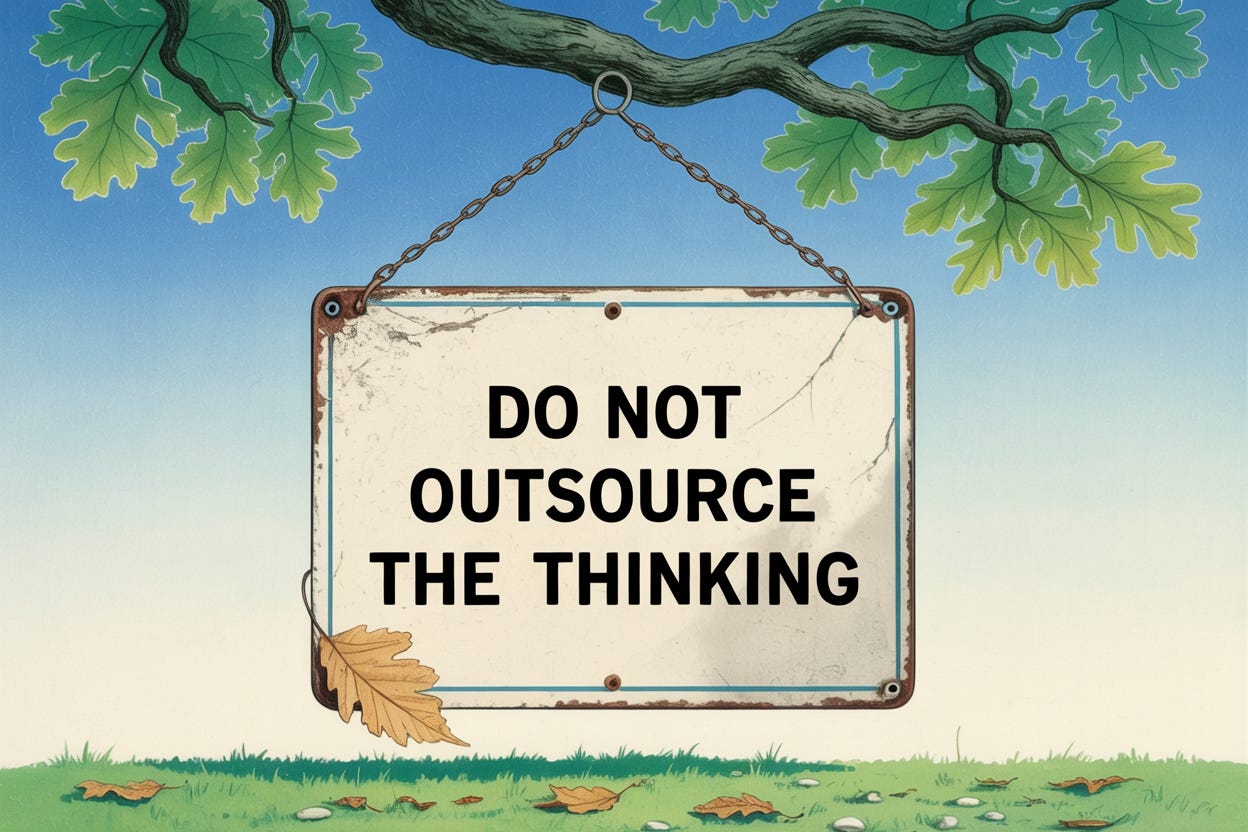
“Do not outsource the thinking.” — Marc Randolph, co-founder of Netflix.
Marc Randolph, who helped birth an empire of algorithmic suggestion with Netflix, offered this warning to a new generation of entrepreneurs staring into the sudden, dizzying dawn of artificial intelligence. Randolph’s admonition is deceptively simple, yet it strikes at the core of a three-century-old human anxiety: the urge to externalize our cognitive friction. We have spent millennia building machines to spare our muscles, and centuries building machines to spare our memories. Now, we have built engines that promise to spare our minds.
The desire to banish the noise of human fallibility is deeply embedded in the genealogy of computing. In the seventeenth century, Gottfried Wilhelm Leibniz dreamed of a calculus ratiocinator, a universal conceptual algebra where philosophical disputes could be settled not by arguing, but by sitting down and saying, “Let us calculate.” Two centuries later, Charles Babbage sought to grind the errors out of human mathematics with brass, pewter, and steam. These men viewed cognition, at least in part, as a mechanical process—a turbulence that could be smoothed into a pure, uncorrupted signal.
Today, the brass gears have been replaced by billions of parameters suspended in microscopic silicon matrices. We have managed to capture human language—every treatise, every tragedy, every mundane forum post—and feed it into statistical engines. When a large language model generates a business plan or writes a block of code, the boundary between calculation and cognition begins to blur. Philosophers of mind and computer scientists debate fiercely whether these networks are genuinely reasoning or merely simulating it with unprecedented fidelity. But regardless of whether a machine is “thinking” in the biological sense, its method is undeniably alien. It is surfing the chaotic currents of probability, predicting the next inevitable ripple in the vast ocean of human syntax. The temptation for the builder, listening to Randolph’s warning but seduced by the screen, is to look at this shimmering output and mistake it for genesis.
If a machine can synthesize the data, draft the strategy, and iterate the design, why not let it shoulder the cognitive load? Because computation, even in its most dazzling probabilistic forms, fundamentally differs from comprehension. A language model can produce startlingly novel combinations of words, pairing concepts that have rarely touched in the history of human text. But ideas do not emerge from the frictionless center of statistical consensus. A probabilistic engine aggregates what has already been said, done, and thought. It is the ultimate archivist, cataloging the entire library of human utterance, yet it remains trapped within the stacks. It cannot leap into the dark. It cannot desire.
Human thought is a messy, highly inefficient thermodynamic process, and that inefficiency is precisely the point. When we wrestle with a complex problem, the frustration, the false starts, and the agonizing internal struggle are the mechanism of discovery, not bugs in the system. The mind requires the friction of cognitive dissonance to strike a spark. It is the effort of holding two contradictory models of the universe in your head until the pressure forces a structural collapse, leaving behind a completely new paradigm. If you outsource that struggle to an algorithm that instantly resolves the tension into a smooth, readable summary, you bypass the very crucible where genuine insight is forged.
The genius of human invention is inseparable from our flaws, our blind spots, and our irrational leaps of faith. Shannon found information theory where others found only noise. That is not something a machine can be pointed toward. We see the inverse of this in the modern phenomenon of the “centaur,” the human-AI hybrid most visible in contemporary chess. The players who over-rely on the neural network’s top suggested moves become brittle, playing a memorized, bloodless game. They outsource the thinking and collapse the moment the position requires intuition over brute calculation. The true grandmasters, by contrast, use the engine to test the boundaries of their own wild, asymmetric ideas. They maintain dominion over the strategy, outsourcing only the tactical verification.
When Randolph warns against outsourcing the thinking, he is defending this necessary dominion. We may delegate the processing. We may offload the synthesis of vast, unwieldy datasets, allowing the machine to act as a powerful lens for our own inquiries. But the conceptual architecture, the act of looking at the noise and deciding what it means, must remain where the friction lives: in the biological mind.
The machine can calculate the odds. Only the mind can decide to rewrite the rules of the game.