

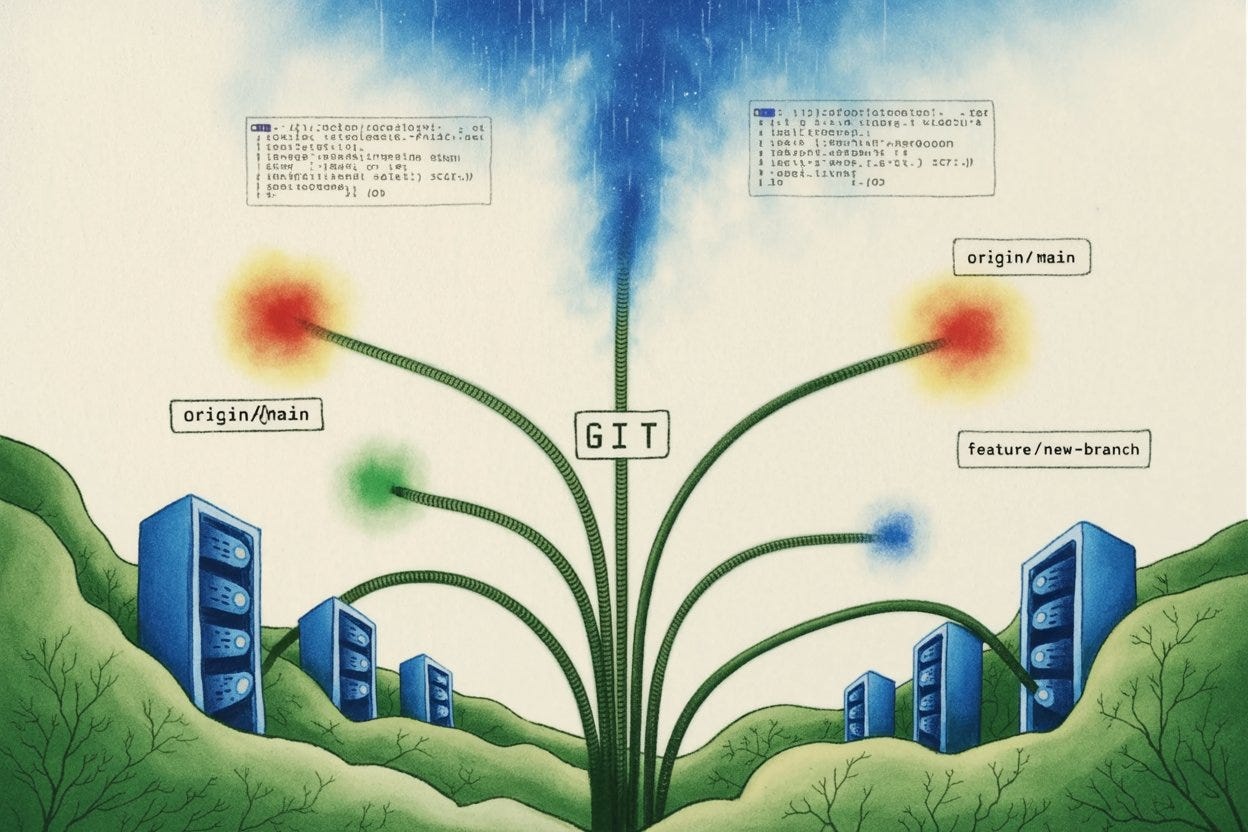
In the physical realm, a painter’s mistake is captured in layers of oil, and a novelist’s discarded thought remains visible in the strike-throughs on a legal pad. But in the silicon universe, to overwrite a file is to obliterate history. The machine does not remember the struggle; it only reflects the current state of the bits. For the first programmers, this amnesia was terrifying. A single errant keystroke could cascade into system-wide failure, with no breadcrumbs leading back to safety. The human desire to freeze time, to capture the ephemeral state of a thought before it mutated into a bug, necessitated a new kind of architecture.
They called it version control. Initially, it was a librarian’s solution to a philosopher’s problem. Systems like the Source Code Control System (SCCS) in the 1970s, and later the Concurrent Versions System (CVS) and Subversion (SVN), operated on a principle of bureaucratic centralization. They established a single, absolute source of truth—a central server holding the master ledger of the code. If a developer wished to alter a file, they had to “check it out,” effectively placing a padlock on that fragment of the universe until their work was done. It was an architecture of bottlenecks. As software projects grew from the work of isolated teams into sprawling global collaborations, the central server became an intolerable choke point. The single source of truth was suffocating the very creativity it was designed to protect.
The Birth of Git
The breaking point arrived at the edge of chaos, within the most complex collaborative intellectual endeavor in human history: the Linux kernel. By the early 2000s, Linux was a teeming bazaar of thousands of developers hurling patches, fixes, and features at the project’s creator, Linus Torvalds. Torvalds was not merely a programmer; he was an arbiter of complex systems, a man with a low tolerance for friction and an intuitive grasp of network dynamics. For a time, the Linux community relied on a proprietary tool called BitKeeper to manage this turbulence. But when the licensing agreement frayed in 2005, the community was left without a mechanism to manage its own evolution.
Torvalds refused to revert to the archaic, centralized systems of the past. He vanished for a weekend and emerged with a radical new paradigm. He did not build a version control system in the traditional sense; he built a cryptographic ledger, a file system that modeled time not as a straight line, but as a branching river. He called it Git.
Git was born from a fundamental conceptual leap: the abandonment of the center. In Torvalds’s architecture, there was no single master server. Every developer who cloned a repository downloaded the entire history of the project—every file, every mutation, every mistaken path ever taken. The network became completely distributed.
Git as a Branching River of Time
But Git’s true genius lay in its internal mechanics, heavily reliant on a mathematical concept known as a Directed Acyclic Graph.
Instead of merely storing the differences (the “diffs”) between files, Git took a snapshot of the entire file system at a given moment. It then fed the contents of that snapshot into a cryptographic hash function—specifically, SHA-1. The hash function chewed up the thousands of lines of code and spat out a 40-character string of hexadecimal gibberish. This string was not a label; it was an exact, mathematically guaranteed fingerprint of the code at that nanosecond. If a single comma was altered, the hash changed entirely.
Through this mechanism, Git transformed fragile text into something crystalline and immutable. A “commit” in Git was not just a save point; it was a node in a vast, interconnected web, inextricably linked to the cryptographically sealed node that preceded it. Torvalds had weaponized cryptography to defeat entropy.
This architecture fundamentally altered the psychology of software development. Because every state was perfectly preserved and mathematically verifiable, fear evaporated. Developers could create “branches”—parallel universes of the code—instantaneously and at zero cost. A programmer could diverge from the main timeline, experiment with a radical new idea, fail entirely, and then effortlessly snap back to the primary reality as if the failure had never occurred. Time was no longer a rigid track; it was fluid, malleable, and safe.
When parallel branches needed to be reconciled, Git performed a “merge.” Here, the software acted almost as an arbitrator of human intent, weaving two divergent histories back into a single, unified future. It was a chaotic, organic process that mirrored human thought far better than the rigid filing cabinets of older systems.
Git began as a desperate weekend hack to manage a specific, sprawling operating system. Yet, because it so perfectly modeled the messy, non-linear, collaborative nature of human intellect, it devoured the world. It became the unseen substrate of the digital age, the memory bank for almost every piece of software that powers modern civilization. It is the ledger of our collective digital ambition, proving that out of maximum distributed chaos, we can extract perfect, cryptographic order.