

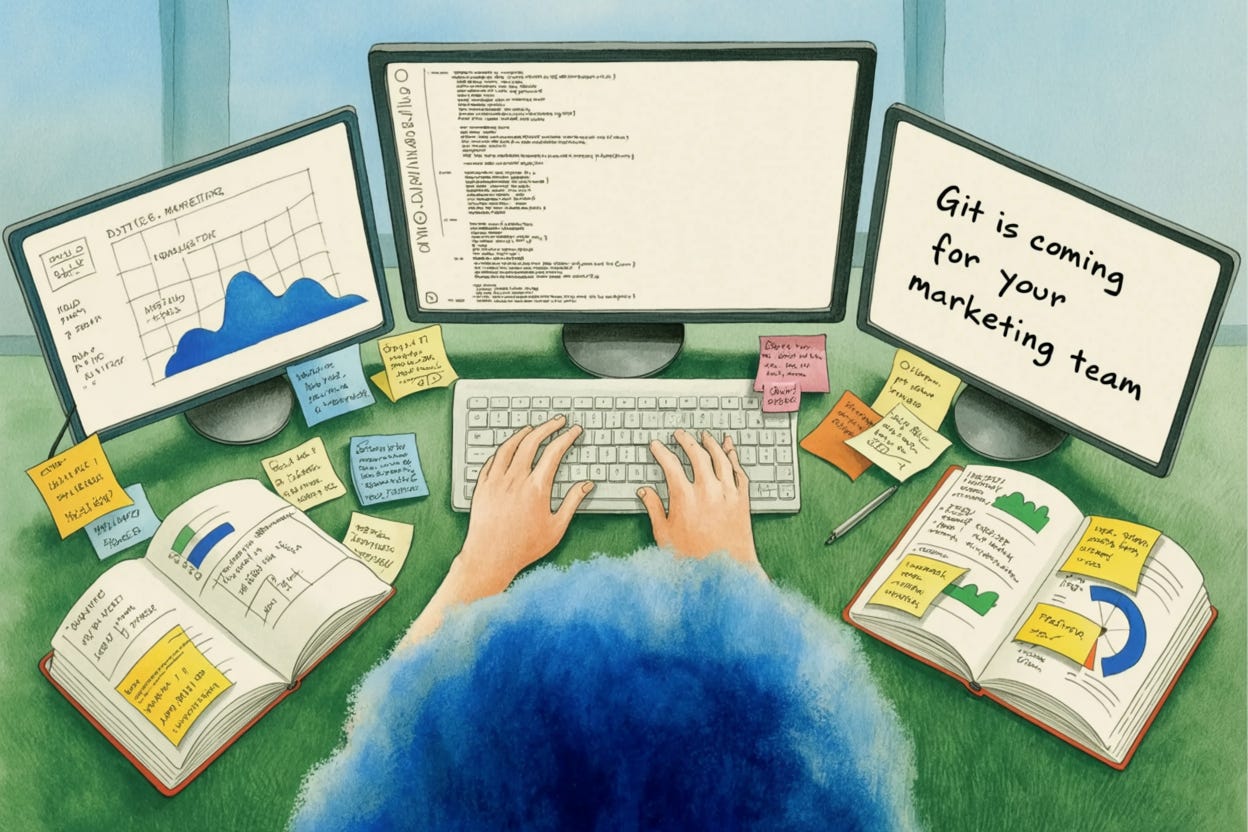
I taught myself a few new Git power moves over the weekend and came to a strange realization: the future of marketing might be a tool from 2005.
Here’s why.
Picture yourself as a marketing director. It is two o’clock in the morning on a Thursday, and your desk is lit only by the harsh blue glow of your monitor. You are preparing the final copy for a multimillion-dollar global ad campaign.
Look at your screen. It is a graveyard of Microsoft Word files and a chaotic web of Google Docs. Campaign_Copy_V1.docx. A link to Campaign_Copy_V3_Bob_Edits. Campaign_Copy_FINAL.docx. A shared Google Doc titled Copy_FINAL_REAL_THIS_ONE_DO_NOT_EDIT. You are exhausted. You copy the text from what you think is the correct Google Doc and paste it into an email to the web development team. You click send. You go to sleep.
The next morning, the campaign goes live. It features a catastrophic typo in the main headline. It was a typo corrected three days earlier by a junior copywriter in a different version of the document. But you had copied from the wrong link. You didn’t just fail. You failed spectacularly. And you failed for a reason no one saw coming.
When you think about the future of marketing, you usually think about algorithms. You think about generative AI. You think about hyper-targeted ads. But the actual future of your industry might not be a shiny new artificial intelligence platform at all. It might be a twenty-one-year-old tool built by a frustrated software engineer.
The conventional wisdom in the business world is that you, as a creative professional, should use intuitive tools. You should use shared cloud drives. You should use live collaborative documents like Google Docs. You are given tools designed for seamless, real-time typing because we believe marketing is an inherently messy, artistic process that resists rigid, mathematical structure.
But there is a problem with that theory. Your work is no longer just art. It is a highly complex system of asynchronous collaboration. When you have five people writing, editing, and resolving comments on a single webpage at the same time, a shared document is not a solution. It is a trap.
To understand the future of marketing, you have to look away from marketing entirely. You have to look at software engineers.
In 2005, the creator of the Linux operating system, Linus Torvalds, was facing a crisis. Thousands of programmers were trying to write code for the same system at the same time. The existing tools were slow. They were buggy. The developers constantly overwrote each other’s work. So Torvalds built a new system. He called it Git.
At its core, Git is an engine for Information Lineage.
It does not just save a file. It records the entire history of a project. It tracks who changed what, when they changed it, and why they changed it.
But Git is for coders, right?
Code is just text. Marketing copy is just text. But in the spring of 2026, that text is no longer just being read by your human colleagues. AI agents do not want to read a proprietary Microsoft Word file. They stumble over messy docs full of hidden code and invisible formatting tags. They want plain, unadorned text. They want Markdown.
Markdown is a way to format writing using basic, universal symbols. A hashtag creates a header. Asterisks create bold text. It is entirely plain text. It is elegant. It is lightweight. And it has become the lingua franca of the Agentic Era. AI agents speak it natively. When you combine the pristine tracking of Git with the universal language of Markdown, you unlock a wholly new way of working. You do not just organize your files. You build a bridge between human creativity and machine intelligence.
Let us break down the four pillars of this future.
1. The Repository: The Incorruptible Ledger
Forget messy shared drives. A repository, or “repo,” is the master container for your Markdown files. But unlike a static folder on a cloud drive, the repository is aware of its own history. If an AI agent accidentally overwrites a crucial paragraph of your launch email, the repository remembers. You can simply roll back time to retrieve it. It is a perfect, indestructible ledger.
2. The Branch: The Safe Sandbox
This is where the magic happens. Imagine you want your AI agent to completely rewrite a landing page, but you are not sure if the new copy will be approved by the legal team. In the old world, you would duplicate the Google Doc and rename it, completely losing its connection to the original text. In the Git world, you create a Branch.
A branch is an exact, parallel universe of your project. You and your AI can experiment in this branch. You can rewrite the entire page. You can make terrible mistakes. It does not affect the main project. Your experimental work exists in complete isolation until you are absolutely ready to share it.
3. The Commit: The Rationale
When you save a Word document, you just press a button. When you type in a Google Doc, it saves every keystroke automatically, creating an endless, unreadable sludge of version history. The computer does not care why you saved it. Git demands more. When you save a change in Git, you make a “Commit.” And every commit requires a short message. You must type a sentence explaining your action.
“Updated the headline to reflect the new pricing strategy.”
“Agent removed the second paragraph because it was too wordy.”
You are not just saving a file. You are documenting the thought process for both humans and machines.
4. The Pull Request: The Peer Review
Eventually, your parallel universe needs to merge back into the main project. You do this by opening a Pull Request. You are essentially asking your team to look at your branch, review the commits, and approve the merge. It is built-in quality control. It forces conversation. It forces alignment.
Let us return to your desk at two o’clock in the morning.
Imagine if your team had been living in this future. There would be no Copy_FINAL_REAL_THIS_ONE_DO_NOT_EDIT. There would only be the main repository. When you went to check the final copy, you would not be hunting through endless Google Doc links and resolved comments. You would look at the clear, chronological ledger of Commits. You would see exactly when the junior copywriter fixed the typo. You would see exactly what the AI agent optimized. You would merge the final approved Branch. You would go to sleep with absolute certainty.
You do not need simpler tools. You need better mental models. We have spent decades treating creative work as something chaotic that cannot be tracked or managed with precision. But when you adopt systems like Git and embrace Markdown as your lingua franca, you are doing something profound. You are protecting the history of your ideas. You are communicating with clarity. The future of marketing is not just about better ads. It is about a world where your good work is never lost in a folder again.