

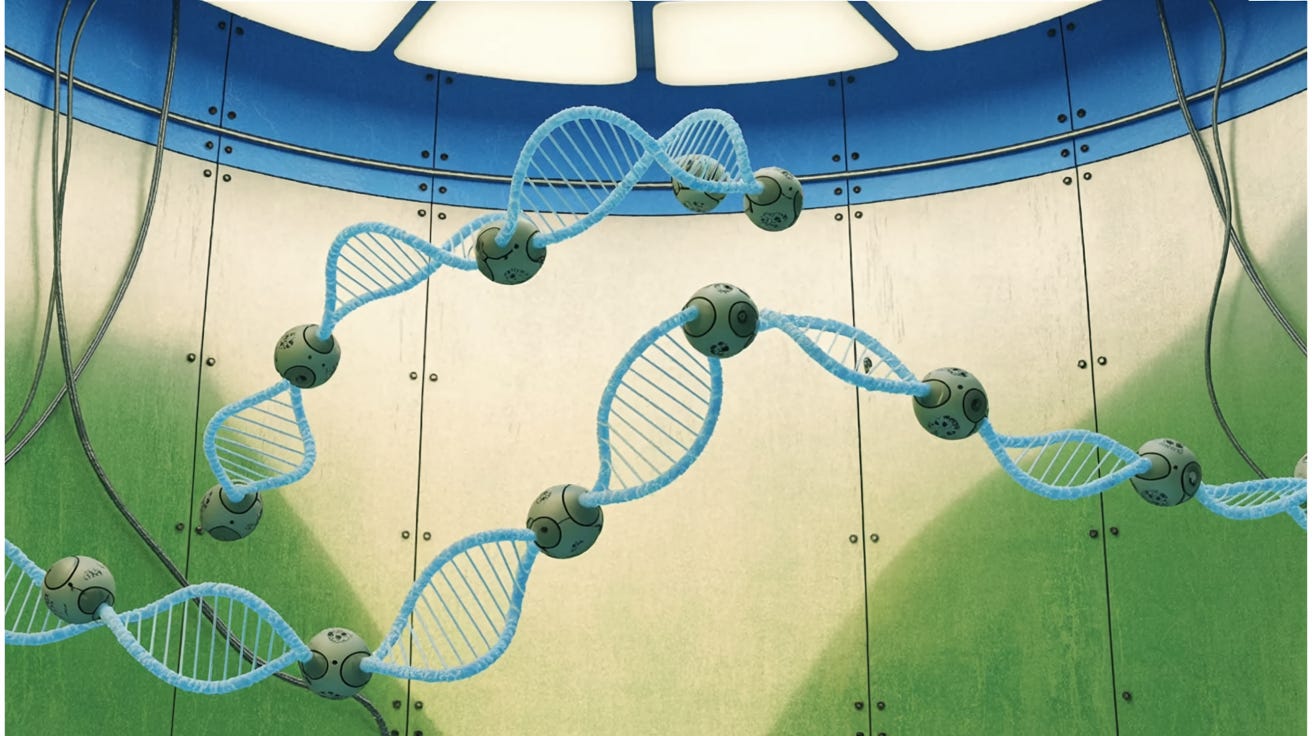
Picture the period at the end of this sentence. Now imagine building a machine so small that hundreds of them could park inside that dot without touching. It has moving parts, a payload, and instructions about when to open and when to stay shut. That machine exists. It has been built thousands of times over in laboratories around the world, and its material is the surprise: DNA, the same four-letter molecule that spells out every living thing on Earth, repurposed into structural lumber.
We think of DNA as information. It’s the blueprint, the code, the thing that gets read. What took researchers a while to exploit is that DNA is also a material. It has shape, and it has rules. An A always pairs with a T, a G always pairs with a C, and those pairings are reliable in a way almost nothing else at that scale is. If you know the sequence of one strand, you know exactly what will stick to it. That predictability is the whole trick. You can design a strand of DNA the way an architect designs a truss so that it folds into a chosen geometry and holds, carrying structure instead of a gene.
Folding paper, folding molecules
The breakthrough that turned this into an engineering discipline has a humble name: DNA origami. In 2006, a Caltech researcher named Paul Rothemund published a method for taking one very long strand of viral DNA and pinning it into shape with a couple hundred short “staple” strands, each designed to grab two distant points on the long strand and clip them together. Fold enough of these points and the long strand collapses into whatever form you specified, a star or a box. He made nanoscale smiley faces, each about the width of a large virus, to prove it.
This landed hard because it made the process programmable. Nobody sculpts these things by hand; nobody has hands that small. You design the staples on a computer, order the sequences from a synthesis company the way you’d order screws, mix everything in a test tube, warm it, and let it cool. As it cools, the strands find their partners and the structure assembles itself. Millions of copies, all folding in parallel, all identical. This is manufacturing without a factory floor: the instructions for assembly are baked into the parts. Give the molecules the right sequences and the right conditions, and they build the machine while you watch.
The roots go back to a crystallographer named Nadrian Seeman, who in the early 1980s had the almost heretical idea that DNA’s real value might be as a construction material rather than a genetic one. The story, probably half-true in the way good origin stories are, is that he was staring at an M.C. Escher woodcut of fish arranged in a lattice and realized he could build scaffolding the same way, out of DNA junctions. It stayed a niche pursuit for years. Then origami arrived, and the field had a way to build almost any shape on demand. A curiosity became a toolkit.
From shapes to machines
A static shape is a sculpture. What turns a sculpture into a robot is the ability to do something: to sense a condition and act on it. Here DNA has a second gift beyond its reliability. It can be designed to change its mind.
You can build a DNA structure that stays latched shut until it meets a specific molecular signal, then springs open. The mechanism feels almost mechanical. Imagine a hinged clamshell held closed by DNA “locks.” Each lock is a strand folded back on itself, engineered so that a particular target molecule, say a protein found on the surface of a certain kind of cell, grabs the lock harder than the lock grabs itself. When that target shows up, the lock lets go. Release enough locks and the box swings open and exposes what you tucked inside.
In 2012, a team including Shawn Douglas and George Church built exactly this: a barrel-shaped DNA container latched with locks keyed to markers found on certain cancer and immune cells. Inside, they packed antibody fragments, molecular instructions that tell a cell to stop dividing or to die. In a dish, the container stayed sealed as it drifted past healthy cells and cracked open only when it met its target, releasing its payload where it was meant to go. It sensed a condition and acted on it, woven from the same thread as the cells it was hunting.
Movement came next. Researchers have built DNA walkers that step along a track one leg at a time, and DNA circuits that perform simple logic, releasing a payload only when two or three molecular conditions are met at once. In 2018, a group led by Baoquan Ding and Hao Yan reported DNA nanorobots that patrolled the bloodstream of tumor-bearing mice carrying an enzyme called thrombin, which clots blood. The robots stayed closed until they docked onto a protein that appears mainly on the vessels feeding tumors. There they opened, dumped the thrombin, and choked off the tumor’s blood supply. The tumors shrank, and healthy tissue was left alone.
The appeal is precision. Chemotherapy is a carpet bomb; it poisons everything and relies on cancer cells being slightly more vulnerable than healthy ones, which is why it’s so brutal. A DNA nanorobot offers a guided strike instead: a drug that stays inert as it circulates and becomes active only at the exact address where it’s needed. The payload never touches the tissue you want to protect. The side effects that make patients dread treatment could largely disappear. This therapeutic promise is one of the main reasons DNA origami has become so central to biomedical nanotechnology.
The bloodstream is a hostile place
The gap between that promise and the pharmacy is wide, and most of it is chemistry and biology nobody has solved yet.
The human bloodstream is not a clean laboratory dish. It’s a churning, salty, enzyme-rich river patrolled by an immune system whose job is to notice foreign objects and destroy them. DNA in that environment is food; the body is full of enzymes called nucleases that chew up loose DNA as a matter of routine. A naked origami structure can come apart within hours. So researchers armor these devices, coating them in protective layers, cross-linking the strands so they hold together, and wrapping them in materials that slip past immune surveillance long enough to reach the target. Each of those fixes is its own research program, and each adds cost.
Aim is the other problem. A nanorobot that opens at the wrong address is worse than useless; it’s a precision weapon pointed at healthy tissue. The molecular locks have to be specific enough that they almost never trip by accident, across billions of cells and countless near-miss encounters. Biology is noisy. Building sensors that reliable, inside a system that unpredictable, is genuinely hard, and most of the dramatic demonstrations so far have happened in dishes or in mice rather than people. Manufacturing at the scale and purity a real drug demands, where every batch must be provably identical and safe, is another mountain.
DNA nanorobots are not arriving at your hospital next year. What is arriving is a steady accumulation of proofs: that the folding works, that the sensing works, that the payload delivery works, each pushed a little further along the path from bench to bedside. The field sits in the long middle, past impossible and short of routine.
Why it matters that they’re made of us
Our machines have always been made of things other than life: stone, bronze, iron, and silicon. They were the not-alive tools we used to act on the living world. These devices turn that arrangement around. They are built from the very molecule that defines life, folded into machines that swim through the living body to repair it. The tool and the patient are the same stuff.
That points toward a coming era where the line between manufactured and grown, between device and organism, gets genuinely blurry, where medicine looks less like handing you a pill and more like dispatching a fleet of programmable molecular agents, each smaller than a speck of dust, each carrying instructions we wrote. We spent a century learning to read the code of life. We are now, tentatively but unmistakably, learning to build with it.