

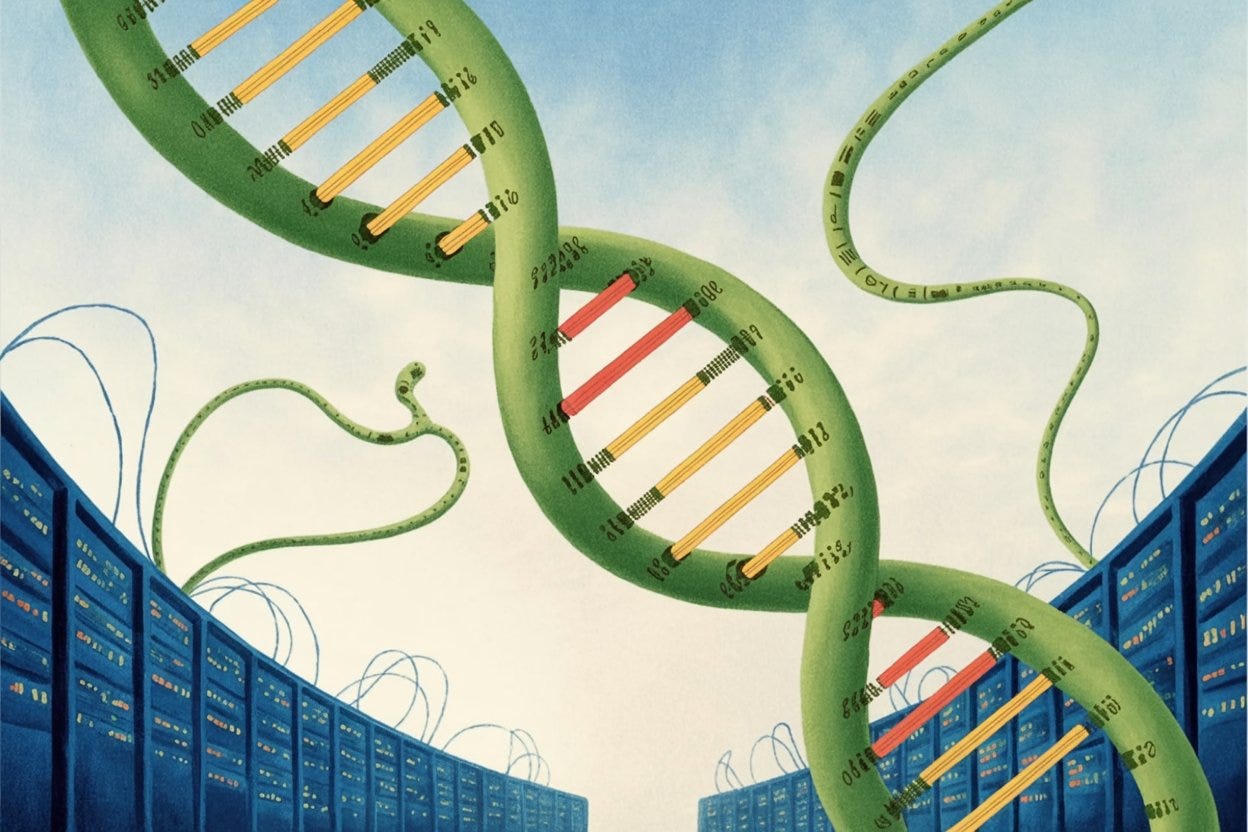
Consider the DNA molecule. Tucked away in the nucleus of every living cell, from the humblest amoeba to the most complex primate, lies a coiled ribbon of information. It is a masterpiece of storage efficiency—a simple, four-letter alphabet capable of describing the precise architecture of a blue whale or the chemical instructions for the scent of a jasmine flower. This code is not proprietary; it is not locked behind the firewall of a single species or dependent on a specific biological operating system to be read. It is universal. A virus can read it; a bacterium can swap it; a scientist can transcribe it. It is the durability of this code, its glorious, open simplicity, that has allowed life to persist through cataclysms that wiped the surface of the earth clean. Life remembers because its memory is written in a language that the universe itself understands.
When we turn our gaze from the biological to the organizational, we see a stark and troubling contrast. The modern business is an organism, certainly. It consumes energy, it reacts to stimuli, it grows, and it reproduces. But its memory—the accumulated wisdom of its operations, the “skills” that define its behavior—is dangerously fragile. We have been seduced by the glittering allure of complex, proprietary systems. We store the vital instincts of our organizations in the cloud, in siloed databases and formatting-heavy platforms that act as walled gardens. We are building our collective brains on rented land, using languages that only the landlord speaks.
There is a movement stirring, however, that mimics the wisdom of the double helix. It is the concept of treating business infrastructure as code. At its heart, this is a biological shift. It is the realization that for an organization’s knowledge to survive the inevitable entropy of the market, it must be decoupled from the machinery that interprets it. It must be stripped of its fancy formatting and proprietary wrappers and reduced to its elemental essence: plain text.
In this context, the humble Markdown file becomes the nucleotide of corporate memory. To store “skills”—the processes, the documentation, the operational heuristics—in local Markdown files is to return to the resilience of DNA. A proprietary database is like a delicate, tropical orchid; it requires a very specific environment—a specific software version, a subscription fee, an internet connection—to bloom. If the environment shifts, if the vendor vanishes or the platform decays, the flower dies, and the genetic history it carried is lost to the silence.
But a Markdown file? That is a seed. It is dry, compact, and seemingly inert. Yet, it carries within it the full potential of the information it holds, readable by any text editor on any machine, today or a hundred years from now. It does not care if you are using Windows or Linux, a mainframe or a handheld device. It is a fossil that refuses to stay buried. By treating business documentation as code—committing it to repositories, versioning it, and keeping it local—we are creating a fossil record that breathes. We are ensuring that the history of the organization is not a series of ephemeral hallucinations in the cloud, but a tangible, sedimented reality.
This approach acknowledges a fundamental truth of nature: complexity is the enemy of longevity. The systems that survive are those that are modular and redundant. In a biological ecosystem, diversity and decentralization ensure that if one pathway is blocked, life finds another. When an organization centralizes its knowledge in a closed system, it creates a single point of failure. It becomes a monoculture, susceptible to the blight of obsolescence.
By shifting to a “docs-as-code” philosophy, we are effectively giving the organization an exoskeleton. We are taking the soft, vulnerable tissue of our ideas and processes and encasing them in the hard, durable chitin of plain text. This allows for a kind of portability that borders on telepathy. Just as a strand of RNA can drift through a cell and trigger the production of a protein, a repository of Markdown files can be cloned, shared, and instantiated anywhere. The knowledge becomes fluid, moving through the organization like blood through veins, rather than being hoarded in the stagnant pools of a document management system.
There is something almost mystical about this return to simplicity. It suggests that the most advanced way to handle information is not through more complex algorithms, but through a deeper respect for the raw data itself. It is a recognition that the medium is not the message; the message is the message, and the medium should be as transparent as air.
In the end, this is not merely a technical decision; it is an evolutionary strategy. We are attempting to insulate our collective intelligence from the ravages of time. We are trying to ensure that the “ghost in the machine” has a body that can survive the death of the machine itself. By writing our business infrastructure in the universal language of code and text, we are planting trees that will shade a future we may not see. We are aligning our artificial structures with the deep, resonant currents of nature, ensuring that even if the technological tide goes out, the footprint of our knowledge will remain, etched clearly in the stone.