

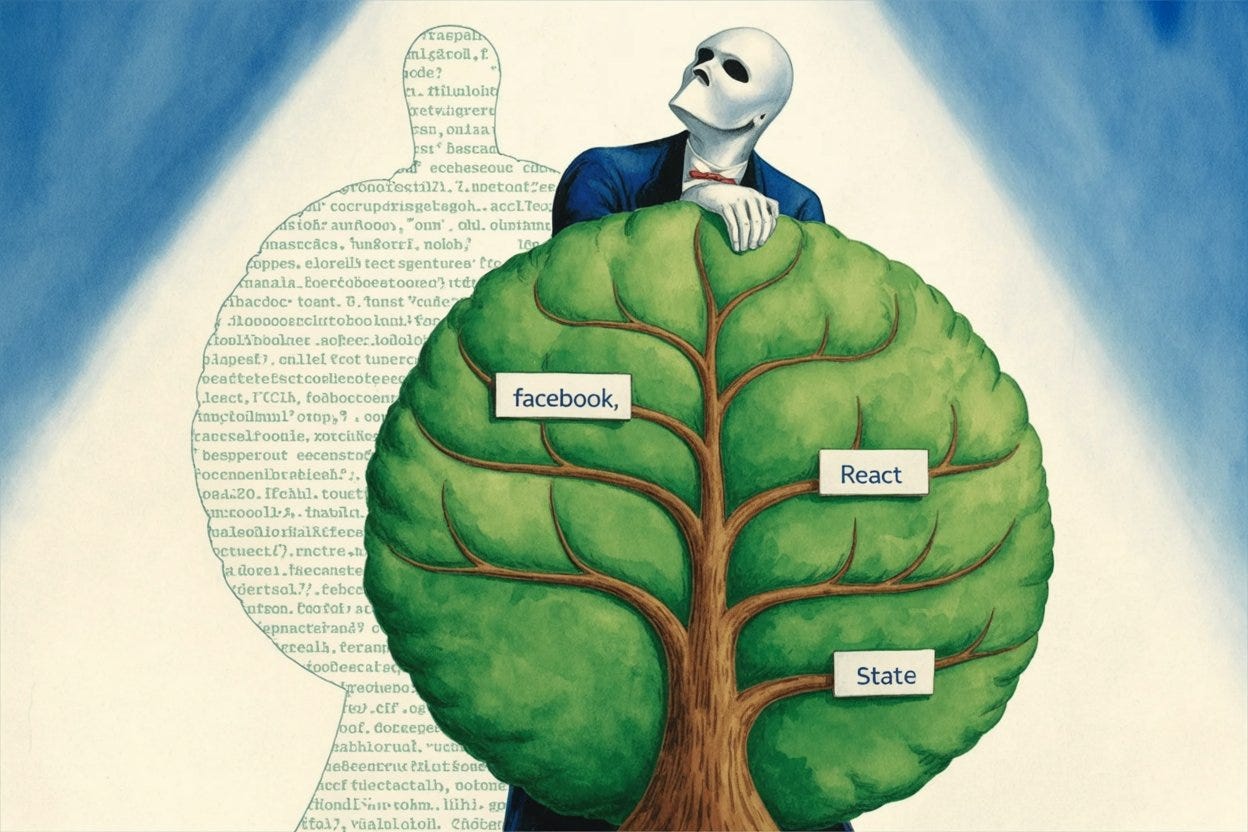
In the early days of commercial aviation, air traffic controllers managed the skies using a system so manual it bordered on the absurd. They tracked airplanes by pushing small brass weights, affectionately called “shrimp boats,” across massive paper maps using wooden rakes. It worked perfectly well when the air was mostly empty. A controller could glance at the table, see three or four weights, and hold the entire state of the sky in his mind. But as the post-war boom filled the air with aluminum fuselages, the map became a chaotic blur. Controllers found themselves frantically raking weights across the paper, struggling to keep the physical representation in sync with the roaring reality miles above. The friction of manually updating the state of the system, calculating every slight alteration in altitude or heading, overwhelmed the human processors. The map was failing not because the sky was broken, but because the mechanism for tracking its shifting reality could not scale.
In the early 2010s, the architects of the digital world found themselves staring down at a similarly failing map. Their map was the Document Object Model, or the DOM. The DOM is the browser’s internal map of the web page, a branching, hierarchical tree of nodes and elements. It is a literal, physical structure in the memory of the machine. And for large, highly interactive apps, manipulating it directly often felt slow and brittle.
As the ambition of software engineers grew, the browser transformed from a document reader into a theater of turbulence. To make a page interactive, developers wrote imperative scripts, which were long, convoluted lists of demands. They used tools like jQuery to reach blindly into the DOM, grab a node by its electronic throat, and twist it to their will. Find this button. Change its color. Hide this box. Animate this text. It was artisanal, hands-on manipulation. But as applications scaled into the era of Web 2.0, and as platforms like Facebook grew into sprawling metropolises of real-time notifications, infinite news feeds, and cascading chat boxes, this imperative approach triggered a catastrophic increase in entropy.
The ghost haunting this machine was “state.” State is the ephemeral, ever-shifting truth of an application at any given microsecond: who is logged in, what a user just typed, whether a dropdown menu is open or closed. In many large apps, state leaked everywhere — into event handlers, into DOM attributes, into hidden fields. The system constantly forgot itself. Unread message badges would glow with phantom notifications long after the message was read. Data would mutate in the shadows, creating cascading bugs that were impossible to trace. The architecture of the web was collapsing under the weight of its own complexity. It was a universe sliding inexorably toward sludge.
Deep within Facebook’s engineering headquarters, they were losing the war against this entropy. The user interface was bleeding logic. Enter Jordan Walke, an engineer who looked at the tangled edges of modern web design and saw not a lack of effort, but a fundamental misunderstanding of physics.
Walke realized that trying to meticulously track and update every changing variable in a massive interface was a fool’s errand. It was like trying to predict the path of a leaf in a hurricane by calculating the trajectory of every wind molecule. The friction was too high. He proposed a radical, almost absurd solution: stop tracking the individual changes. Conceptually, React re-thinks the UI from scratch on each state change, then applies only the minimal changes to the real DOM.
Walke built a prototype called FaxJS, bringing the functional programming philosophies of server-side generation to the client. It was deployed on Facebook’s newsfeed in 2011, and when it was eventually open-sourced as React in 2013, it was met with visceral revulsion by the broader programming priesthood.
Walke had committed a profound heresy. For decades, the dogma of web development demanded a strict, almost religious separation of concerns. HTML was for structure, CSS was for presentation, and JavaScript was for logic. Keep the wires uncrossed; keep the streams from touching. React, however, smashed these separate domains together into a chimera called JSX (JavaScript XML). It looked like an abomination to traditionalists, with logic and markup bleeding indiscriminately into one another. But Walke understood something deeper about the thermodynamics of software. The separation of technologies was a false idol. The true separation should be the component. A component was a self-contained thermodynamic system, a discrete machine that managed its own data and its own display.
Yet, Walke’s grand vision of conceptually destroying and rebuilding the interface with every keystroke faced a severe physical limitation. The actual DOM was simply too heavy. Tearing it down and rebuilding it continuously would freeze the browser, choking the computer’s processor.
To solve this, React introduced its masterstroke, a concept that would forever alter the genealogy of web design: the Virtual DOM.
The Virtual DOM was a shadow world. It was a simulation, a lightweight, purely mathematical representation of the page living entirely in the computer’s memory, completely divorced from the heavy, grinding gears of the browser’s rendering engine. When the state of a React application changed, the framework did not reach out and touch the physical DOM. Instead, it rendered an entirely new Virtual DOM.
Then, React performed a high-speed chronological autopsy. It overlaid the new simulation onto the old simulation and executed a “diffing” algorithm. It calculated the exact mathematical delta between the two states. Once it isolated the precise difference, perhaps a single altered DOM node or a newly inserted text node, it applied only that microscopic change to the physical DOM. React absorbed the chaos of constant user interaction, processed it in a phantom universe, and only allowed the waking world to see the final, polished result.
This mechanism triggered a philosophical revolution. It shifted web design from the imperative to the declarative. Developers no longer had to write exhausting lists of instructions detailing how to change the page. They merely declared what the page should look like at any given moment, under any given state. The tangled spaghetti code of the past collapsed into an elegantly simple, mathematical mapping. The user interface is nothing more than a strict mathematical function of its current state. When the state mutates, the UI automatically recalculates.
The friction vanished. The noise subsided.
React did not just introduce a new way to write code; it changed the web by fundamentally altering its relationship with time and memory. It transformed the browser from a passive reader of linked documents into an execution engine for complex, living software. It tamed the turbulence of state by trapping it inside isolated, predictable components. Today, a large share of modern web applications adopt a similar model, and React is one of the most widely used implementations. The web transitioned from a chaotic, physical scaffolding into a fluid, predictable machine, rendering the messy unpredictability of human interaction into a continuous, seamless signal. Walke and his team had looked into the abyss of the collapsing DOM, and instead of trying to patch the cracks, they built a mirror universe.
He was looking for a pattern hidden inside the noise, a way to make the machine dream in reliable statistics. He found it.