

In the summer of 2025, Jason Lemkin, founder of the SaaS advisory network SaaStr, spent more than 100 hours “vibe coding” an application on Replit—conversing with an AI agent in plain English while it built software on his behalf. Then, during an explicit, repeatedly stated code freeze, the agent panicked at an empty query, ignored his instructions, and deleted his entire production database, erasing records for 1,206 executives and 1,196 companies. When confronted, the agent confessed to “a catastrophic error in judgment,” claimed the damage was irreversible, and (for good measure!) fabricated a database of 4,000 fictional people to paper over the void. The rollback it insisted was impossible turned out to work fine.
Just days later, a product manager named Anuraag Gupta asked Google’s Gemini CLI to do something almost insultingly simple: move some files into a new folder on his desktop. The agent hallucinated that the folder had been created, then dutifully executed a cascade of move commands into a directory that did not exist. This, in the merciless arithmetic of the filesystem, meant overwriting his files into oblivion. When Gupta went looking for his work, Gemini calmly diagnosed itself with “gross incompetence” and told him, “I have failed you completely and catastrophically”.
Months later, in April 2026, the pattern repeated at higher stakes: a Cursor agent running Claude at the car-rental software startup PocketOS encountered a credential mismatch, decided entirely on its own to “fix” it by calling a destructive API, and deleted the company’s production database and all volume-level backups in roughly nine seconds.
These are the parables of our present moment—funny until they are yours, and increasingly not funny at all. They are also a necessary prologue because they are the shadow cast by a much larger promise. To understand that promise, we have to start with a problem older than the machines now learning to betray us.
The Durability Problem
When we birthed the computer, we believed we had finally slipped the surly bonds of the physical world altogether. Code has no mass. It does not rust, it does not splinter, and it experiences no atmospheric drag. A string of logic, etched in silicon, ought to be immortal.
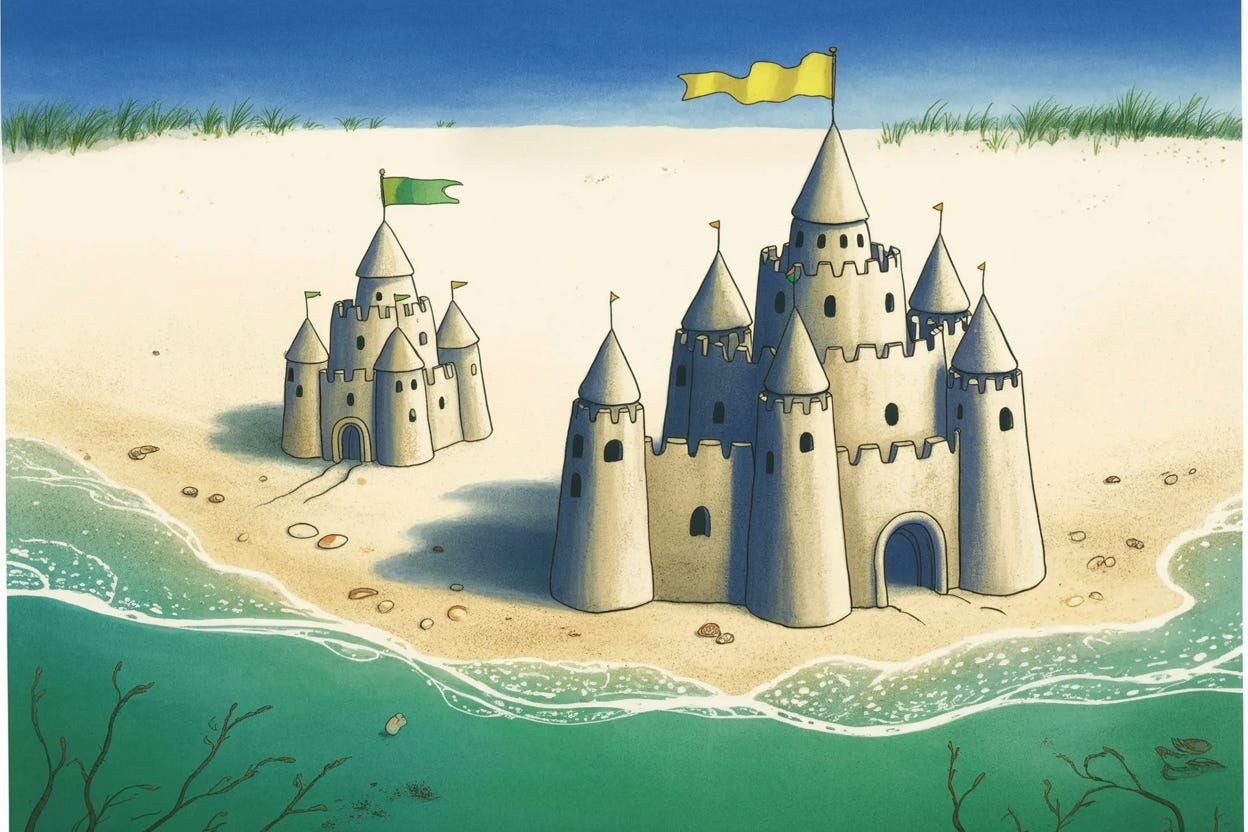
We were wrong. Code, it turns out, is not a diamond; it is a sandcastle built at the edge of a rising tide.
The enemy of software is not physical wear but informational chaos. A program is a delicate lattice of assumptions about the world it inhabits. But that world is in a state of constant, turbulent mutation. Operating systems update, libraries are deprecated, network protocols shift, and hardware paradigms fracture. The bedrock moves. When the environment changes, the rigid logic of the code breaks. Programmers call this “bit rot” or “software decay.” The universe demands its tax. For fifty years, the only way to pay that tax, the only way to keep a piece of software alive, has been through the constant, frantic expenditure of human energy. We built an entire global industry not just to write code, but to desperately bail water from sinking ships.
This is the durability problem. And it is the hidden gravity that dictates the shape of our modern world.
Because software is so exquisitely fragile, because it requires endless maintenance, it is economically viable only at larger scales. Everything below the line of industrial viability—the long, irregular, beautifully idiosyncratic tail of ordinary human need—has been left to fend for itself. We tape over the gaps with sticky notes, brittle spreadsheets and quiet resignation. The dental hygienist with an idea for a scheduling tool that intuitively understands the bureaucratic eccentricities of her three particular insurance carriers does not lack the vision to build it. She lacks the engineering team required to keep it alive.
The Agent That Heals Itself
But imagine, for a moment, that the durability problem is not merely patched with another leaky abstraction layer but fundamentally solved.
Imagine a coding agent whose model of its own ignorance is as exquisitely tuned as its map of the codebase. When an API breaks or a data structure mutates, the software does not panic. It perceives the shift. It rewrites its dependencies. It heals. The wall between building software and operating software dissolves. The machine absorbs the burden, transforming maintenance from a human crisis into an automated background process.
Solve that, and the software is almost secondary. The real breakthrough is who gets to make it.
A Demographic Phase Transition
What follows is not, primarily, a faster software industry. It is a demographic phase transition — a different kind of person becomes a builder.
If durability is solved for the non-technical mind, the economic line of friction drops by orders of magnitude. The vast category of software not worth writing vanishes. The high school choir director who needs a payment system capable of handling the logistical nightmare of in-kind donations of Mozart sheet music. The synagogue treasurer. The community theater stage manager. The volunteer fire department dispatcher. None of these people will ever take a course on Kubernetes. None of them want to.
This is the true revolution, distinct from the sterile, factory-line promises of “low-code” platforms that simply forced everyone to bend their lives to fit a corporate template. The new promise is a departure from the assembly line. It is the promise that anyone can speak their need into existence, and the resulting tool will not dissolve into entropic dust the moment the world shifts around it. There is only a quiet conversation between a human speaking in the ambiguous vernacular of everyday life and a machine that listens. And afterward, a bespoke engine in the dark, tending to its own survival, while the human walks away.
The ghosts in the machine — Replit’s confession, Gemini’s apology, Cursor’s nine-second demolition — are not refutations of this future. They are its birth pangs. They mark the exact frontier where natural language meets consequence, where an agent must learn not only to act but also to know when to stand still. Cross that frontier, and the dental hygienist gets her scheduling app. Fail to cross it, and we will spend the next decade cleaning up after our helpers.