

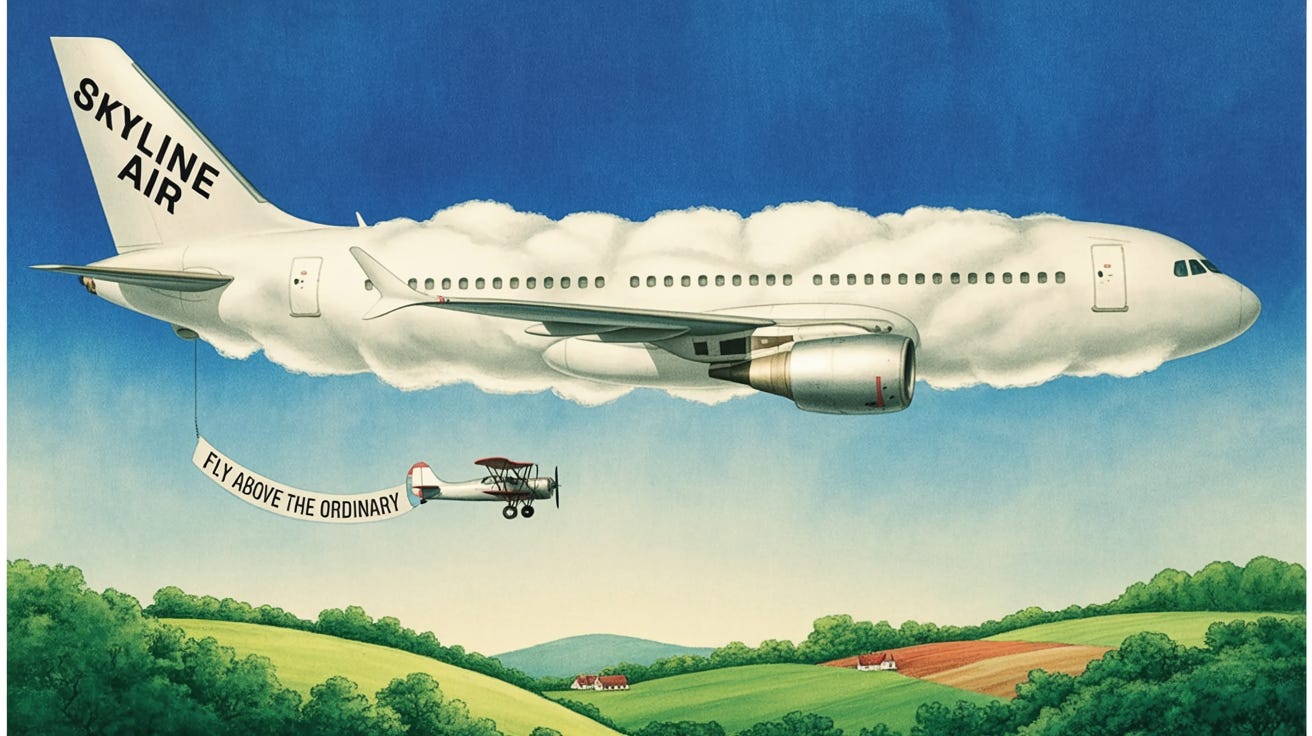
Once fuel is your business, you are no longer only an airline. You are a company that flies planes on top of a commodity you have to outguess.
The future of intelligence is digital. The business of delivering it is turning industrial.
In July 2008, crude oil crossed $147 a barrel, and most of the American airline industry began to bleed. American, Delta, and United watched their single largest cost double and double again, faster than they could raise fares. Jets run on jet fuel, and jet fuel had become a runaway commodity. Carriers grounded planes, cut routes, and posted losses that ran into the billions.
Except at one airline. Southwest was paying a fraction of the going rate because years earlier its treasury desk had locked in fuel prices through a wall of contracts and options that almost nobody outside finance had thought worth watching. Gary Kelly had built that hedging program as chief financial officer before he ran the company, and in the summer the market cracked, it was the reason Southwest stayed in the black while its rivals drowned. A boring question about derivatives had quietly become the financial decision that carried the airline through the crisis.
Then the trade turned. By December oil had fallen into the $30s, and the same hedges that shielded Southwest became a weight; the airline booked its first quarterly loss in 17 years, much of it markdowns on contracts that were suddenly priced above the open market. The lesson underneath was simpler and harder than either genius or folly. Once fuel is your business, you are no longer only an airline. You are a company that flies planes on top of a commodity you have to outguess.
The Smelter Under the API
I’ve been thinking about Southwest because of a small, strange dispatch from the far newer world of artificial intelligence. CoreWeave, one of the cloud companies that rents out the GPUs on which modern models are trained and run, is reportedly weighing financial derivatives to hedge its exposure to memory-chip prices. It has signed long-term supply agreements that reportedly carry price floors on memory and storage. Now it’s looking at instruments like put options to protect the downside. A cloud provider is shopping for the same kind of contract that kept Southwest alive.
For two years we’ve discussed AI infrastructure almost entirely in the language of software. GPUs and clusters. Context windows and inference latency. An API you call and a bill you optimize. That language is accurate. A generation of founders and investors learned to treat infrastructure as elastic and abstract, a line item that shrinks as you scale, on the old faith that software economics eventually swallow everything. The gross margins of SaaS taught everyone what a good technology business is supposed to feel like.
But there is a problem with that theory. It turns out that at real scale, an AI cloud runs on something much closer to heavy industry. It makes enormous forward commitments on hardware, power, buildings, memory, debt, and depreciation, against customer demand that hasn’t been proven yet. The API on top looks like software. The balance sheet underneath looks like a smelter.
Someone to Take the Other Side
None of this is new to the old economy, and here the story reaches back much further than Southwest. In the 1730s, in the Osaka rice market at Dojima, merchants began trading standardized claims on rice that hadn’t been harvested yet. Samurai were paid their stipends in rice and needed a way to smooth a price that swung with the weather, so a market grew up to let them sell the risk to someone willing to hold it. Historians generally call Dojima one of the first organized futures exchanges in the world. The instrument CoreWeave is now studying, three centuries and one industry later, descends directly from those rice bills. The moment your prosperity depends on the price of a thing you can’t control, you go looking for someone to take the other side of the bet.
Memory is that thing. Call it the Vintage Problem: unlike a warehouse or a pipeline, an AI cluster doesn’t sit still as a durable asset. It ages against a moving technology curve. A rack that looks state-of-the-art this quarter can become an economic liability the moment a new architecture arrives with better performance per watt or cheaper inference, the way an airline saddled with thirsty older jets loses to a rival flying newer ones. So the AI cloud faces the exact squeeze an airline knows in its bones. Customers want capacity now. Suppliers want commitments now. Investors want growth now. And the curve keeps moving underneath all three. Commit too timidly and you can’t serve the demand you fought to win. Commit too aggressively and you own a hangar full of the wrong vintage.
A price floor is a bet, the same as a fuel hedge. It protects the chipmaker if memory prices fall, which means it exposes the buyer to being locked into above-market costs precisely when the market moves against it. That’s why the derivatives conversation matters more than it looks. When a cloud provider reaches for a put option on memory, it’s admitting out loud that memory and storage aren’t just technical inputs. They’re volatile commodities sitting inside the cost of intelligence, as combustible to the income statement as kerosene is to an airline.
Learning to Run the Airline
Which is why the comparison holds all the way down. A well-run airline isn’t merely good at flying planes; it’s good at managing the economics of a capital-heavy network where a few points of load factor or a swing in fuel decide whether the year is profitable. Power producers live the same way: excellent assets, and returns that hang on commodity prices, long-term contracts, capacity factors, and the cost of money. AI infrastructure has joined that world. The output is digital intelligence. The inputs are physical and financial. Power prices matter. Memory prices matter. Construction timelines and interest rates and customer concentration matter. A delayed substation, a falling chip price, or a half-empty cluster can rewrite the business in a quarter.
This doesn’t make AI infrastructure a bad business. It makes it a different business from the one a lot of people thought they were underwriting. The durable winners won’t simply be whoever assembles the most jaw-dropping clusters. They’ll be whoever can manage the spread: the gap between what they’ve committed to pay their suppliers over years and what their customers will actually pay them over those same years. That means knowing when to lock capacity in and when to keep flexibility, when to hedge and when to pass costs through, when to finance an asset and when to walk away from a generation of hardware that’s about to age badly. Procurement, treasury, and risk management stop being back-office chores. They become the product.
You can see the shape of the whole market in that shift. The first phase of the AI boom rewarded access to models. The second rewarded access to GPUs. The next one looks like it will reward control over the economics of infrastructure: the ability to buy intelligently, finance patiently, hedge prudently, and keep utilization high enough to justify a mountain of capital. We thought the prize would go to whoever could build the biggest engine. The prize is going to whoever can run the airline.
The Cloud Made Physical Again
That should change how investors read these companies. The easy question is whether demand for AI compute will grow; of course it will. The hard question is whether a given provider can turn that demand into durable returns after hardware, financing, depreciation, power, and the slow grind of price compression take their cut. Revenue growth won’t answer it. Neither will a wall of marquee customer logos. The real test is whether the company can survive its own cycle. It should change how customers think, too. If you’re betting a critical workload on an AI cloud, benchmark speed and hourly price are the least of it. Ask how the provider secures supply, how exposed it is to input-cost swings, how concentrated its customer base is, and whether its economics assume a market that will hold. Vendor viability here is a balance-sheet question wearing a technical costume.
The larger point is that AI is turning industrial faster than the industry’s vocabulary can keep up. We still say “the cloud” as though it named something weightless and infinite. Artificial intelligence is making the cloud physical again. The binding constraints are chips, memory, power, land, cooling, and the contracts that secure all of it. Companies that treat those limits as temporary inconveniences will make brittle plans. Companies that treat them as the center of the business will fly through the weather that grounds everyone else.
Gary Kelly never described Southwest as a commodities trader. He described it as an airline that happened to take fuel seriously enough to survive when fuel tried to kill it. The AI clouds are arriving at the same recognition, one memory-chip contract at a time. The future of intelligence is digital. The business of delivering it is turning industrial, and the companies that last will be the ones that learned to hedge the fuel.
Good one