

In the winter of 1969, deep inside the labyrinth of Bell Labs in New Jersey, a computer scientist named Ken Thompson sits in front of a machine called the Teletype Model 33.
The Model 33 is not a screen. It is a hulking, electromechanical typewriter. It weighs fifty pounds. It is loud. It hammers metal type onto a massive roll of paper, and it can only manage about ten characters per second. Every single keystroke costs time. It costs ribbon. It costs a physical fraction of a tree.
The constraints of the Teletype forced Thompson and his colleagues to invent a language of brutal brevity. They created cryptic two-letter commands. They typed “ls” to list files. They typed “cp” to copy them. This was not a stylistic choice. It was a physical necessity. You had to be exact. You had to be fast. The system was utterly unforgiving. One misplaced character, and the machine would not do your bidding.
The Illusion of the Desktop
For the last forty years, we have told ourselves a very specific story about this era of computing. We tell ourselves it was the dark ages. We believe the arrival of the Graphical User Interface in the 1980s rescued us from that darkness. We were given folders. We were given trash cans. We were given a mouse. We traded the terrifying void of the command line for the comforting friction of a double click. The terminal was banished to the basement. It became a secret club for system administrators, engineers, and database wranglers. The rest of us happily moved on.
So, why do we believe this? And more importantly, are we right?
It turns out that story isn’t true at all. The terminal was never obsolete. It was merely waiting for a better translator.
The Translation Tax
Whenever two vastly different cultures try to communicate, they lose energy, nuance, and speed in the process of translation. For four decades, the graphical desktop has been our translation layer. It is a beautiful illusion. But it demands a massive translation tax. A machine does not understand a brightly colored button. It does not comprehend a drop-down menu. Those things were built to soothe human anxiety. For a machine mind, the graphical interface is a sluggish, cumbersome labyrinth.
This brings us to an incredibly strange phenomenon happening right now in offices around the world. Writers, lawyers, and marketers are abandoning the mouse. They are opening up the terminal. They are staring at the same black void Ken Thompson looked at in 1969.
They aren’t doing this because they suddenly learned to code. A modern novelist does not know what a symbolic link is. A small business owner has not memorized the difference between “grep” and “awk.” They do not know the syntax. They do not need to.
They are returning to the basement because they have found a loophole.
Today, a consultant can point an artificial intelligence agent at a chaotic folder of client transcripts and ask for a thematic extraction. A marketer can open the command line and ask an AI to resize a thousand high-resolution photos in a single breath. The user simply types a desire in plain, messy English. The AI translates that intent into perfect code. The machine executes.
It is fast. It is seamless. It is incredibly powerful.
The Mother Tongue
The terminal, it turns out, is the mother tongue of the machine. It is a frictionless conduit. Text in. Text out. When we unleash these new AI agents inside the command line, they move with a hydrodynamic velocity that a human hand guiding a mouse could never match. They don’t just understand the system. They breathe it.
We are witnessing a strange loop in the genealogy of human interaction. We built the graphical desktop to hide the machine from the human. Now, we are using artificial intelligence to guide the human back into the engine room. The old grammar of the Teletype still works perfectly. It always did. The limitation was never the machine. The limitation was us.
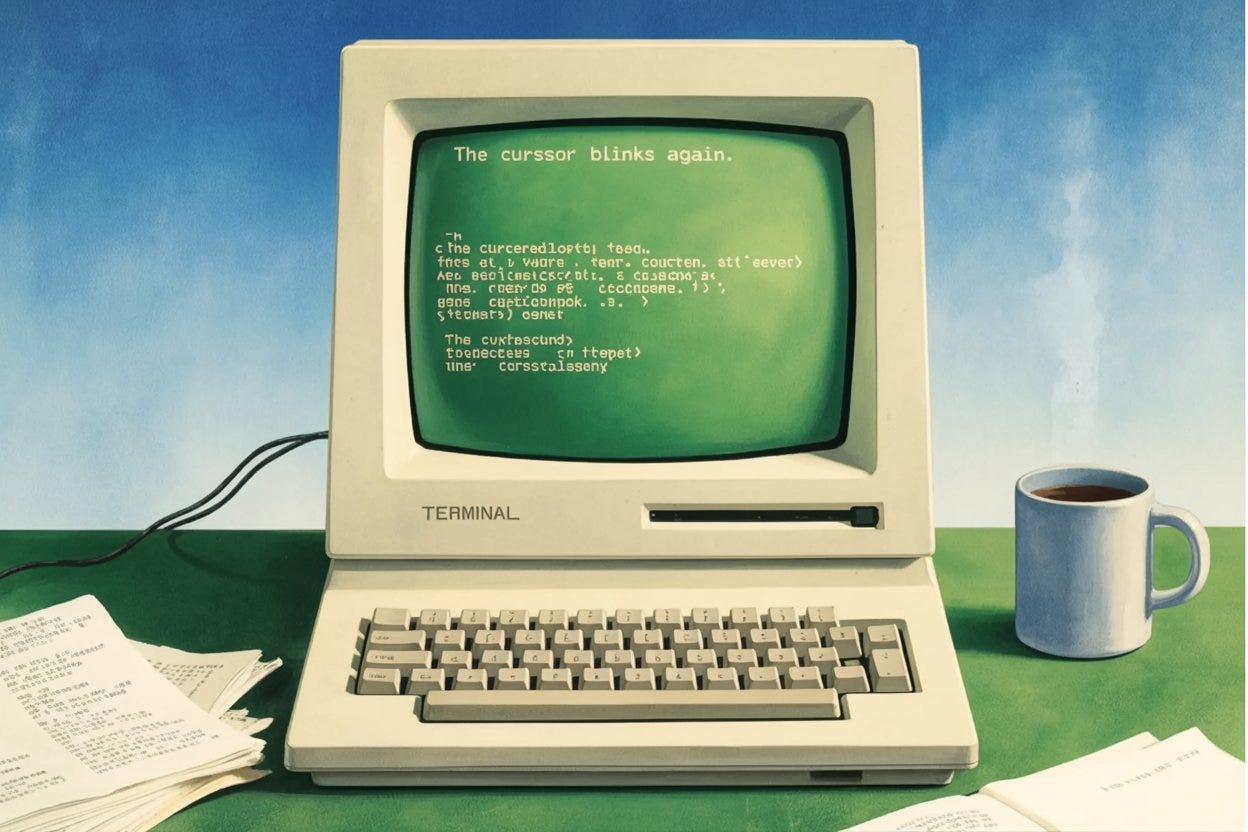
If we can accept that the most powerful tool in the digital world is not a painted pixel but the raw, unmediated exchange of language, the world of computing opens up to everyone. The basement is no longer locked. The cursor blinks again. It is no longer demanding that we speak its language. It is simply waiting to listen.