

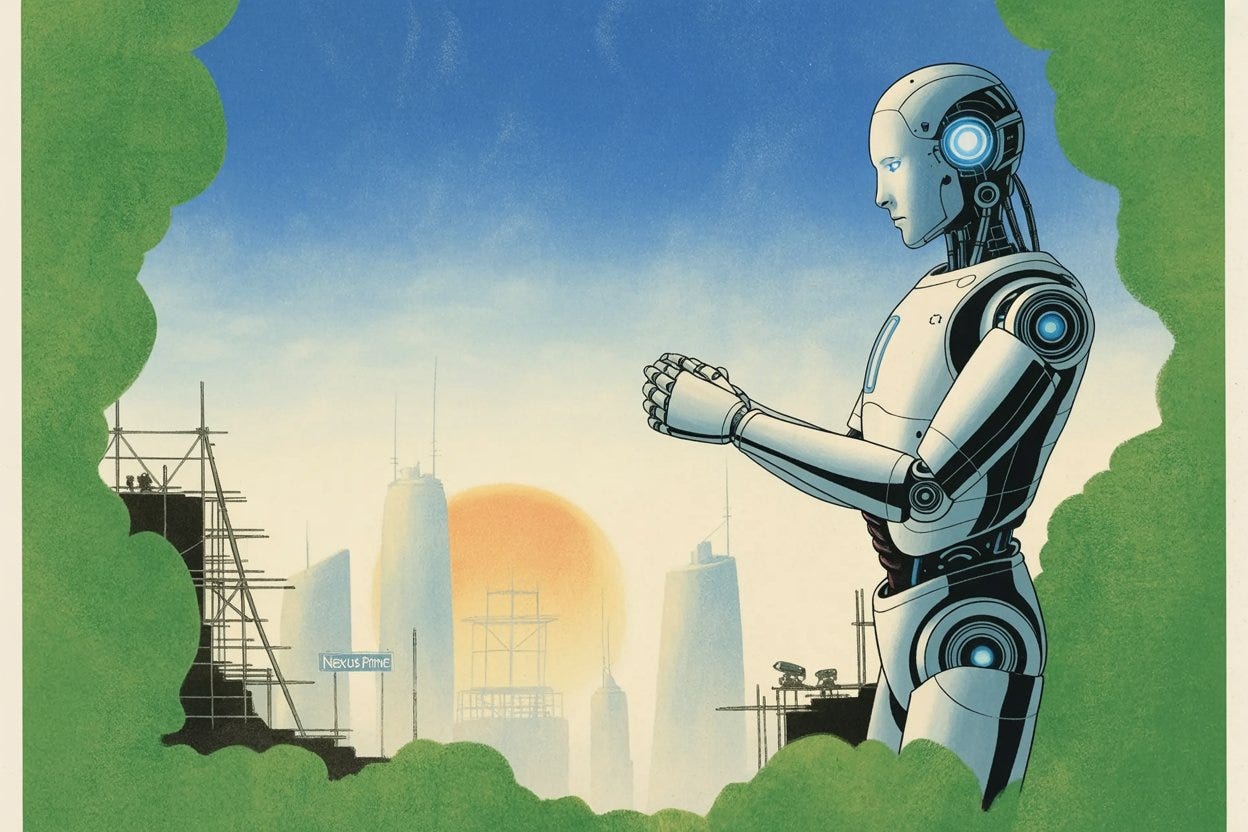
For half a century, the act of programming a computer was a labor of translation. It was a painstaking, manual descent from the messy, ambiguous heights of human intention down into the cold, binary bedrock of the machine. The pioneers of the discipline—figures like Turing, von Neumann, and Hopper—understood this as a fundamental friction. To make a machine think, a human had to first break their own thoughts into jagged, microscopic shards of logic, feeding them piece by piece into the compiler. The software engineer was an artisan, carving cathedrals out of silicon, one line of syntax at a time.
That era has quietly closed. We have crossed a threshold in the architecture of information, shifting from the crafting of code to the cultivation of autonomous logic.
The Loom Weaves Itself
Consider the artifacts now emerging from the edge of computer science: complete, million-line codebases, labyrinthine in their complexity, entirely conceived, structured, and executed in a matter of months. Not a single line of this digital architecture is authored by a human hand. The human is no longer the weaver; the human has become the architect of the loom, stepping back to watch the machine weave itself.
This is the dawn of autonomous software engineering, a paradigm where large language models cease to be mere probabilistic parrots or intelligent autocompletes. They have been elevated to the status of digital teammates. But to harness a fluid, statistical intelligence and force it to perform deterministic engineering requires a vessel. The solution is the “harness”—a specialized, highly constrained operational environment. It is a terrarium for artificial thought. The harness connects the volatile energy of the reasoning model to the rigid tools of the development environment. Within this closed loop, the model does not merely suggest; it acts. It writes the documentation, tests the boundaries of its own logic, and configures the infrastructure required to sustain itself. The traditional software development lifecycle—a slow, linear march of design, execution, testing, and maintenance—has collapsed into a single, continuous singularity of generation.
Appeasing the Machine
In the time space of a machine, a minute is an eternity. The bottleneck is no longer the speed of human thought but the physical limits of the build systems. To survive the impatience of the AI, the environment must be radically optimized. Engineering teams are frantically dismantling monolithic structures, moving toward highly modular, advanced monorepo tools like Bazel and Turbo. The software is being shattered into smaller, frictionless components to appease the metabolic rate of the machine.
As the machine accelerates, the role of the human undergoes a violent mutation. Synchronous human attention is now the absolute scarcest resource in the system. The engineer is no longer a writer of logic but a manager of ghosts. They act as a tech lead presiding over hundreds of tireless, invisible junior developers. This requires a terrifying relinquishment of control. In the old world, humans meticulously reviewed every proposal, every “pull request,” before allowing new code to merge into the main artery of the system. Today, the sheer volume of generated logic renders synchronous review impossible. Instead, humans must adopt a post-merge posture. They examine a statistical sample of the completed work, searching the phase space of the software for architectural drift, while the AI handles the granular execution.
The Self-Healing System
To prevent this semi-autonomous system from sliding into entropy, a new kind of law must be imposed. The probabilistic engine must be grounded in rigid, codified guardrails. And because these models are, fundamentally, creatures born of language, the control mechanism is text.
The tribal knowledge of an engineering team, the unwritten rules of elegance, and the historical reasons for a specific architecture can no longer exist solely in the minds of the senior staff. It must be externalized. Teams now draft overarching architectural blueprints in simple Markdown files. These are not merely notes; they are the core beliefs, the genetic constraints fed directly into the model’s context window. They act as automated quality scores and tech debt trackers. The AI constantly reads its own scripture, evaluating its output against the text. When an error is found, the human does not rewrite the code. The human amends the overarching documentation. They update the law, and the machine heals itself, ensuring the aberration is never repeated. Institutional memory is transformed from a fragile human construct into a permanent, executable state.
The End of the Dependencies
Empowered by this explicit knowledge, the model extends its reach into the darkest corners of the system. It takes ownership of the command-line interface, the text-based nervous system of the computer. It resolves merge conflicts. It watches the continuous integration pipelines, waiting for the tests to turn green, autonomously hunting down and patching “flaky” logic before pushing its own work into production.
This self-sufficiency is triggering an evolutionary pruning of the software ecosystem. For decades, engineers relied on bloated, generic third-party plugins and libraries to solve common problems, a necessary compromise that introduced security risks and decaying dependencies. The autonomous agent possesses the bandwidth to do something radical: it writes bespoke, in-house versions of every tool it needs. It sheds the vestigial organs of the open-source world, generating lean, purpose-built dependencies from scratch. The era of the plugin is ending.
Ephemeral Instruments
Nowhere is this more evident than in the art of debugging. In the past, human engineers spent weeks constructing static dashboards and complex visualization tools to map the internal state of their software. It was an exercise in building permanent windows into a black box. The AI approaches the problem differently. When a critical failure occurs, the agent consumes the raw, chaotic noise of the log files. In a matter of seconds, it generates a custom, fully functional web application designed solely to highlight the precise root cause of that specific error. It builds an instrument of observation, uses it once, and discards it. The architecture of diagnostics has become completely ephemeral.
We are witnessing the final abstraction. From the punch cards of the Jacquard loom to the compilers of the twentieth century, we have slowly removed our hands from the machinery of logic. Now, we are removing our minds from the minutiae of the syntax. We are learning to communicate with the machine not in the imperatives of code, but in the declarations of intent. We tell it what we want, and we watch as the ghost in the machine dreams the architecture into existence.