

In 1980, Joseph F. Engelberger published Robotics in Practice: Management and Applications of Industrial Robots. To the uninitiated, it might look like a technical manual, but to the industry, it was a declaration of a new era.
Engelberger wasn’t writing science fiction; he was writing the shop floor bible. Known as the “Father of Robotics,” he didn’t deal in hypotheticals; he dealt in hydraulics. He founded Unimation and is the man responsible for installing Unimate, the world’s first industrial robot, on a GM assembly line in 1961. This book was his blueprint for integrating the “steel collar” workforce with the blue-collar one.
When Engelberger’s book was published, there was another titan in the field of robotics: Isaac Asimov, whose Three Laws of Robotics had captivated millions through science fiction. But while Asimov’s laws were philosophical constructs, Engelberger’s book was grounded in factory floors and production quotas. Asimov asked “what if robots could think?”; Engelberger asked “how do we make robots work?” It was the difference between dreaming about the future and building it.
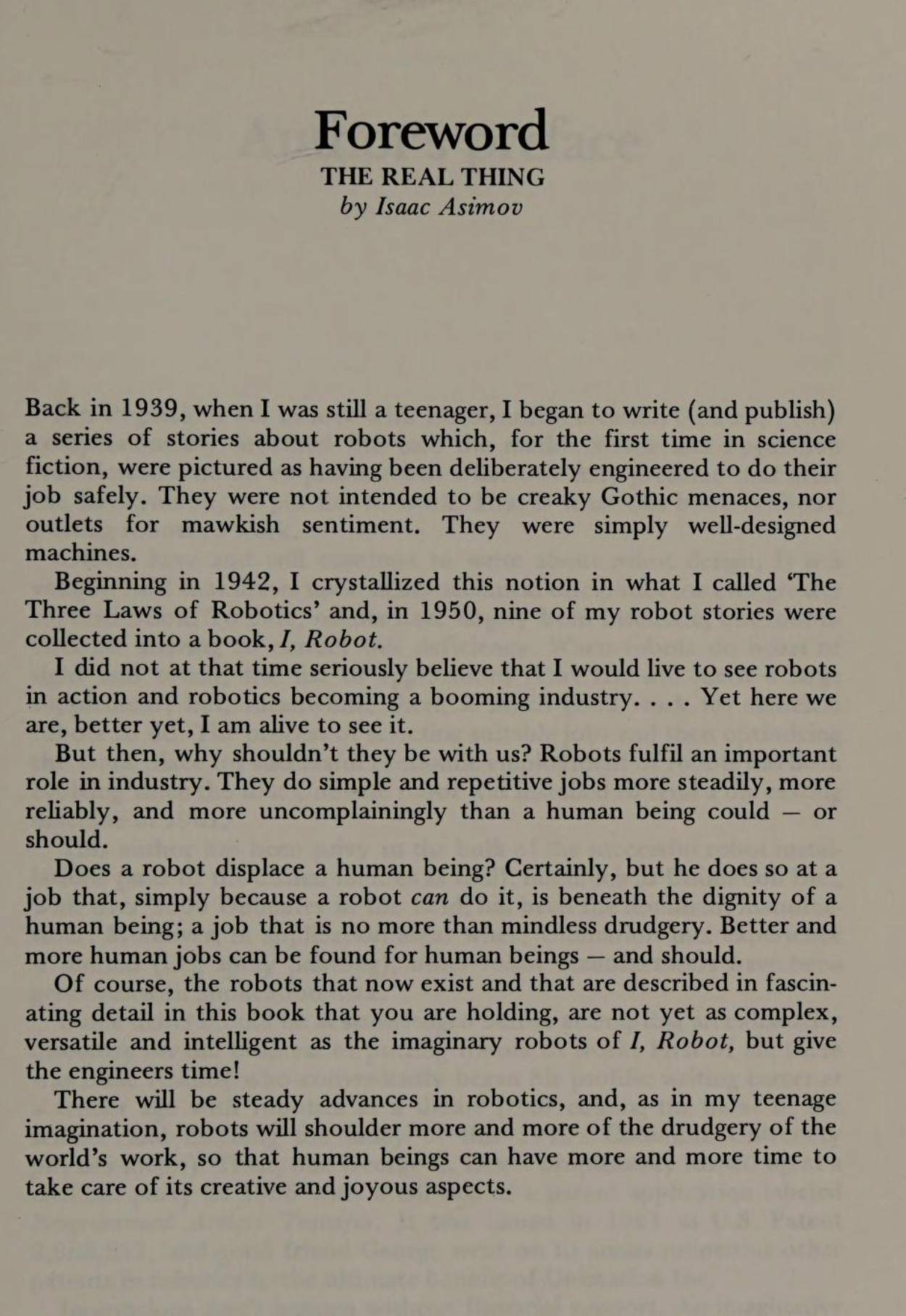
And in 1980, it was Engelberger who asked Asimov to write this foreword to his book to formally bridge their two worlds.
This single page represents the moment where the dream shook hands with the reality.
This one page essay is a bridge between two men who defined the machine age:
The Dreamer: Isaac Asimov
You likely know him as the “Godfather of Robot Fiction.” He is the man writing this foreword.
His Role: He didn’t build robots; he imagined them. In the 1940s, he coined the term “Robotics” and created the “Three Laws of Robotics.”
His Philosophy: Before Asimov, robots in fiction were monsters (Frankenstein) that destroyed their creators. Asimov changed the narrative. He viewed robots as tools—rational, safe, and engineered to help humanity.
In this text: He is acknowledging that the “positronic brains” of his stories haven’t arrived yet, but the industrial robots he dreamed of are finally here to take the “drudgery” off human shoulders.
The Builder: Joseph F. Engelberger
He is the author of the book this foreword sits in. He is known as the “Father of Robotics.”
His Role: While Asimov wrote stories, Engelberger built the iron. He founded Unimation, the world’s first robotics company. In 1961, he installed “Unimate,” the first industrial robot, on a GM assembly line.
His Philosophy: Engelberger explicitly stated that he was inspired to build real robots after reading Asimov’s stories in college. He wanted to build the “well-designed machines” Asimov wrote about.
The Connection: This foreword is the closing of a loop. The writer (Asimov) inspired the engineer (Engelberger), who built the industry, and then asked the writer to introduce his manual on how to use them.
Asimov designed the soul of the industry; Engelberger built the body. This text is the moment the two acknowledged that the future had finally arrived on the shop floor.