

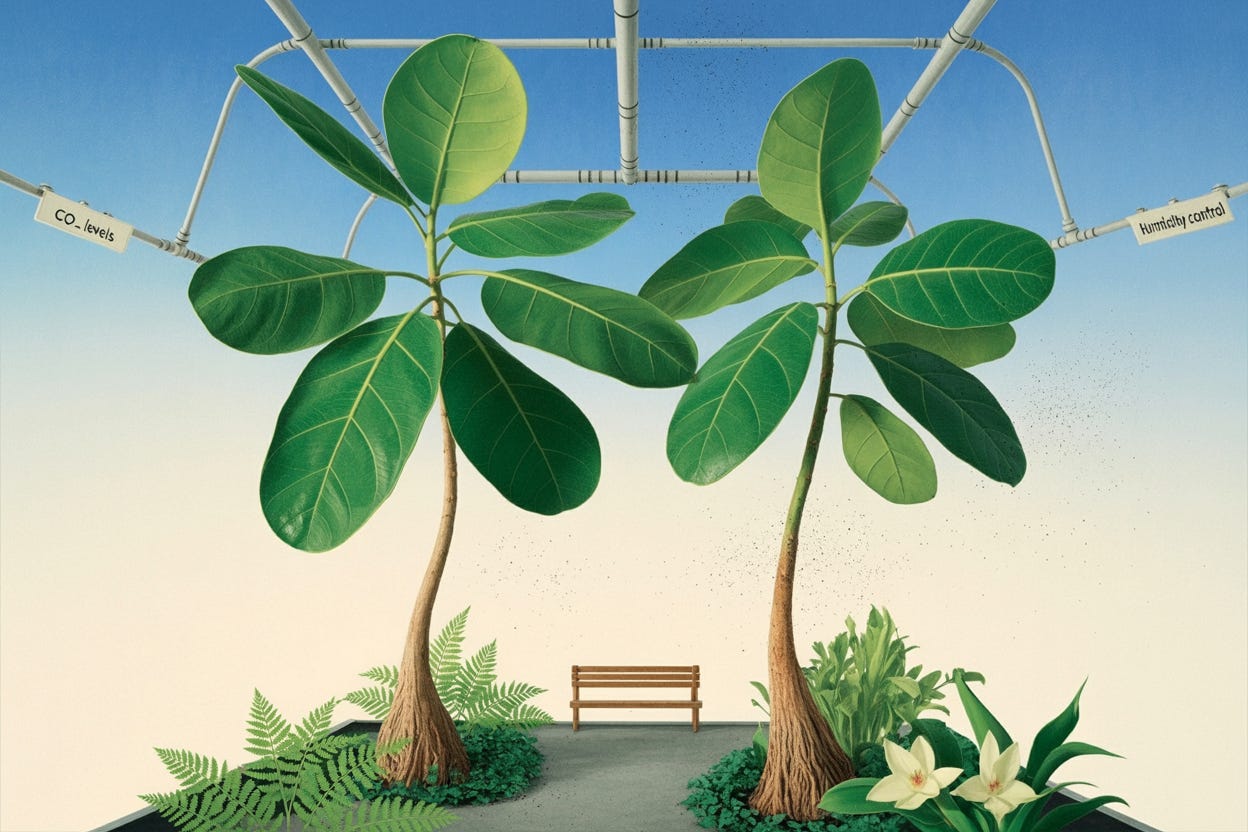
Consider the trees once sealed within the ambitious, sunlit dome of Biosphere 2. Within that perfectly engineered Eden, sheltered from the unpredictable elements of the desert outside, the saplings grew with astonishing speed. They reached for the artificial canopy, lush and vibrant, presenting a picture of flawless botanical health. But before long, a strange phenomenon occurred: one by one, the trees collapsed under their own weight. The botanists soon isolated the missing ingredient, a force entirely invisible yet structurally imperative. There was no wind. In the natural world, the constant, rhythmic buffeting of the breeze forces a tree to lay down “reaction wood”—dense, fibrous tissue that anchors the roots in the dark earth and fortifies the trunk against the sky. Without the friction of the wind, the trees developed no structural integrity. They were superficially perfect, yet fundamentally fragile.
There is a profound biological truth hidden in this architectural failure: life requires resistance to build resilience. The organism must push against its environment to know its own boundaries, to develop the internal, resonant tension necessary for survival. This principle of persistence extends far beyond the soil and the sap. It pulses in the electrical storms of the human brain, dictating the very shape of our consciousness.
Consider the wolf, moving silently through the snow-muffled forests of the north. The hunt is not merely a means to an end; it is an extended, deeply sensory dialogue with the environment. The faint scent of a trail carried on the cold air, the geometry of a broken twig, the shifting barometric pressure, all these variables demand that the wolf’s mind engage in a continuous, focused pursuit. If the wolf were magically and repeatedly teleported directly to its prey, its physical muscles might remain intact, but its attunement to the forest would rapidly dull. Its biological antenna, tuned to the delicate frequencies of the wild, would fold inward.
We are now entering a peculiar era in our own evolution, constructing a cognitive terrarium designed to eliminate the hunt. We call it artificial intelligence—a digital canopy erected to shelter us from the friction of not knowing. Recent empirical observations of human behavior interacting with these synthetic minds reveal a chilling echo of the falling trees. When men and women are given access to algorithmic assistants to solve mathematical puzzles or untangle the meaning of complex texts, they perform with sudden, frictionless brilliance. The answers flow freely, like water over smooth stones.
But when the digital assistant is abruptly removed, a shadow falls over the mind. Plunged back into the natural, unmediated state of cognitive struggle, these same individuals do not merely return to their baseline abilities; they wither. Confronted with a new problem, their resolve shatters. The solve rate plummets; the instinct to abandon the task entirely surges. Within a mere ten minutes of outsourcing their mental labor, the vital, unseen muscle of persistence begins to atrophy.
It is easy to view this through the sterile, reductionist lens of behavioral psychology, labeling the phenomenon “skill degradation” or “over-reliance.” But if we step back and look through the broader, holistic lens of supernature, recognizing that the mysterious capabilities of the mind are natural phenomena bound by natural laws, we begin to see the deeper currents at play. The human mind is not a cold calculating machine. It is a living, breathing organism, intricately connected to the evolutionary tides that shaped it.
When we engage in the deeply human act of problem-solving, when we sit in the dark and wrestle with an elusive equation or dig through the dense sediment of a difficult paragraph, we are not merely extracting a piece of data. We are sending roots down into the soil of the collective unconscious. We are firing electrical signals across synapses, forging pathways of blood and breath that link our immediate, conscious frustration to the ancient, survival-driven ingenuity of our ancestors. The friction of the unknown is our cognitive wind. It is the invisible force that stimulates the mind to build its own reaction.
When a participant types a query into a machine and receives an instantaneous, perfectly synthesized solution, they are bypassed. The destination is reached, but the journey, the vital, biological rhythm of trial, error, tension, and release, is stolen from them. They have consumed the fruit without planting the seed.
It is particularly telling that those in the experiment who used the artificial mind merely as a sounding board, seeking subtle hints rather than absolute answers, did not lose their persistence. They allowed the machine to act like the natural wind, bending but not breaking the bough. Yet the majority, those who demanded the direct and final solution, surrendered their agency entirely. They traded the resonant, electric spark of independent discovery for the dull comfort of an imported answer.
What happens to a species that engineers the struggle out of its own cognitive existence? We are biological entities tuned to a universe of profound mysteries. Our intuition, our sudden leaps of insight, our folklore, and our flashes of genius are all born from the tension of persistence. They are the emergent properties of a mind that has been pushed to the edge of the known and forced to build a bridge into the dark.
If we allow our daily interactions with artificial intelligence to strip away our tolerance for difficulty, we risk far more than a statistical decline in arithmetic scores or reading comprehension. We risk severing the deep, sensory connection between the human organism and the unsolved universe. We risk cultivating a generation of beautiful, fast-growing minds, perfectly adapted to a sheltered terrarium of algorithms, but wholly incapable of standing upright when the glass inevitably shatters and the real wind begins to blow. We must remember that the unexplained, the difficult, and the seemingly impossible are not mere obstacles to be bypassed by a machine; they are the very elements that make the mind alive.