

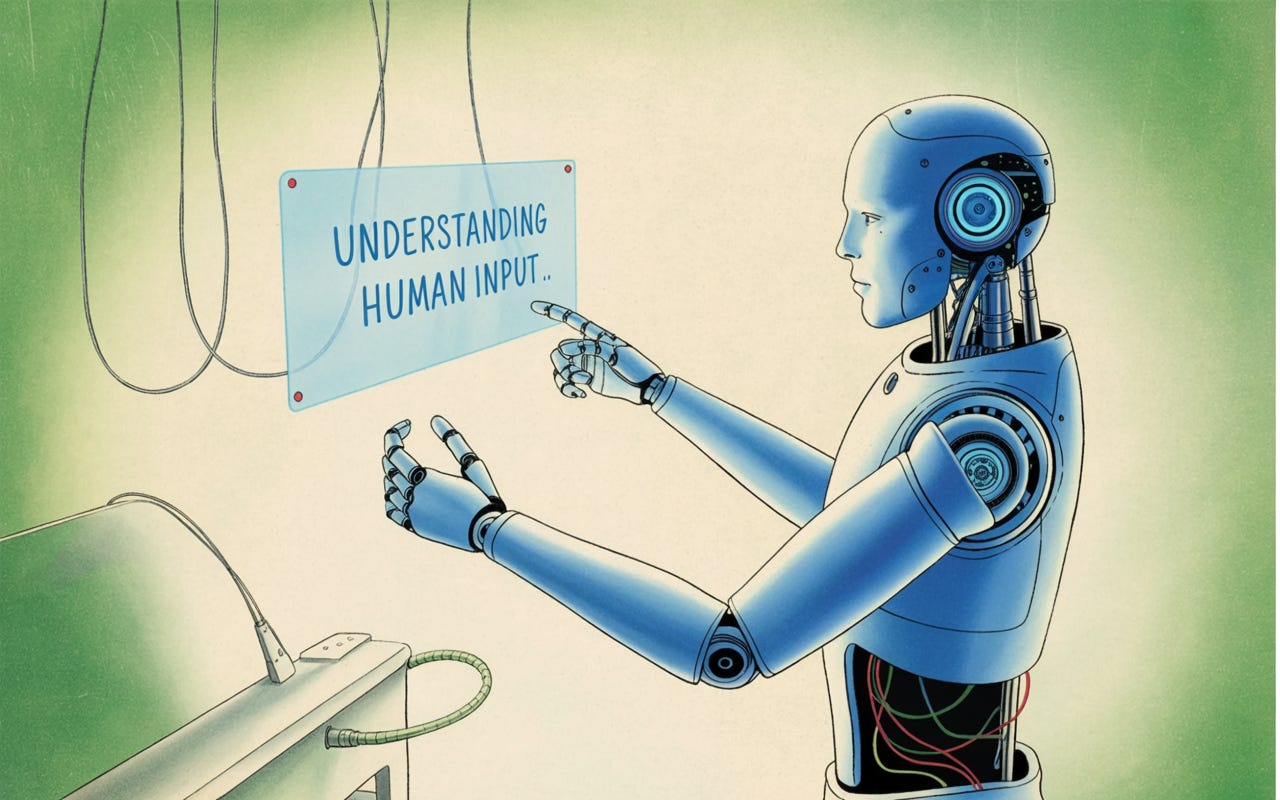
Until recently, most robots have been, essentially, high-precision repetitive motion machines. They were brilliant at welding the same seam ten thousand times but utterly baffled by a stray soda can on the floor.
The landscape is changing, driven not by vague promises of AI but by the concrete arrival of Vision-Language-Action (VLA) models. VLAs do something revolutionary: they let robots see what's in front of them, understand what you're asking in plain English, and act accordingly—all in one unified system. No separate vision module, no rigid programming, no brittle rule sets. Just: “Fold that shirt.” And the robot figures it out.
If robotics is having its 'Netscape moment'—the moment when a technology suddenly becomes accessible and transformative—VLAs are why. They're not just an upgrade. They're a new operating system for physical intelligence.
The Great Translation Problem
To appreciate a VLA, you first have to appreciate the nightmare of robot programming. Historically, if you wanted a robot to pick up a strawberry, you had to code the geometry of the hand, the pressure of the grip, and the exact coordinates of the fruit. If the strawberry moved two inches, the code broke.
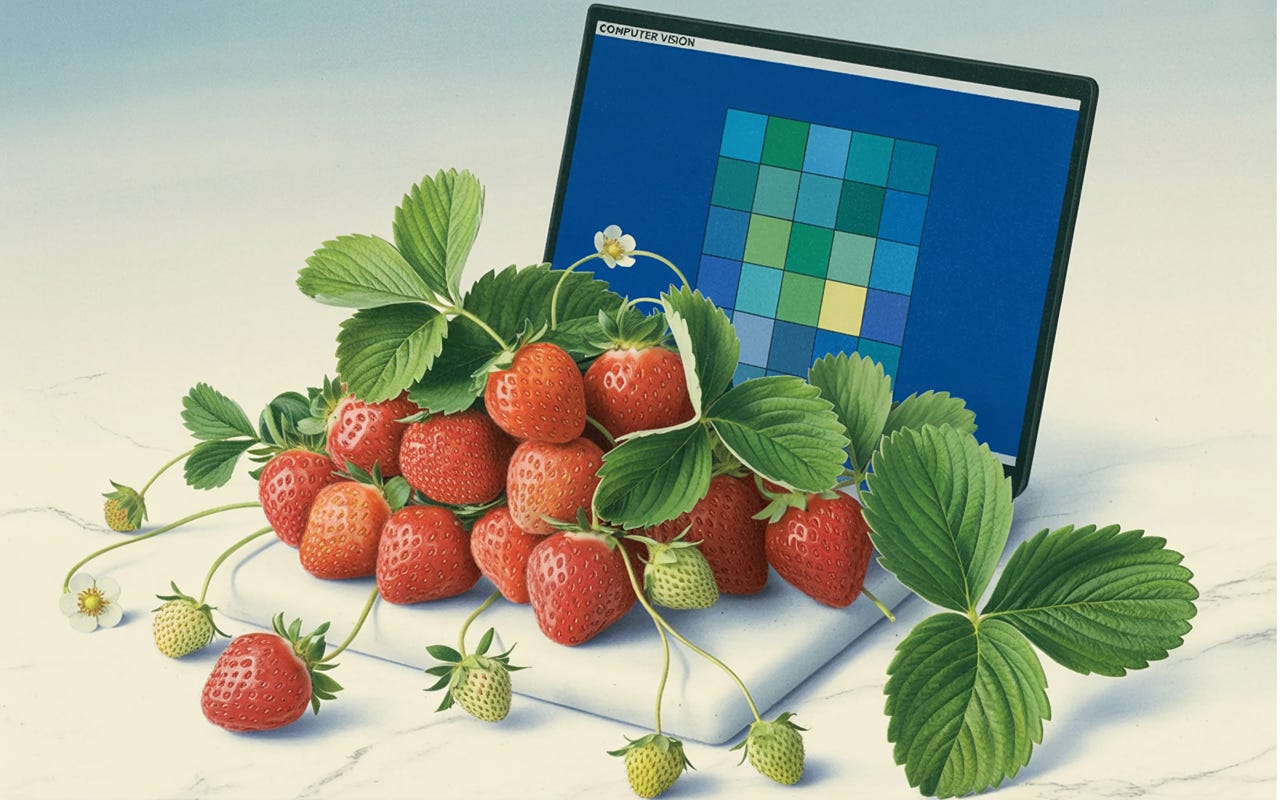
The first breakthrough came with Vision-Language Models (VLMs)—the technology behind GPT-4o and Gemini. Suddenly, robots could look at a strawberry and describe it: “That’s a red fruit on the counter.” But description isn’t action. A massive gap remained between understanding and doing. The VLM could recognize the strawberry, even tell you it’s ripe, but it had no idea how to translate that knowledge into motor commands—how to rotate the wrist 14 degrees, close the gripper with precisely 2 Newtons of force, and lift without crushing. Thinking and acting remained separate systems, duct-taped together.
The VLA is the bridge. It doesn’t just recognize the strawberry; it maps the pixels and the linguistic command (”Pick up the fruit”) directly into robotic tokens. > The Metaphor: If traditional robotics was like following a rigid, pre-printed map, and VLMs were like having a passenger who can read the street signs but can’t drive, then a VLA is a driver who has seen a billion hours of dashcam footage. It perceives, understands, and steers all in one continuous loop.
Why VLAs Are “Cool” (The Technical Mojo)
What gets my curiosity revving is how VLAs solve the generalization problem. In the software world, we take “write once, run anywhere” for granted. In robotics, it’s been “write once, run only on this specific arm in this specific lighting.” VLAs change this because they are trained on massive datasets. They learn the intent of an action rather than the coordinates of a movement.
Semantic Reasoning: You can tell a VLA-equipped robot, “Clean up the spill.” It doesn’t need to be told to find a paper towel. It understands the relationship between “spill” (visual), “clean” (language), and “wipe” (action).
Zero-Shot Learning: This is the magic trick. You can show a VLA a tool it has never seen before—say, a strange ergonomic spatula—and because it understands the “language” of shapes and physics, it can intuit how to use it.
Emergent Common Sense: Because these models are often built on top of Large Language Models (LLMs), they inherit a “world model.” They know that if you ask for a “snack,” a rock is a bad choice, even if no one explicitly programmed “don’t eat rocks” into the motor controller.
In the past, we tried to solve robotics with pure logic. But the world is messy, “lossy,” and unpredictable. VLAs embrace that messiness. They treat the physical world as a series of probabilities, just like an LLM treats the next word in a sentence. When a VLA-powered robot reaches for a glass, it’s “predicting” the next sequence of motor torques based on the visual feedback of the glass’s reflection.

A VLA doesn’t care if it’s controlling a bipedal humanoid or a toaster with a telescopic arm. If it can map pixels and words to motor outputs, it can master the environment.
Why This Matters
For decades, the ghost in the machine was blind and mute. It could execute flawless instructions but had no awareness of the world it inhabited. Vision-Language Models gave it a voice to describe what it saw, but it still couldn’t act on that perception. The hands remained disconnected from the eyes.
Vision-Language-Action models change this entirely. They don’t just put eyes in the machine; they forge a direct connection between seeing, understanding, and doing. The ghost is no longer a separate, disembodied intelligence trapped inside. It is now an embodied agent, learning the physics of its own form and the logic of the world around it. The machine is finally waking up, and with VLA as its guide, the ghost in the machine is finally learning not just to see, but to act.