

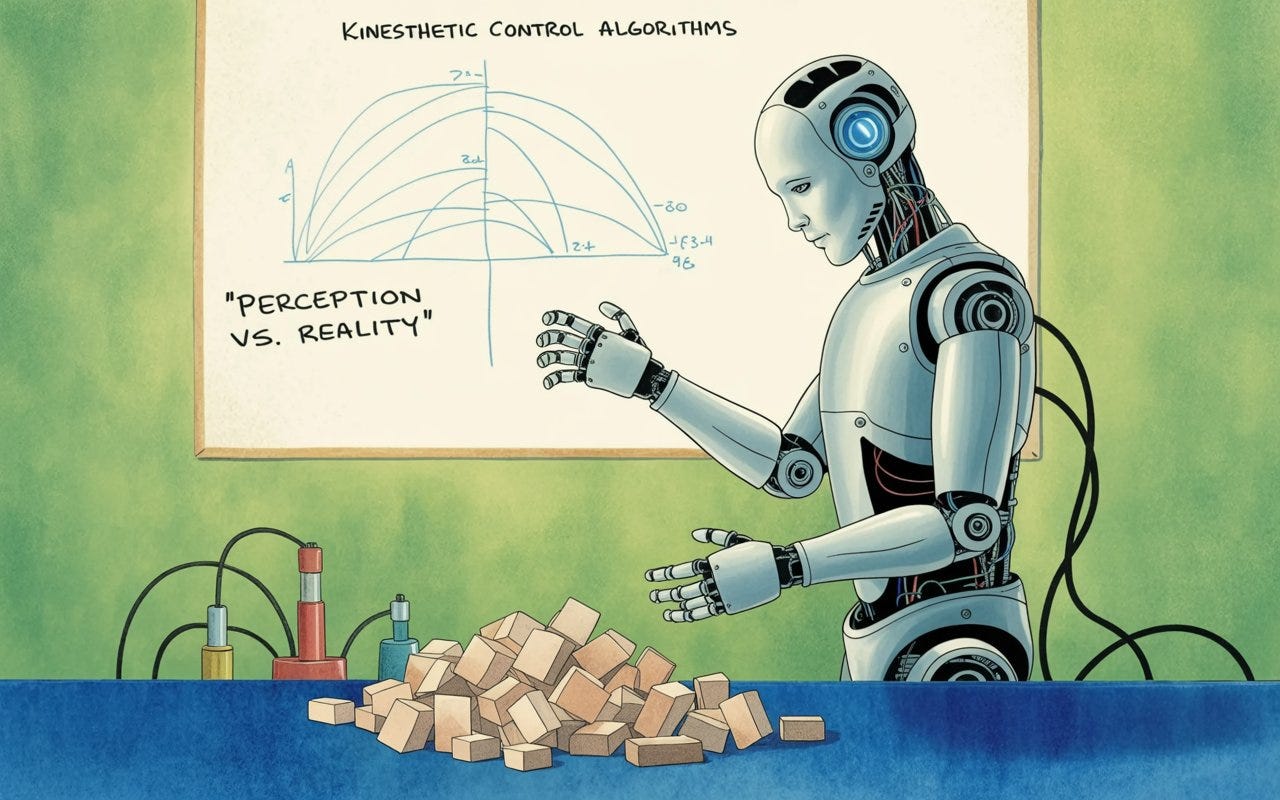
To understand why robots are clumsy, you have to understand the lie we tell computers. Most physics engines (the software that runs simulations) are built on rigid body dynamics. They assume objects are infinitely stiff. They don’t bend, squish, or deform.
This works great for video games. It works terribly for reality.
In the real world, nothing is rigid. When you touch a table, your finger deforms, the table vibrates microscopically, and friction engages in a chaotic dance of molecular interaction. But a simulator sees two indestructible geometric shapes colliding.
In calculus terms, a robot moving through free space is smooth. The math is continuous; you can take derivatives all day long. But the nanosecond it hits a wall, the velocity instantly changes. The forces spike to infinity if the bodies are perfectly rigid. The solver (the math engine) freaks out. It has to make a choice: do I let the objects penetrate each other (unrealistic) or do I apply a massive, artificial force to push them apart (instability)?
The State-Space Explosion: Walking vs. Washing Dishes
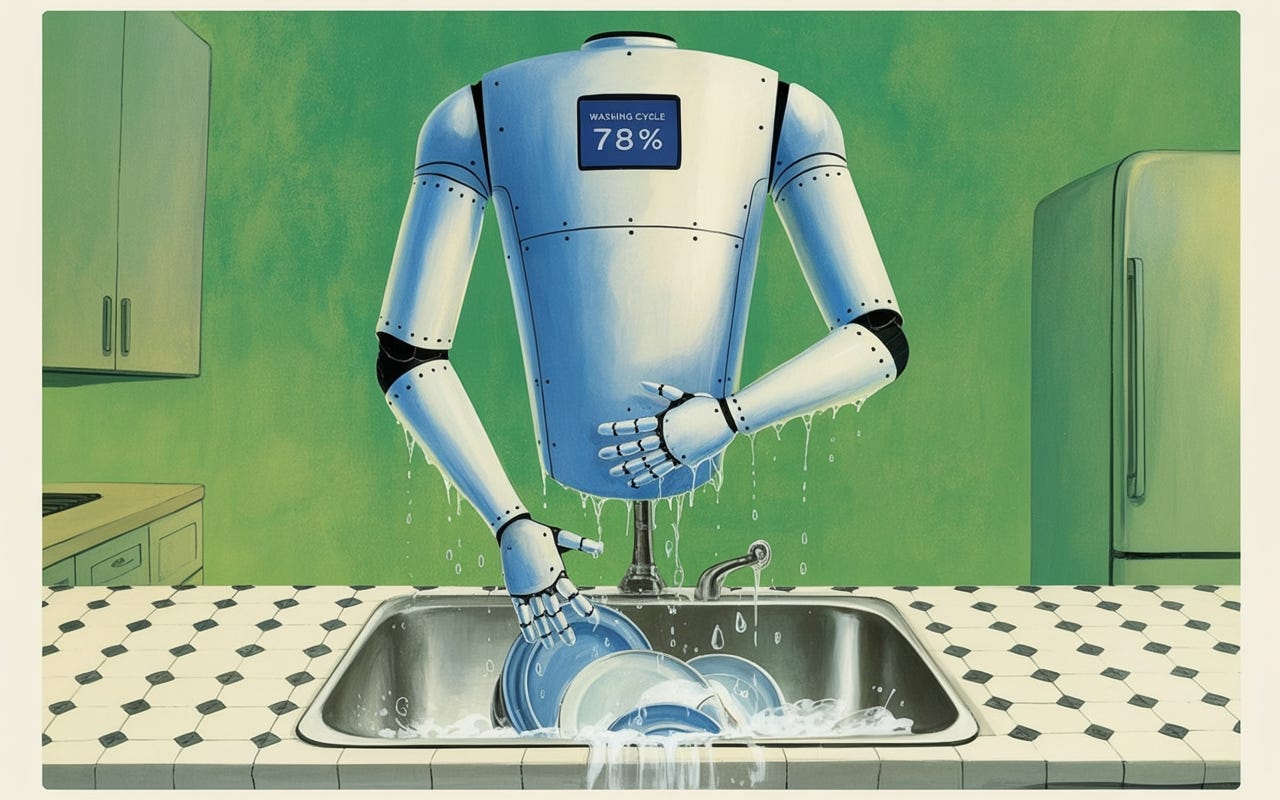
There is a massive difference between moving through the world and moving things within it. Locomotion involves intermittent contact—a rhythmic cycle where a foot hits, pushes, and swings—which allows us to simplify the physics by treating the foot as a single point. Manipulation is far messier. It requires continuous, sliding contact across multiple points simultaneously, transforming a solvable math problem into a chaotic dance of shifting surfaces that a simulator struggles to track.
Think about the act of buttoning a shirt.
To a human, this is muscle memory. To a simulator, it is a catastrophe. You have soft skin (the finger) pushing a flexible, deformable object (the button) through a topological nightmare (the buttonhole) surrounded by fabric that folds, wrinkles, and stretches.
To accurately simulate buttoning a shirt using classical physics, you would need to calculate the position, velocity, and friction of every fiber, the tension on the thread holding the button, and the deformation of the robotic fingertip.
The same applies to chopping an onion. An onion isn’t a rigid sphere; it’s a series of concentric, slippery layers. As the knife enters, layers separate, juices (changing friction) release, and shards fly off.
Trying to track every “shard of a chopped onion” isn’t just hard; it is computationally impossible. We call this the curse of dimensionality. The math doesn’t just scale linearly; it scales exponentially. You would need a supercomputer to simulate the chopping of a single scallion.
The “God Mode” Fallacy

There is a naïve belief that if we just throw enough compute at the problem, we can achieve perfect state estimation. The idea is that a sufficiently powerful robot could know the exact position of every atom it needed to interact with.
But in robotics, latency kills. If your robot takes 10 seconds to calculate the physics of the onion layer before moving the knife, you don’t have a chef; you have a statue.
We are hitting the law of diminishing returns with simulation fidelity. We are trying to solve a physics problem that doesn’t need to be solved. You don’t button your shirt by calculating the vector forces of the cotton fibers. You do it by feeling it.
The Pivot: Embracing the Squishy
So, if we can’t compute our way out of this, what’s the play?
The future of manipulation lies in two concepts that sound counter-intuitive to the “hard” engineering mindset: partial information and soft robotics.
We need to stop trying to be God. We need controllers (the software brains) that are comfortable with ambiguity.
Instead of asking, “What are the exact coordinates of the button?” the controller should ask, “Do I feel resistance? Okay, wiggle until the resistance drops.”
This is proprioception over perception. It’s moving from a visual-heavy dependency (trying to see the shirt state) to a tactile-heavy dependency (feeling the engagement). We need algorithms that are robust to noise, that assume the world is messy, and that optimize for the goal (button is through) rather than the state (thread 452 is at coordinate Z).
Hardware as Software (Soft Robotics)
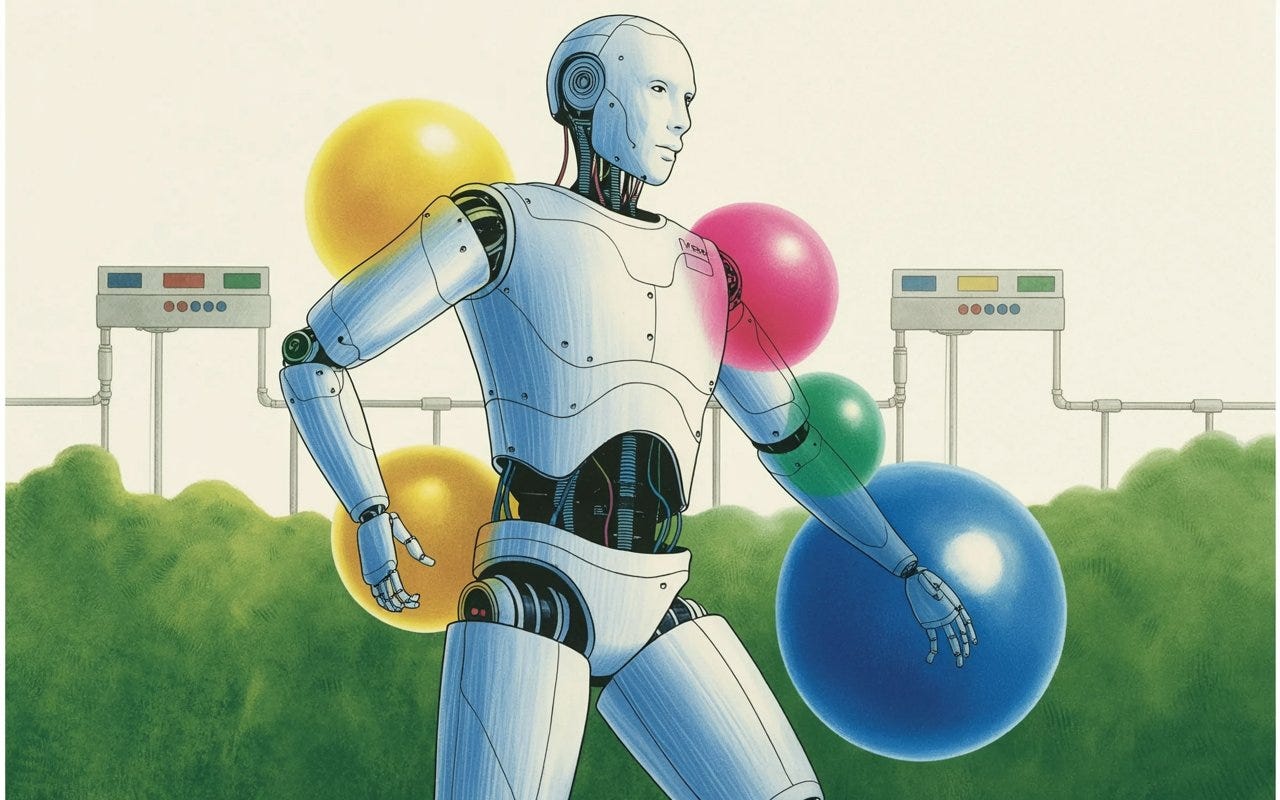
If you build a hand out of rigid metal, your control software must be perfect. If you are off by 1mm, you crush the egg.
But if you build a hand out of soft silicone or pneumatics, the hardware solves the physics problem for you.
When a soft robotic finger grabs a mug, it deforms around the handle. It doesn’t need to calculate the perfect friction vectors for 1,000 contact points. The material simply conforms to the shape, maximizing contact area and friction naturally.
We are outsourcing the computation to the physics of the material.
By using soft actuators and compliant joints, we don’t need to model the contact perfectly because the soft material absorbs the error. The error margin goes from microns to centimeters. Suddenly, the impossible math problem becomes a manageable engineering problem.
Ultimately, curing robotic clumsiness isn’t about building a faster processor; it is about building a softer touch. We have reached the limits of rigid body simulations, and trying to force the chaotic, squishy reality of the world into neat mathematical boxes is a dead end. The future of robotics depends on abandoning the “God Mode” fantasy of perfect calculation and embracing the messy ambiguity of the physical world. By moving from visual planning to tactile feeling, and by outsourcing complex computations to compliant materials, we stop fighting physics and start working with it. The most advanced robot of the future won’t be the one that knows the exact position of every atom but the one that is flexible enough not to care.