

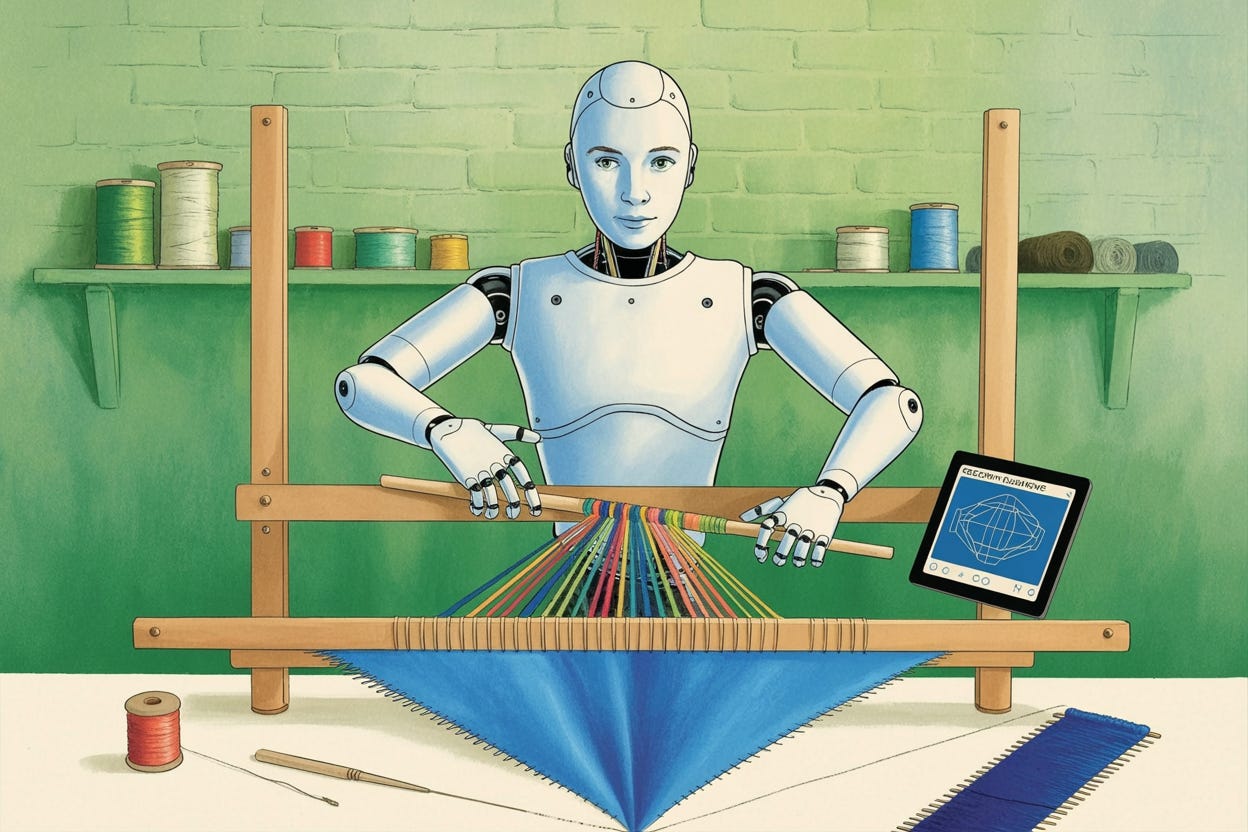
In the early nineteenth century, the English textile counties were ablaze with a specific, violent anxiety. Men with hammers—the Luddites, though they took their name from a spectral, mythical King Ludd—smashed the stocking frames and power looms that threatened to sever their connection to the means of production. They were not, as history has cruelly remembered them, mindless enemies of technology. They were skilled artisans who saw the machinery as a breach of contract, a distortion of the value of human labor. They heard the clatter of the loom and heard the silence of their own futures.
Yet, looking back across the chasm of two centuries, we see the pattern that was invisible to them. The machine did not eliminate the human; it displaced the locus of effort. The weaver who once threw the shuttle by hand became the mechanic who oiled the gears, the engineer who designed the punch cards—those early, stiff squares of cardboard that held the ghost of binary code long before Silicon Valley existed. The Industrial Revolution did not remove humanity from the equation; it elevated the human from the source of power to the source of control.
We stand now at a similar precipice, the air thick with the hum of a different kind of engine. The anxiety is familiar. We fear the robot, the algorithm, the “smart” system that promises to drive our trucks, stock our warehouses, and write our code. The prevailing narrative is one of subtraction: the machine enters, the human leaves. But this view is a misunderstanding of both the nature of machines and the nature of information.
Automation is not a replacement; it is an abstraction layer.
Consider the steam engine. Before Watt, work was biological—the straining of muscle, the burning of calories. The engine abstracted force. It allowed a single human to direct the energy of a thousand horses. Now, the revolution is not in force, but in cognition. We are outsourcing the rote loops of logic, the pattern matching, the repetitive decisions that clog the neural pathways. But just as the steam engine required a governor—a device to regulate its fury—the autonomous fleets and generative engines of today require a new class of governor.
We are drifting toward a workforce not of laborers, but of orchestrators.
The job title “robot operator” sounds pedestrian, almost retro-futuristic, summoning images of men in jumpsuits pushing buttons. But the reality will be far more complex and far more intimate. The operator will be a shepherd of probability. Whether managing a fleet of autonomous logistics drones or guiding a swarm of code-writing agents, the human role becomes one of handling the edge cases—the moments where the clean mathematical model collides with the messy, chaotic reality of the physical world.
We will see the rise of the “fleet manager,” a role that has less to do with logistics and more to do with conducting a symphony. Imagine a single person overseeing a hundred semi-autonomous trucks. They are not driving; the trucks are driving. The human is monitoring the health of the system, intervening only when the pattern breaks, smoothing the turbulence in the flow. They are the Maxwell’s Demon of the highway, sorting the hot data from the cold, maintaining order in a system constantly tending toward chaos.
Furthermore, the programmer does not vanish; the programmer evolves. For decades, coding has been an act of translation, painstakingly converting human intent into the rigid syntax of C++ or Python. It was manual labor of the mind. As AI begins to generate code, the programmer shifts from being a bricklayer to an architect. The task becomes one of verification, of design, of asking the right question. The code is the clay; the human is the sculptor. The “operator” of the code is the one who understands the grand design, the one who can distinguish between a solution that works and an elegant solution.
This shift is not without its friction. The Luddites were right about the pain of transition. The evolution from manual labor to system management requires a retraining of the collective nervous system. It demands a literacy in systems thinking, a comfort with abstraction that our education systems are only just beginning to recognize. We are asking people to stop being the muscle and start being the nervous system.
History suggests that we are not heading toward a world where humans are obsolete, but toward a world where humans are amplified. We are building levers for the mind. The danger is not that the machines will take over, but that we will fail to recognize the new responsibilities they place upon us. We are becoming the pilots of a vessel traveling faster than we can physically run. The controls are in our hands. The machine provides the velocity; the human provides the destination.
The silence the Luddites feared never came. The factory floor just changed its tune—from the rhythmic thud of the loom to the silent, frenetic processing of data. And in the center of it, persistent and necessary, stands the human operator, watching the screens, waiting for the anomaly, the only thing in the loop capable of genuine surprise.