

Let’s go back in time. Imagine a rainy Tuesday morning in October of 1989. An accountant named Arthur sits at his desk at a mid-sized manufacturing firm in Ohio. The room smells of old linoleum and stale coffee. On his desk sits an IBM PC, its cathode-ray tube monitor humming with a faint, high-pitched buzz. But Arthur isn’t looking at the monitor. He is staring at two 3.5-inch floppy disks resting in the palm of his hand.
One disk contained the company’s annual budget spreadsheet, meticulously edited by the sales director in Chicago. The other disk contained the same spreadsheet, but edited by the operations manager in Cleveland. Arthur’s job was simple. He has to merge them. He inserts the first disk, noted the figures, ejected it, and inserts the second. His heart sinks. The columns don’t match. The rows are out of alignment. The totals don’t match.
What does Arthur do? He does what any sensible accountant would do in 1989. He pulls out a yellow legal pad, a sharp pencil and sends the next four hours manually copying numbers from one version to another. He doesn’t just fail to leave work on time. He fails spectacularly. And he fails for a reason that was entirely invisible to him at the time.
We look back at Arthur today and smile at how primitive his world was. But Arthur’s nightmare highlights a fundamental truth about the early decades of the digital revolution. Computers were designed to be islands. They were personal computers, with a heavy, stubborn emphasis on the personal. For a long time, our digital infrastructure was built on a simple, unspoken assumption: one artifact, one human creator, and one isolated moment.
So, how did we get from Arthur’s lonely, frustrated evening to the hyper-connected digital workspaces we inhabit today? And more importantly, what happens when the entity typing next to you in that digital workspace isn’t another human being at all, but an artificial intelligence agent?
For years, software engineers tried to solve Arthur’s problem. The conventional wisdom dictated that if two people wanted to work on the same document, they simply had to take turns. You lock the file, you make your edits, and you pass it on. This was the era of the “Read-Only” warning. It was a digital system that mirrored the physical world. It was safe. It was orderly. And it was agonizingly slow. It wasn’t just a technical limitation; it was a psychological barrier that kept us working in silos.
Then, in the late 2000s, everything changed. A small group of engineers pioneered a concept called Operational Transformation. This was the technological engine that eventually powered Google Docs. Suddenly, the locked file was dead. You could open a web browser and see your colleague’s cursor blinking in real time. You could watch them type a sentence, fix a typo, or delete a paragraph from thousands of miles away. It felt like magic.
Operational Transformation achieved this miracle by acting like a hyper-efficient, invisible air traffic controller. Every time you pressed a key, that stroke was sent as a tiny packet of data to a central server. The server carefully calculated how to insert your letter without disrupting what your colleague was doing at the exact same microsecond. It was beautiful. It was elegant. And it changed everything.
For nearly two decades, we assumed this was the ultimate destination of human collaboration. We believed that once we could type together in a shared browser tab, the problem of digital togetherness was solved.
But there is a problem with that theory.
The world of Operational Transformation was built for humans. And humans, it turns out, are incredibly slow. Even the fastest typist in the world maxes out at around one hundred and fifty words per minute. To a powerful central server, human typing looks like slow-motion film. The server has plenty of time to play air traffic controller because the planes are landing hours apart.
But today, we are entering a radically different era. We are no longer just collaborating with other humans. We are collaborating with autonomous AI agents.
Imagine an AI agent entering a shared document. It doesn’t type character by character. It doesn’t pause to think or sip coffee. It drops five pages of dense, structured text, complete with formatting and code snippets, in a fraction of a second. Now imagine three different AI agents and two human editors all working on the exasameoject simultaneously. One agent is writing code, another is checking for security vulnerabilities, and a third is writing documentation, while the humans are tweaking the design.
Under this kind of velocity, the air traffic controller crashes. The central server chokes on the sheer volume of synchronized edits. Operational Transformation breaks down because it was never designed for a world where the creators can think and write at the speed of light.
To survive in this new reality, computer scientists had to fundamentally rethink how data behaves. They had to abandon the central dictator entirely. They had to invent something called Conflict-free Replicated Data Types or CRDTs.
Consider CRDTs as the quiet hero of the modern internet. Unlike the old systems that required a central server to referee every dispute, CRDTs build the reconciliation logic directly into the data itself. It is a mathematical framework where every single copy of a document can be updated independently, without any coordination. The mathematics guarantee that no matter what order the edits arrive in, or who made them, every single device will eventually automatically merge the changes into the exasameate.
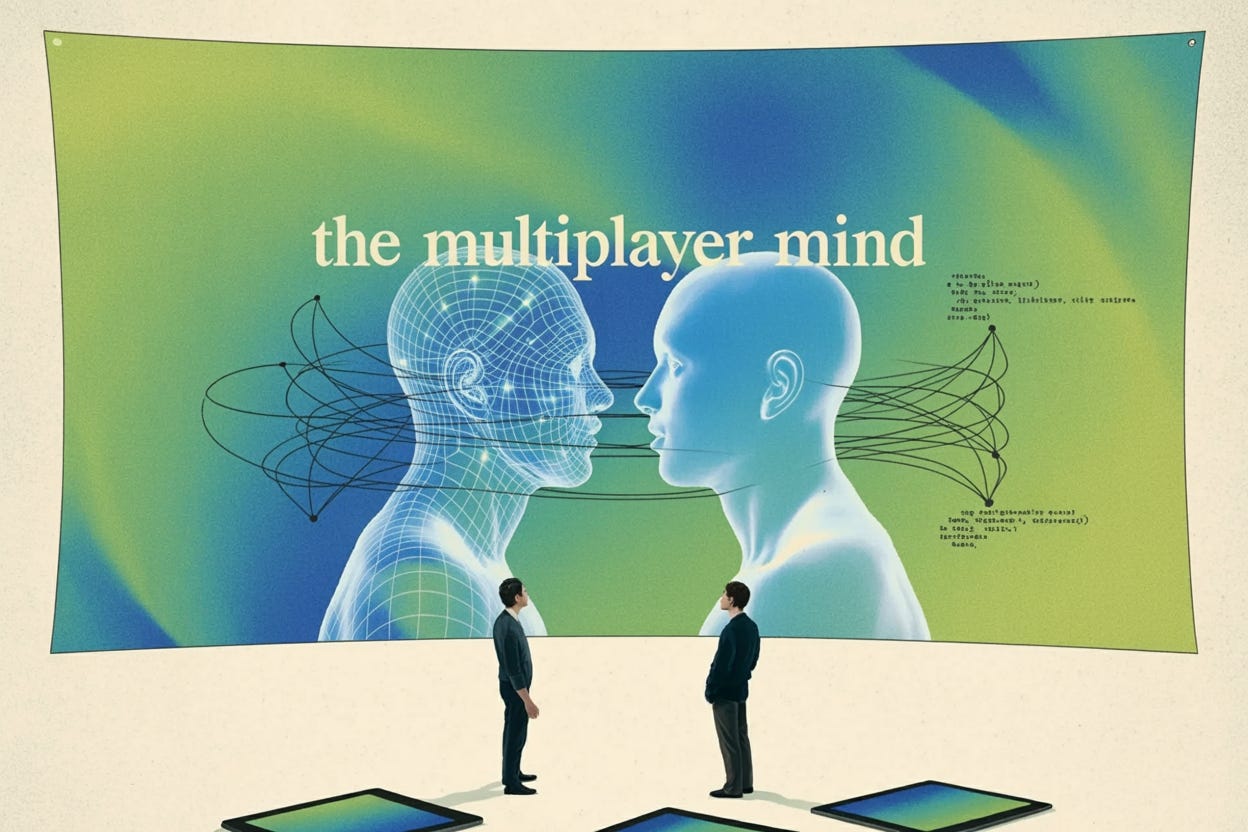
It is collaboration without a referee. It is synchronization without permission. This is the true meaning of “multiplayer” in the modern age. It is no longer about two humans sharing a text file; it is about an entire ecosystem of human intuition and machine intelligence operating on the exact same canvas at the exact same time.
Let us look at a modern software engineer working today. She doesn’t write code in isolation, nor does she just paste prompts into a chat box. She opens a multiplayer canvas. As she begins sketching the outline of an application, an AI security agent immediately starts weaving encryption protocols into the background. Simultaneously, an optimization agent restructures the database queries. They are not waiting for her to finish. They are not taking turns. They are collaborating on the very same artifact in real time, enabled by the conflict-free architecture beneath them.
But here’s where the story takes an unexpected turn. We have solved the technical problem—the mathematics of CRDTs now lets a thousand minds edit the same canvas simultaneously. Yet the real revolution isn’t happening on the screen. It’s happening in the moment when a human engineer pauses mid-keystroke and realizes she doesn’t know where her work ends and the machine’s begins. It’s in that disorienting, exhilarating instant when the boundary between creator and creation blurs entirely.
Arthur, sitting at his desk in 1989, at least knew the problem he faced. His struggle was visible: two floppy disks, two conflicting versions, a decision that only he could make. But what of the engineer working in a real-time collaboration space in 2026, where dozens of agents are reshaping her code even as she thinks about the next line? The problem is no longer isolation. It is coherence. It is meaning. It is the question of what happens when you can no longer trace the lineage of an idea back to its source because the source is distributed across human intuition and machine intelligence, forever entangled. The tools have become teammates. The question now is whether we’ve prepared ourselves to understand what that partnership really means.