

It is Tuesday morning in a downtown high-rise. You rush into the lobby, already late for a meeting. You stride to the elevator bank and press the call button. The circuit registers your request. The button lights up, casting its small, reassuring amber glow.
But the elevator does not arrive.
Ten seconds pass. The doors remain closed. Doubt creeps in. So what do you do?
You press the button again. Then a third time. Then you hammer the plastic disc in a brief fit of impatient repetition, as though the physical force of your urgency might somehow compel the machinery to move faster.
You have done this before. You have pressed crosswalk buttons furiously when the light refused to change. You have mashed refresh when a web page was slow to load. You behave as if your commands are cumulative, as if asking harder or asking louder changes the outcome.
But there is a problem with that theory.
The machinery behind the elevator panel does not care about your panic. It does not summon five cars. It does not descend five times faster. Each frantic press is absorbed into a small existing fact: your call has already been registered. The system may debounce, queue, and schedule in ways more complicated than you can see, but from your side of the panel, the essential truth remains unchanged: you are waiting to go down.
This is not a trivial design quirk. It is the machine’s forgiveness of your neuroses. And as it turns out, this same philosophy is one of the principles keeping our modern, hyper-connected digital world from collapsing into chaos.
The Squabbling Parliament
To build modern digital infrastructure is to wage a perpetual war against disorder.
We have a deeply ingrained mental model of the internet. We gaze into the glass of our screens and perceive a unified, seamless monolith. We imagine a perfect, frictionless cloud that holds our money, our memories, our conversations, and our commerce. We tend to picture it as a pristine highway system, where a command is issued and instantly obeyed.
But that is not what the internet is.
Beneath the surface, behind the cool hum of data centers, reality is closer to a fractured parliament of machines. The space between them is not empty. It is full of delay, loss, congestion, and tiny opportunities for misunderstanding.
When a server in Virginia sends a command to a database in Tokyo, that message is encoded into pulses of light. It is fired across ocean floors. It is routed through switches that can and will fail. It is subjected to the stubborn physical fact that the universe is a noisy place. Wires fray. Power grids blink. Photons scatter into the dark.
This creates a terrifying dilemma. The fundamental problem of a distributed system is a problem of human anxiety translated into logic:
How do you know you have been heard?
In a network, a machine speaks into the void and waits for an echo. It expects an acknowledgment. If that echo does not return, the system faces a crisis. Did the message die on the way there? Or did the message arrive while the acknowledgment died on the way back?
The human instinct, when faced with silence, is to shout again. The machine, programmed in our image, does the same thing. It resends the packet. It repeats the command.
And here, at the edge where order meets disorder, reliability begins to invite disaster.
If the original message survived, the repetition becomes a mutation. Imagine a command to deduct ten dollars from a bank account. It arrives twice. Without some memory of the first request, the account is debited twice. Imagine a command to fire a spacecraft’s thruster. It is executed in duplicate. The spacecraft veers off course. The very mechanism designed to ensure reliability becomes an amplifying feedback loop: a storm of redundant commands tearing the system’s state to shreds.
We built networks to conquer space. We found ourselves defeated by time and uncertainty.
The Ghost in the Algebra
The defense against this turbulence did not emerge from the server farms of the twenty-first century. It came from the quiet, chalk-dusted halls of nineteenth-century mathematics.
In 1870, Benjamin Peirce, a formidable Harvard mathematician, was wandering through the abstract landscapes of algebra. Peirce saw mathematics not merely as a tool for ledgers and measurements but as a kind of cosmic grammar. He was exploring algebras where familiar rules warped and bent, and he needed a vocabulary for operations that behaved strangely.
In work first presented in 1870 and later published as Linear Associative Algebra, Peirce coined a word from Latin roots: idem, meaning “the same,” and potent, meaning “having power.”
The same power.
He called it idempotency.
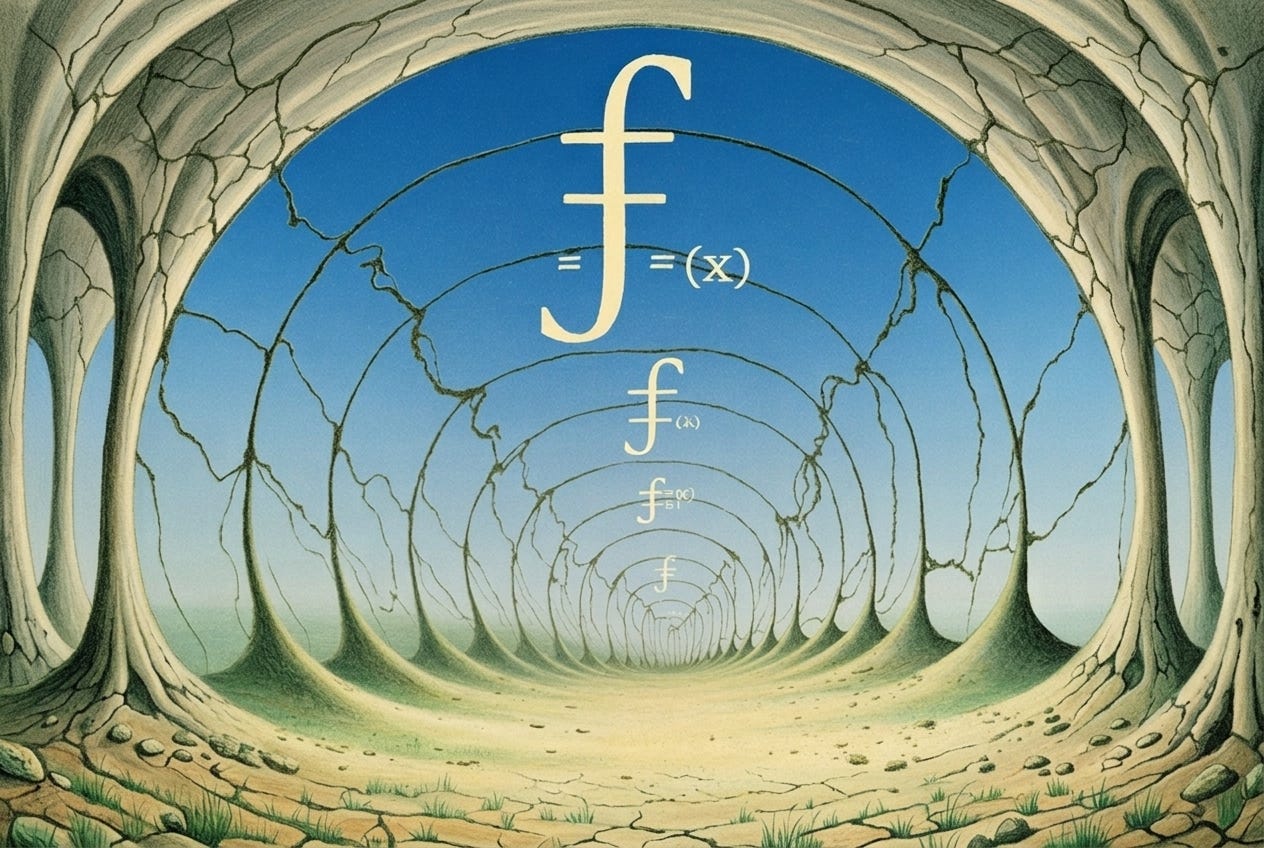
It was a beautiful, esoteric abstraction. Peirce used it to describe an element that remains unchanged when multiplied by itself. In mathematical terms:
It is a number that devours its own reflection and remains perfectly intact. In pure functions, it is expressed as:
You can apply the operation once. You can apply it a thousand times in a frenzied loop. The world of the equation settles into the same state.
For a century, idempotency was a mathematical ghost: elegant, useful, but largely confined to textbooks and abstract structures. It seemed far removed from the physical world.
Then came the great linking of the planet.
As ARPANET blossomed into the internet, and isolated mainframes dissolved into sprawling asynchronous webs, computer scientists ran headlong into the wall of network entropy. The pioneers of distributed systems realized they were no longer dealing with simple logic gates. They were dealing with uncertainty, delay, duplication, and failure. You could not build a reliable whole out of unreliable, stuttering parts without changing the way machines commanded one another.
So they reached back through the decades and dusted off Peirce’s ghost.
Idempotency was resurrected. It was no longer a curiosity of algebra. It became an architectural imperative of the digital age.
The Seawall

To make a system idempotent is to build a shock absorber for the chaos of the network. It requires a philosophical shift in how we write software.
We must move away from blind, relative commands. Instructions like “add ten,” “move left,” or “append this record” are vulnerable to repetition. If they are executed twice, the world changes twice.
Instead, engineers try to craft commands that either describe an absolute end state or carry a memory of their own identity.
Do not merely say:
Deduct ten dollars.
Say, more carefully:
Apply transaction 8F3A once.
Or, where the domain allows it:
The balance is now forty dollars if we are still updating the version of the account we think we are updating.
The difference may look semantic. It is not. It is the difference between a system that shatters under pressure and one that bends.
In modern payment systems, this idea often appears as an idempotency key: a unique marker attached to a request so the system can recognize the same command when it comes back wearing the mask of a retry. The first arrival changes the world. The second, third, and four-hundredth arrivals are not treated as new wishes. They are recognized as echoes of the original wish. The system remembers: this has already happened.
This is idempotency made practical. Not the naive command to subtract again, and not the dangerous blind overwrite of stale state, but a disciplined way of giving repetition no additional power. The noise is nullified. The storm of retries washes over the database like waves breaking against a granite seawall.
Resilient Probability
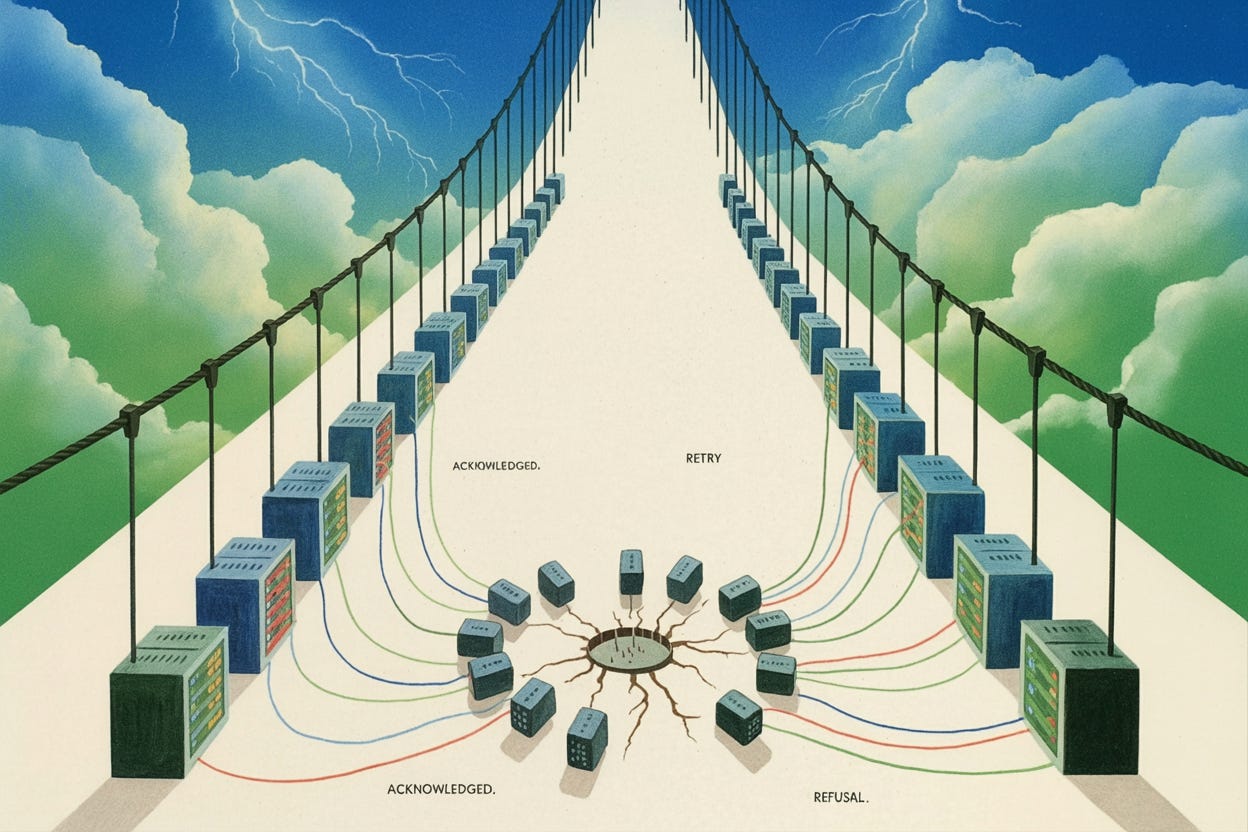
Distributed systems live perpetually on the edge of fracture. They are not perfect machines. They are vast, trembling negotiations among imperfect parts.
The engineers who tame these systems do not do so by pretending failure can be eliminated. They know that trying to enforce perfect order on a noisy universe is a fool’s errand. You cannot guarantee that a message will be delivered exactly once. That is the belief that every command can be transmitted once, received once, understood once, and executed once.
The real world does not grant us that luxury.
Instead, engineers design software that assumes the wires will snap. They accept the messy, stuttering reality of the channel. They build systems that can survive retries, duplicates, silence, and delay. They do not demand that the network become flawless. They make repetition harmless.
This is a profound evolution in the history of engineering. We have moved from brittle certainty, where one wrong command could shatter the machine, to resilient probability, where systems are built to recover, converge, and settle.
One of the clearest modern expressions of this philosophy is the CRDT, the Conflict-free Replicated Data Type: a structure that can be copied across machines, edited independently without coordination, and then merged back into the same state. Its guarantees rest on three mathematical properties, and one of them is Peirce’s own: idempotency. Merging the same change a thousand times has no more effect than merging it once.
The place where most of us now encounter this philosophy is not in a bank vault or a server rack, but in the glowing rectangles where we work together. Open a shared document, a design canvas, a multiplayer spreadsheet, or a chat thread, and you are no longer alone inside the machine. Other cursors move beside yours. Sentences appear while you are still typing. A teammate deletes a paragraph at the same moment you rewrite it. An agent summarizes a section, renames a file, drafts a reply, or rearranges a table while you are still deciding what you meant.
This is no longer a single-user interface. It is a crowded room.
And crowded rooms are disorderly. Humans pause, revise, undo, and contradict themselves. Agents may act faster still, issuing cascades of small edits, sometimes in parallel, sometimes from stale context, sometimes before the rest of the room has caught up. The old fantasy of software as a private conversation between one user and one machine begins to break down. The interface becomes a distributed system. The document becomes a negotiated state.
In that world, the question is no longer merely whether a command was received. It is whether many partially informed actors (human and artificial) can change the same shared object without tearing it apart.
This is where CRDTs become more than an abstract data structure. They offer a way for collaborative software to remain local and immediate without demanding perfect coordination. You type on a plane with no signal. Your colleague edits from another continent. An agent proposes changes in the background. Each replica carries its own version of reality for a while. Later, when the network heals, those realities are merged. If the system is designed correctly, the document does not become a battlefield of contradictions. It converges.
A CRDT does not ask the network to behave perfectly. It does not require every replica to move in lockstep, or every message to arrive exactly once, or every machine to pause while the others catch up. It assumes disagreement will happen. It assumes messages will be delayed, duplicated, and reordered. Then it gives each replica a way to absorb those disruptions and still converge on the same truth.
This is the seawall made concrete. Not merely a single elevator button filtering repeated presses, but whole constellations of machines learning to tolerate repeated histories. In a CRDT, duplication is not a catastrophe. It is just weather.
By weaving the mathematical dreams of a nineteenth-century Harvard professor into the silicon architecture of the twenty-first century, we have taught our machines to weather their own internal storms.
We no longer try to shout down the noise of the universe.
We simply structure our commands so that the noise no longer matters.
Order is not imposed on chaos. It is coaxed out of it.