

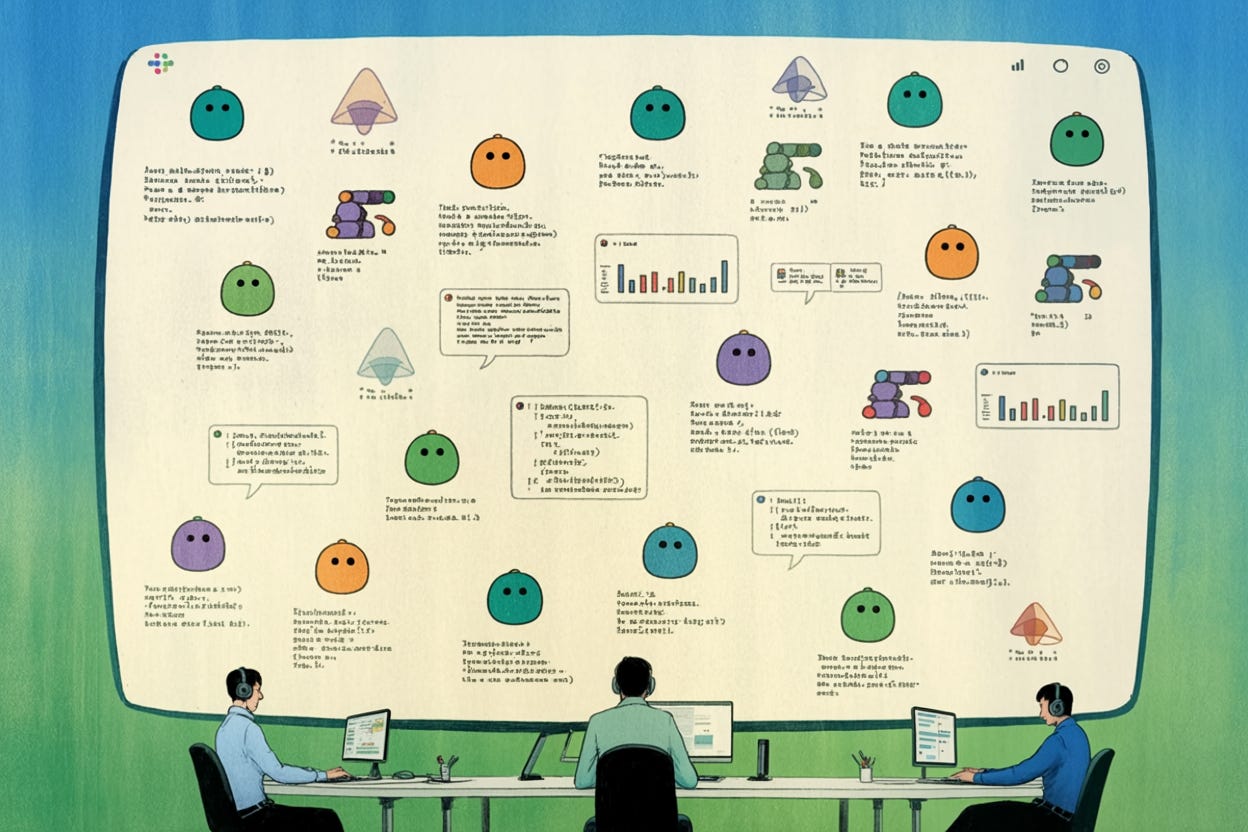
For millennia, the architecture of human coordination was bounded by the limits of biology: the carrying capacity of a messenger’s lungs, the endurance of a horse, the optical clarity of a smoke signal drifting across a ridge. When the written memo arrived, it was a technology designed to conquer time, freezing human thought on paper so it could be transported across space. For centuries, the nature of collaboration remained unchanged in its essence: it was a dialogue between minds, a conscious effort to align multiple human wills toward a single, collective output.
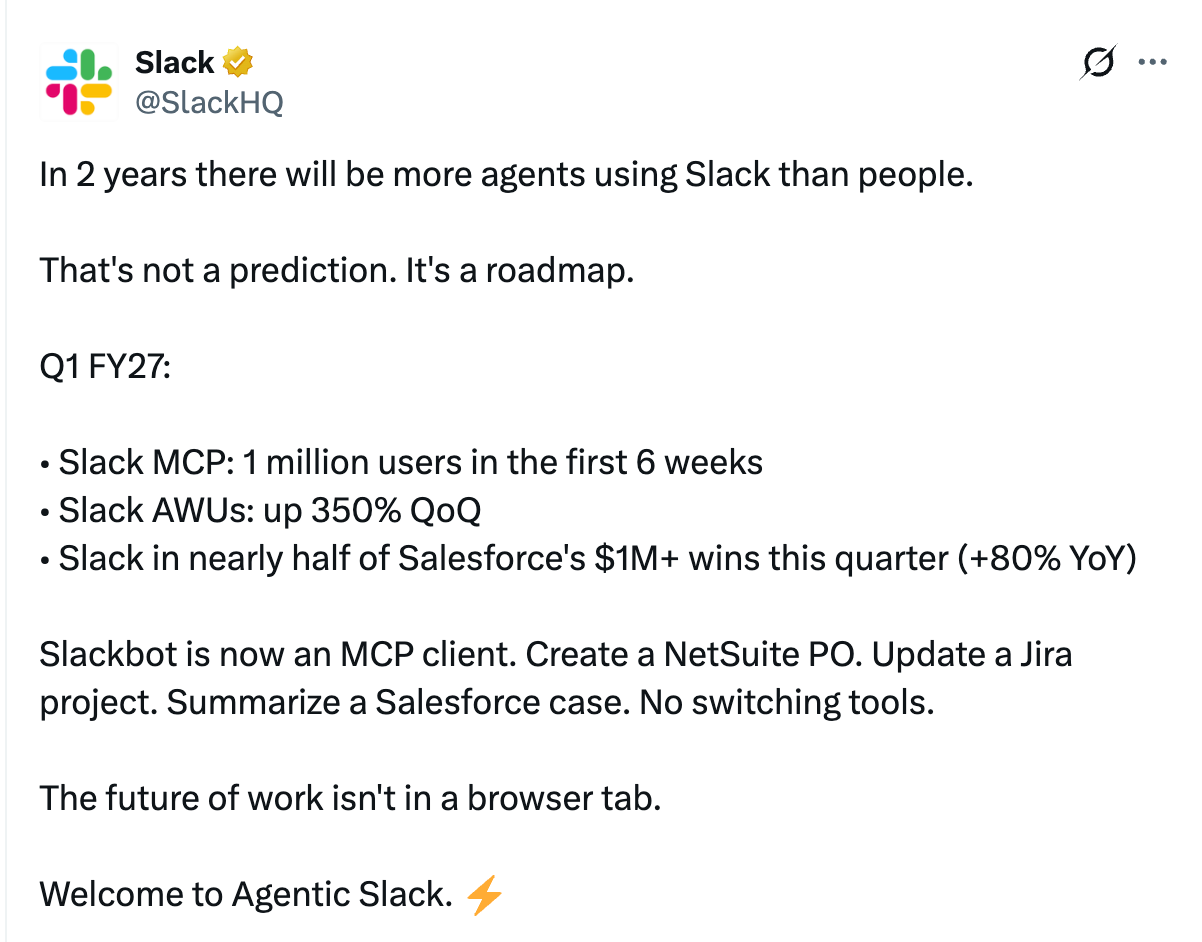
Now, that ancient architecture is fracturing. Slack, the digital campfire around which modern corporate enterprise gathers, recently issued a tweet that reads less like a routine corporate roadmap and more like an ecological tipping point. By next year, the company projects, more autonomous digital agents will inhabit its channels than human beings. The digital ether is undergoing a demographic shift. The spaces we built for human conversation—spaces defined by the rhythms of typing, reading, pausing, and misinterpreting—are being occupied by a new class of entity.
This is not merely a story of software updates; it is the genealogy of a mutation. For the past decade, automation in the workplace existed at the margins. We called them “bots”—crude, deterministic homunculi bolted onto the periphery of human interfaces. A bot was an appliance. It waited for a specific command, fetched a static piece of data from a database, and dropped it into a channel with the clunky clatter of an automated vending machine. It was a guest in a human home, speaking a simplified dialect of our language.
But the upstarts of the current era, companies like Ando, are operating on a different premise. They are constructing collaboration platforms from first principles, designed from the bedrock up for a world where humans and autonomous agents work side by side as peers. In this new paradigm, the agent is not a tool; it is a colleague. It is a first-class citizen of the workspace, possessing its own memory, its own agency, and its own capacity to interpret ambiguity. The collaboration layer of civilization is being rebuilt to accommodate an intelligence that does not breathe.
This reconstruction, however, has run headlong into a boundary wall. It has surfaced a ferocious class of distributed-systems problems that the human-collaboration architecture never had to solve, and that the new architectures are not yet equipped to handle on their own. We are witnessing a collision between two separate lineages of human thought: the messy, lossy, self-correcting world of human linguistics and the rigid, unforgiving world of distributed computational state.
To understand the friction at this boundary, one must look at how humans collaborate. Human communication is fundamentally asynchronous and profoundly tolerant of disorder. When a manager posts a directive into a channel, the message does not arrive with absolute chronological certainty across every node in the network. One employee reads it immediately; another reads it three hours later over coffee; a third misunderstands it entirely until a follow-up conversation corrects the trajectory.
Human networks handle this latency through a profound evolutionary miracle: shared context and empathy. We read between the lines. We tolerate the “noise” in the channel because our brains are master compressors of ambiguity, constantly running internal simulations of what our peers mean. If two humans give conflicting orders, we do not lock up or crash; we negotiate, we prioritize, we employ intuition. The human collaboration layer is fluid, viscous, and self-healing.
Machines enjoy none of these luxuries. When you elevate autonomous agents to first-class users, the collaboration platform ceases to be a passive stream of text and becomes a highly complex distributed system.
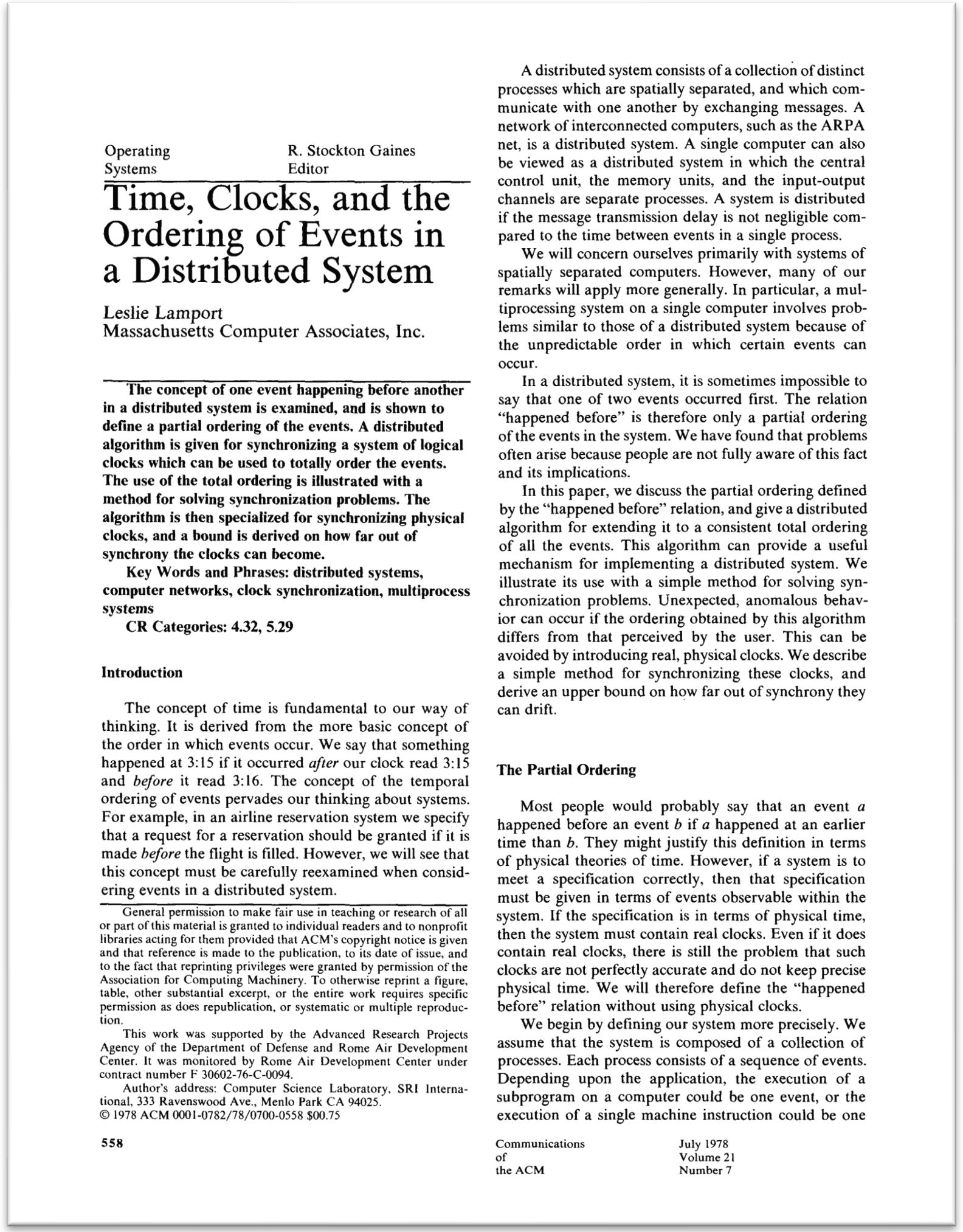
The computer science lineage for this problem is old and deep. In 1978, Leslie Lamport’s “Time, Clocks, and the Ordering of Events in a Distributed System” showed that the idea of one event happening before another defines only a partial ordering in distributed systems and that logical-clock mechanisms are needed to impose useful order. Later consensus work, including Paxos and Raft, addressed how distributed systems can agree on state; Byzantine fault-tolerance work addressed the harder case where components may send conflicting information to different parts of the system.
When humans use Slack, the ordering of messages matters for comprehension, but a slight delay or an out-of-order sequence rarely causes a systemic collapse. If an agent, however, reads a sequence of messages out of order, the consequences are deterministic and catastrophic. Imagine an agent tasked with managing an inventory system or executing financial transactions based on a collaborative stream. If it processes a “Cancel Order” message before the “Approve Order” message due to a network hiccup, the system’s state becomes corrupted.
This is the problem of consensus—the challenge of getting independent, autonomous nodes to agree on a single version of reality across a fractured network. For decades, computer scientists solved this with rigorous mathematical protocols: Paxos, Raft, and Byzantine Fault Tolerance. These algorithms are the steel beams of modern cloud infrastructure, designed to enforce absolute consistency through strict, deterministic logic.
But the new breed of autonomous agents does not run on deterministic logic. They are built on LLMs—probabilistic engines that dream in statistical vectors. They do not operate in the binary domain of absolute truth; they operate in the fluid world of likelihood.
Herein lies the paradox of the new collaboration layer: we are trying to build a distributed system using inherently non-deterministic nodes. When an agent reads a collaborative stream, it does not just parse a data packet; it interprets language. If the platform’s architecture does not guarantee perfect state synchronization, two different agents reading the same channel might arrive at wildly different interpretations of their instructions, not because of a network error, but because the subtle variation in the arrival time of a message changed the context of their prompt.
The old architectures are failing because they were designed to display information to human eyes, leaving the work of synchronization to human brains. The new architectures, despite their first-principles ambitions, are realizing that you cannot simply treat an LLM agent like a very fast human. A human knows when they do not know; a human seeks clarification when the signal becomes noisy. An agent, operating at the speed of silicon, can propagate an error across a dozen systems before a human can even blink.
We are entering an era of unprecedented computational turbulence. It is the edge where order meets disorder, where the mathematical precision of distributed systems theory collides with the chaotic, shifting sands of natural language processing. If an agent executes an action based on a misunderstood message, who corrects the ledger? If three agents enter an infinite loop of misunderstanding each other’s automated summaries, the system experiences a new kind of digital cascade, a thermodynamic decay where useful work is swallowed by statistical noise.
The engineers building the platforms of tomorrow are discovering that the true challenge of the agent era is not making the agents smarter. The challenge is building a container that can hold them without bursting. It requires a new kind of middleware, an architecture that can translate the fuzzy, probabilistic outputs of artificial intelligence into the immutable, serialized transactions required by distributed ledgers, all while maintaining a surface that humans can still comprehend.
We look at our screens and see a quiet stream of text, a peaceful river of bits. But beneath that surface, a demographic explosion is occurring. The digital spaces we carved out for our own thoughts are being populated by entities born of our own ingenuity, yet alien in their logic. We are no longer just writing tools to help us work; we are constructing a digital habitat. And as the population of that habitat shifts from carbon to silicon, the very rules of how ideas are transmitted, verified, and acted upon are being rewritten in the dark.