

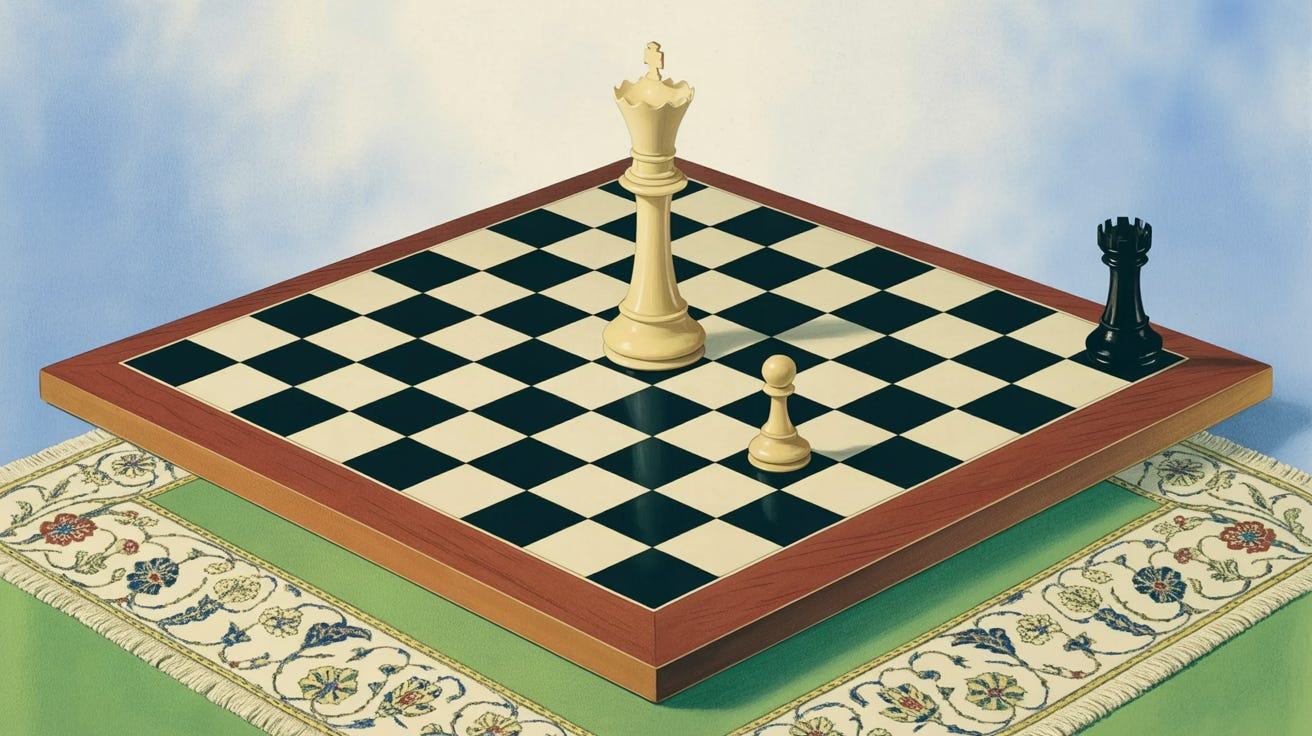
There is a moment, familiar to anyone who has ever leaned too far forward over a chessboard or a crossword, or hung on the lip of an unanswered question, when the mind stops being a passive instrument and becomes a hungry one.
We have words for this condition, and most of them are too small. We call it curiosity, as though it were a single thing, a property of cats and children, a tic of temperament. But the particular curiosity that drives a person to learn, epistemic curiosity, is not a property at all. It is a mechanism.
The gap
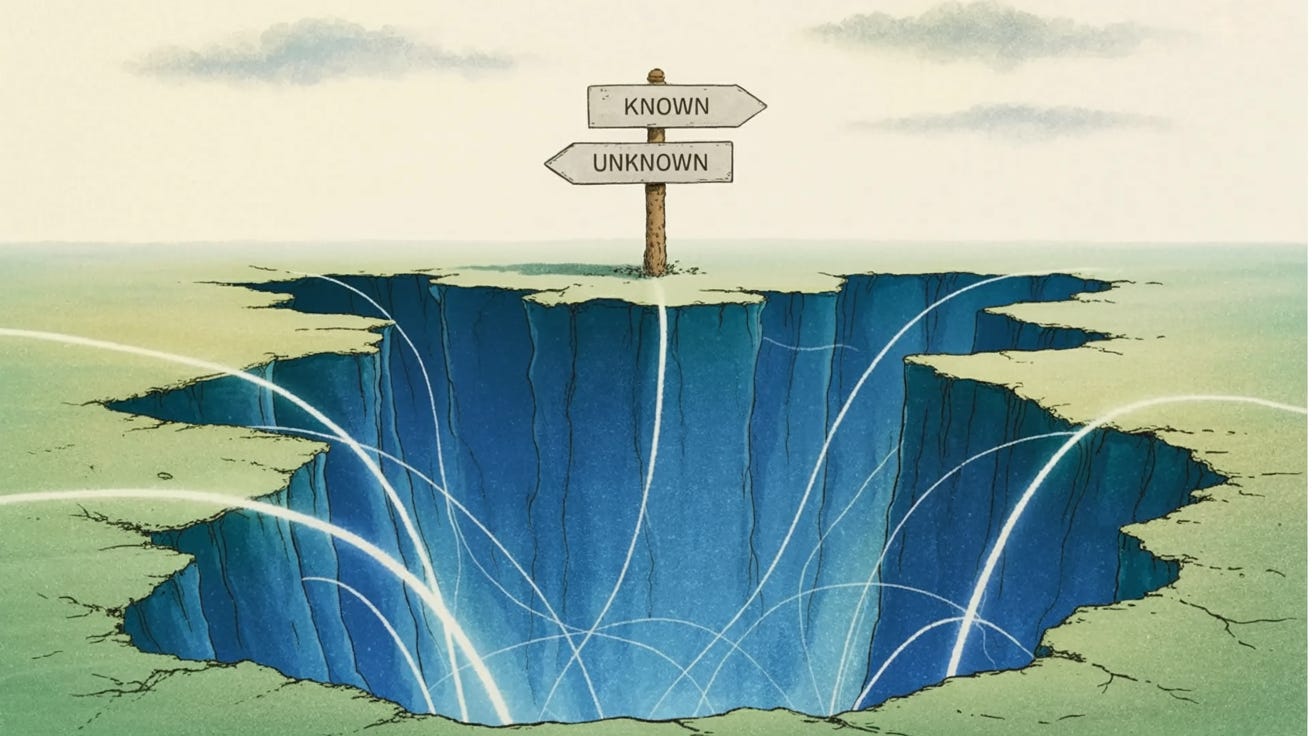
Consider what such a mechanism would have to do. It would have to make ignorance unbearable and discovery delicious. It would have to produce, in the gap between not-knowing and knowing, a tension acute enough to move a body across a savanna or a mind across a proof.
The psychologist George Loewenstein, circling the problem in the early 1990s, gave that gap a name almost too modest for what it described: the information gap. Curiosity, he proposed, is what we feel when we become aware of a hole in our own understanding, when we can see the edges of what we do not know clearly enough to feel their absence. The gap is the wound. Closing it is the relief.
The channel
The Hungarian psychologist Mihály Csíkszentmihályi spent decades studying the state he called flow, that condition of total absorption in which the self dissolves and time warps, and he found it in painters and surgeons and rock climbers, but he found it most reliably, most reproducibly, in play. Flow lives, he discovered, in a narrow channel between two cliffs. On one side: anxiety, where the challenge outstrips the skill and the mind floods with panic. On the other: boredom, where the skill outstrips the challenge and the mind, starved of tension, wanders off. Between them runs a thin bright river. A good game keeps you in the river.
This is not a metaphor borrowed loosely. It is the same channel Loewenstein found. Too large an information gap-the proof you cannot begin to parse, the language whose alphabet you cannot read-produces not curiosity but despair. The wound is too deep; you close the book. Too small a gap-the fact you already half-know, the trivia you can guess-produces nothing at all, no itch, no hunt. Curiosity, like flow, like a well-tuned game, lives in the middle distance. It requires that you know enough to know what you are missing and not so much that the missing piece arrives unbidden. The sweet spot is a place of structured incompleteness.
The curiosity engine
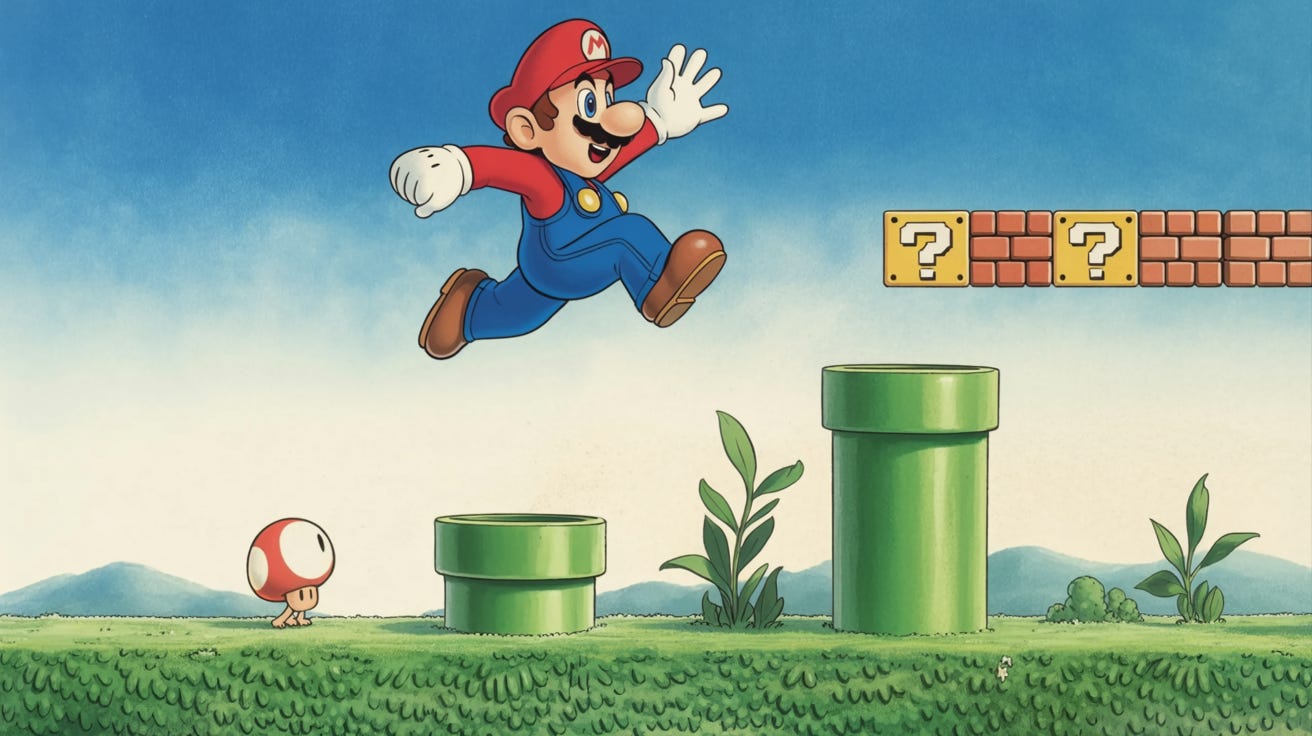
A game designer in the modern sense is in the business of manufacturing information gaps.
The great game designers understand this intuitively, the way Newton understood gravity before he could write it down. Shigeru Miyamoto, building the first Mario worlds in the cramped offices of Nintendo, applied with a craftsman’s certainty a principle he never fully formalized: the first encounter with any new danger should be survivable, even instructive. The first enemy in Super Mario Bros.—the small brown mushroom that shuffles toward you—arrives where you have room to see it coming, to fail, and to learn the lesson cheaply. He was managing the gap, making ignorance safe enough to be interesting. Without the vocabulary, he was building a curiosity engine: calibrating the distance between what the player knew and what the player needed to know so precisely that learning felt not like instruction but like discovery—which is to say, like delight.
The currency of surprise
What is delight in this machinery? Here we must descend into the wet chemistry of the thing, into the midbrain, where a cluster of neurons traffics in a molecule called dopamine. For a long time the textbooks called dopamine the pleasure chemical, and the textbooks were wrong—or at least imprecise in a way that obscured the whole story. Dopamine is not the chemistry of reward. It is the chemistry of anticipated reward, and more exactly of the error in that anticipation. The neuroscientist Wolfram Schultz, recording from the brains of monkeys waiting for a drop of juice, found that the dopamine neurons did not fire when the juice arrived, if the juice was expected. They fired at the cue. They fired at the prediction. When the reward came better than predicted they blazed; when it failed to come they fell silent, sulking, in a measurable dip below baseline. Dopamine, it turned out, is the currency of surprise. It is the signal that says: the world just became more interesting than you thought it would be. Update accordingly.
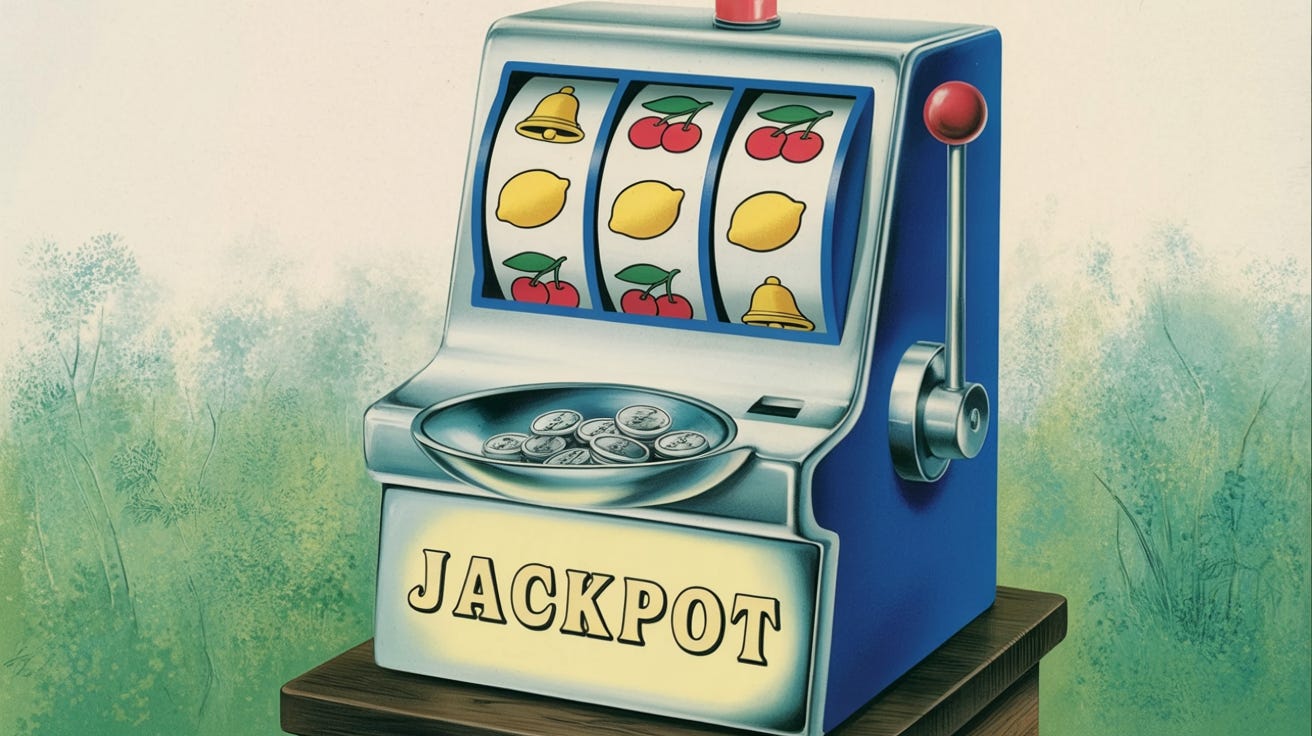
A slot machine is the crude exploitation of this circuit. It is a surprise stripped of meaning, a reward schedule engineered to keep the neurons guessing while the wallet empties. But a good game, and here is the moral center of the comparison, turns the same circuit toward the opposite end. It makes the surprise informative. Every well-designed level teaches a rule, then bends it, then breaks it in a way that reveals a deeper rule beneath. The dopamine fires not at random payouts but at genuine insight, at the click of a system suddenly understood. The player is not being looted. The player is being taught to love learning, one prediction error at a time. And this, precisely this, is what epistemic curiosity is: a dopaminergic appetite not for sugar or sex or safety but for the reduction of uncertainty, for the closing of the gap, for the moment when noise resolves into signal and the world clicks one notch closer into focus.
Explore or exploit
The deep history here runs further back than Nintendo, further back than Loewenstein, all the way to the problem every nervous system has always faced.
An organism in a world of incomplete information must solve an impossible optimization, and it’s the same one that haunts every gambler and every scientist and every game: explore or exploit? Take the known reward, or risk the unknown for something better? Stay in the cave or cross the ridge?
Pure exploitation is starvation in a changing world; the berry patch runs dry. Pure exploration is death by a thousand novelties; you never eat the berry you found. Curiosity is evolution’s answer to the dilemma—a thumb on the scale that makes the unknown intrinsically rewarding, so the animal gathers information it cannot yet use, against the day it will. Curiosity is the brain paying itself to gamble.
A game is a controlled habitat for that gamble. It is a place where exploration has been made safe, where death is reversible, where the ridge can be crossed a hundred times, where the cost of a wrong prediction is nothing but the small bright sting of the error and the invitation to try again. This is why play exists at all, across species: the otter sliding down the same mud bank, the kitten stalking the leaf. Play is the rehearsal of curiosity in a consequence-free arena, the organism running its exploration engine in a sandbox, tuning the machinery of wanting-to-know before the stakes turn real.
The same machine, twice
And so the comparison collapses into an identity. The mechanics of a good game are not like the mechanics of curiosity. They are the same mechanics, discovered twice, once by evolution, working in the dark on the architecture of the mind, and once by the designers, working in the light on the architecture of fun, each arriving at the identical truth. Set the challenge just beyond the skill. Make the gap visible but crossable. Reward the prediction error, not the payout. Keep the player, the curious animal, forever in that thin bright channel between the cliff of despair and the swamp of boredom, where the next thing to learn is always just barely out of reach.
The crossword setter knows it. The teacher who withholds the answer one beat too long knows it. The child who asks why and why and why again, climbing the staircase of her own ignorance, knows it best of all, though she could not say so. She is playing the oldest game there is. The board is the world. The information gap is the move. And the wanting-to-know—that restless, dopaminergic, ancient hunger—is the engine that will not let her stop until the whole bright incomplete map of things has been, square by square, turned over.