

In the winter of 1898, a man named Edwin Seibels was losing his mind.
Seibels was an insurance agent operating out of Columbia, South Carolina. His job, theoretically, was to assess risk. His actual job, however, was managing paper. In the late nineteenth century, businesses stored documents by folding them like accordions and stuffing them into tiny, cramped wooden pigeonholes. It was tedious. It was inefficient. And it was a catastrophe for human memory. If you wanted to find a specific policy, you had to remember exactly which hole you shoved it into. The building was overflowing. The clerks were exhausted.
Seibels realized something profound. The crisis of the modern office was not a lack of information. It was a crisis of geography.
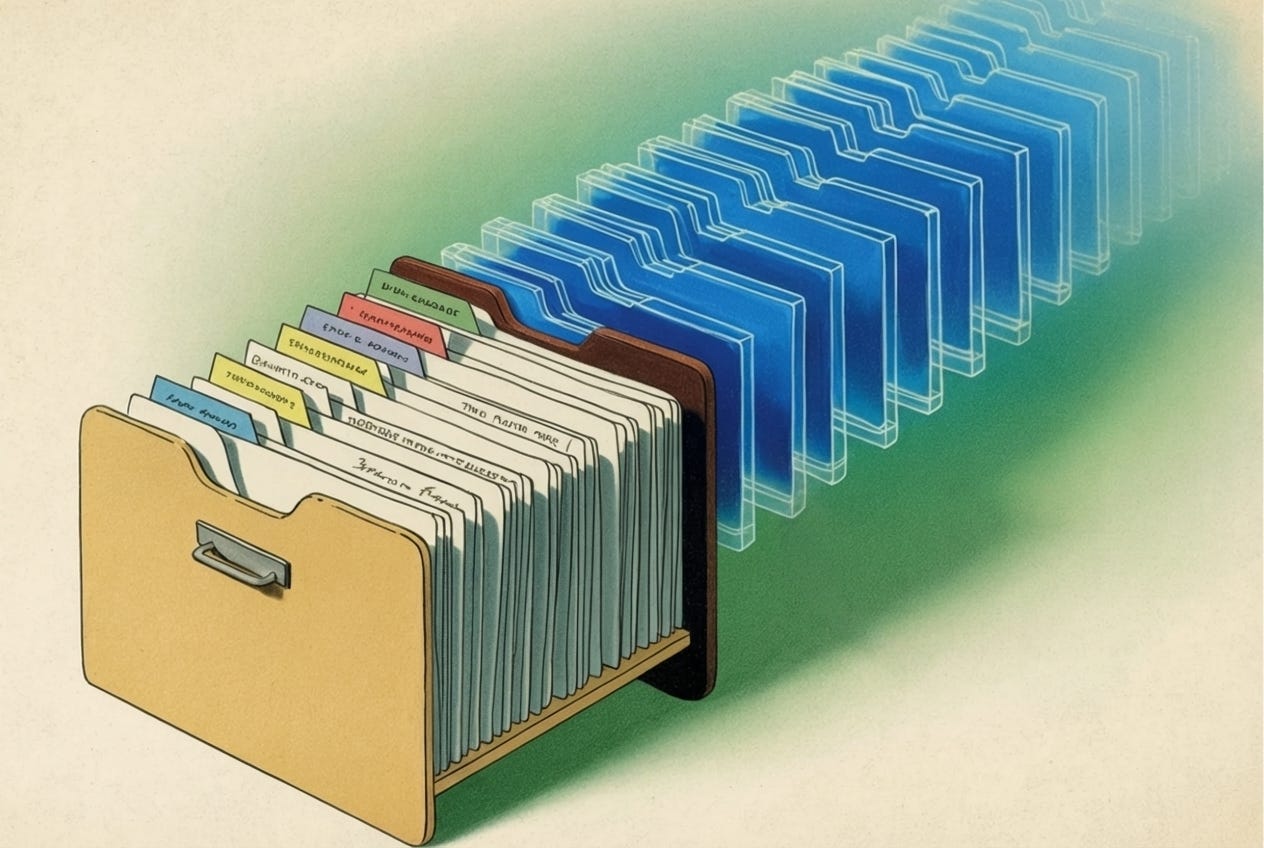
So, he did something radical. He took the papers, laid them flat in folders, and stood them upright in a large drawer.
He invented the vertical filing cabinet. It seems completely obvious to us now. But it was a revolution. Seibels did not invent a new kind of paper. He did not invent a new way to write. He simply invented a place for things to go.
Every major technological revolution produces a glut of new material that has nowhere to live. The spreadsheet revolution gave everyone the ability to model and calculate, and those brilliant models promptly vanished onto local hard drives in folders nobody could locate. The web gave everyone the ability to publish, and those pages withered on unmaintained servers. Software-as-a-service gave us incredible cloud applications, and our data became trapped in fifty different, irreconcilable silos.
And now, artificial intelligence is doing it again. Except it is happening faster, and it is happening to everyone.
We talk endlessly about AI capabilities. We talk about context windows, processing speeds, and the sheer magic of prompting. We assume that the most powerful tool is the one that can build the most complex things. We think the hard part is the creation.
But there is a problem with that theory.
The tool appears. It works beautifully. A marketing manager describes a campaign tracker and suddenly has one. A sales lead asks for a pipeline dashboard and it materializes. But then we are faced with the exact same question that haunted Edwin Seibels.
Where does this go?
The true value of a tool is determined not by its inherent capability but by its physical and digital relationship to the people using it. This is the architecture of proximity and, when a tool lacks it, it becomes an orphaned artifact.
An orphaned artifact might be a brilliant piece of software. It might solve a very real, very painful problem. But if it does not live somewhere your team naturally goes, it is useless. If it lacks the surrounding context that explains why it exists, it becomes a burden. If the next person who needs to modify it cannot find it, it might as well not exist.
This is the part we always miss about the history of technology. Excel did not win because it was the best spreadsheet ever designed. It won, in part, because it lived in a file system people already understood. Google Docs did not win because it was vastly superior to Microsoft Word. It won, in part, because it solved the version control problem by making the URL the absolute destination. Figma did not win because it was the ultimate design tool. It won, in part, because the design lived directly in the browser.
They won because they provided a home.
Today, AI-built tools do not have a home. They land in a chat window, existing only as code blocks in a conversation that will eventually scroll away into oblivion. They sit on standalone platforms, stranded at random web addresses. They are buildings with no streets. They are cities with no maps. They are classic Orphaned Artifacts.
So, why do we accept this? And more importantly, how do we fix it?
A true place must possess three specific traits. First, your team must already go there. It cannot require a new bookmark or a new daily habit. Second, it must have neighbors. A budget dashboard is only useful if it lives right next to the budget analysis document. Proximity creates meaning. Third, it must be alive. When the team’s needs shift, the tool must be able to change in place, with full context.
This is the fundamental argument for a deeply integrated digital workspace. It is not a clever new product category. It is a direct answer to the oldest problem in computing. It is a philosophy of place. The things you build, the things you write, and the things AI generates for you must go into one unified ecosystem. They must live next to each other. They must explain themselves. Your team must be able to actually find them.
We are currently creating at a speed that would have absolutely terrified Edwin Seibels. We are conjuring software out of thin air. We are building entire operational systems in seconds. But the magic of creation means very little if we lose what we create the second we look away.
In a world where AI gives everyone the power to build anything, the scarce resource is no longer capability. It is geography. If we can just understand this hidden mechanism of organization, if we can finally give our digital creations a proper home, we might stop endlessly searching for the tools we have already built. We might, at last, just get to work.