

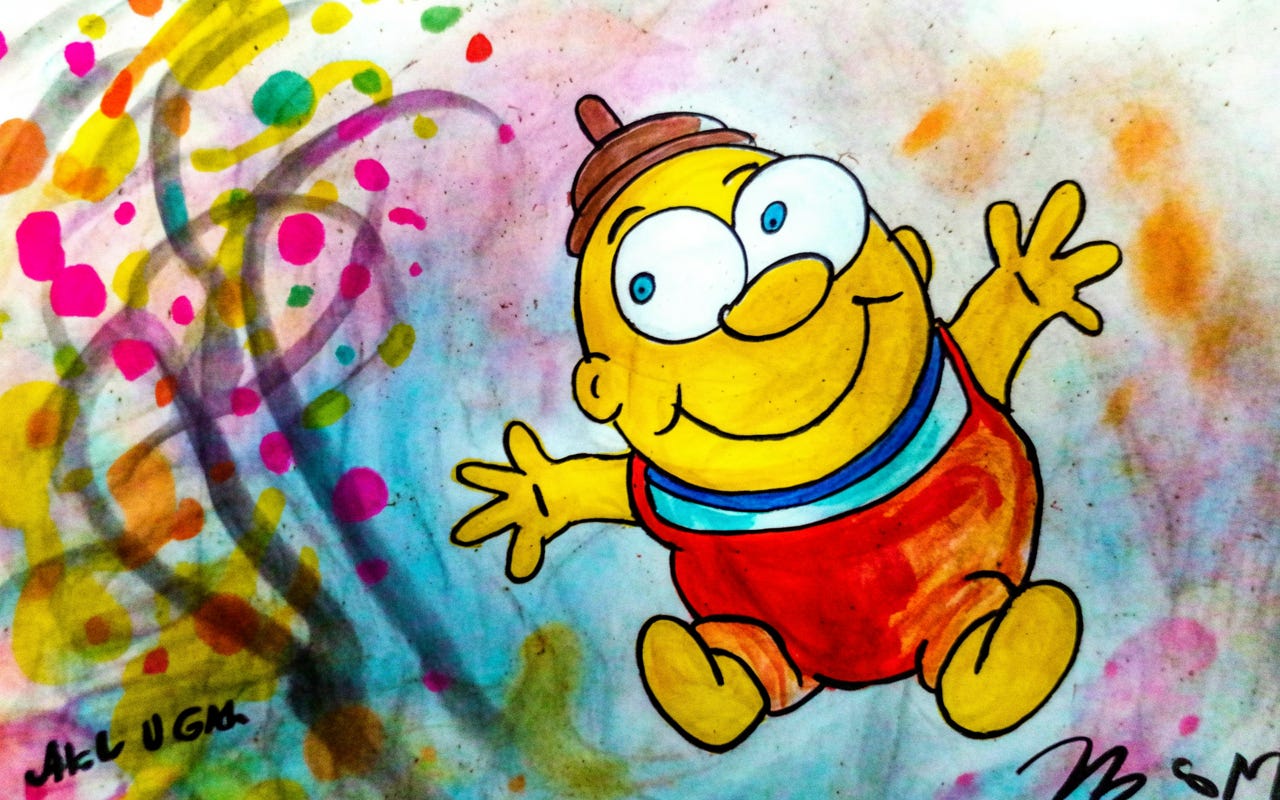
He eats paste. He announces, brightly, that he is “learnding.” Ralph Wiggum, the dim, beaming boy in the back of the classroom on The Simpsons, is the show’s great monument to cheerful incompetence. And yet the engineers who build with artificial intelligence have named one of their most powerful techniques after him. They call it the Ralph Loop. And to understand why, you have to understand a mistake almost everyone makes when they first encounter a smart machine.
Here’s the conventional wisdom. If you have a powerful AI, and you want it to build something complicated, you should manage it. You should break the project into pieces. You should map out which piece depends on which other piece. You should assign tasks to different copies of the AI running at the same time, like a general deploying troops. This feels obviously correct. It’s how we run companies. It’s how we build bridges. More planning, more coordination, more control — better results.
But there is a problem with that theory.
When people actually tried it, it fell apart. Spectacularly. Imagine two AI agents, each assigned to a different part of a project, and both of them realize they need the same shared piece of code to be finished first. So what happens? They both build it. At the same time. In two incompatible ways. And now you have a collision, a traffic accident in slow motion, two workers who have each done the same job and undone each other in the process. The engineers who tried this came away convinced it was hopeless. You simply could not, they concluded, coordinate an army of these things.
What they had built, without realizing it, was the single worst idea in the history of software development. They had reinvented the waterfall.
If you worked in technology in the 1990s, the word makes you shudder. The waterfall was the method where you specified the entire project up front. Every requirement, every dependency, every step, mapped out in advance by people who could not possibly know what they would learn once they actually started building. The documents were so heavy you staggered carrying them into the meeting. It failed, over and over, for a simple reason: you cannot plan your way out of a problem you don’t yet understand. Human beings could never make the waterfall work. So why on earth would a machine?
For a while everyone assumed the AI was the thing falling short — not smart enough, not fast enough, not coordinated enough. But the machine was doing fine. What had failed was the cage we built around it. We had handed our cleverest new tool the dumbest old method, then blamed the tool when it choked.
So what’s the alternative? This is where Ralph comes in.
The Ralph Loop is almost insultingly simple. You don’t plan the order. You don’t draw the dependency map. You give the AI a pile of work and a single instruction: pick the next most important thing and do it. When it finishes, you say it again. Pick the next most important thing. And again. The machine surveys the whole pile fresh each time, figures out on the spot what matters now, does that one thing, forgets everything, and starts over.
The conventional approach treats the AI’s memory and plan as something precious, to be built up carefully and protected. The Ralph Loop throws all of that away on purpose. Every cycle, the machine starts with fresh eyes. It carries no grudge from yesterday about which task was supposed to depend on which. It just looks at the world as it actually is, right now, and asks: what’s the most important thing left to do?
The rigid system, the one that tried to know everything in advance, shattered the instant reality drifted from the plan. The dumb loop, which knew nothing in advance, swallowed every surprise without flinching — because it had never committed to a plan it could be wrong about. The forgetting, the very thing that was supposed to be the loop’s fatal weakness, was precisely what made it unbreakable.
Now, you might object. If this is so simple, why didn’t it work years ago? But the loop wasn’t waiting to be invented. It’s ancient. Isaac Newton found the roots of equations this way, guessing and correcting and guessing again. Engineers in the 1940s built guided missiles on the same principle, feeding the system its own error so it could adjust mid-flight. They called it feedback. The idea that you get to an answer not by computing it once, but by circling it, has been with us for centuries. And notice what feedback has always asked of you: trust reality over the plan. Newton’s next guess answers to his last error, not to a map drawn in advance; the missile steers by the world as it is, not the world it expected to find. That is the loop’s forgetting wearing older clothes, the same refusal to be ruled by a story written before the work began.
But forgetting only explains half of what we saw. It tells you why the loop never shattered the way the rigid plan did. It says nothing about why running it should make the work better. A machine that wipes its memory every cycle could just as easily turn out the same flawed thing forever, fresh eyes and all. So the loop itself was never the missing ingredient. What had been missing all along was the thing you put inside it. For years, telling an AI to “do it again” accomplished nothing because the second attempt came out no better than the first. The machine couldn’t see its own mistakes. Then, around the end of 2025, the models crossed a threshold. They got good enough to look at their own finished work and notice what was wrong with it. And the moment that happened, the oldest trick in mathematics came roaring back to life. Repetition, which had always just been noise, began to compound into improvement.
We spend so much energy trying to be clever in one stroke. Building the perfect plan, the elaborate system, the cathedral of dependencies. And all along, the better idea belonged to the boy eating paste in the back of the classroom. Try the thing. Try it again. Keep trying until the world relents. What looked like foolishness was, all along, the most sophisticated strategy we had. We just needed a partner finally smart enough to make the foolishness pay.