

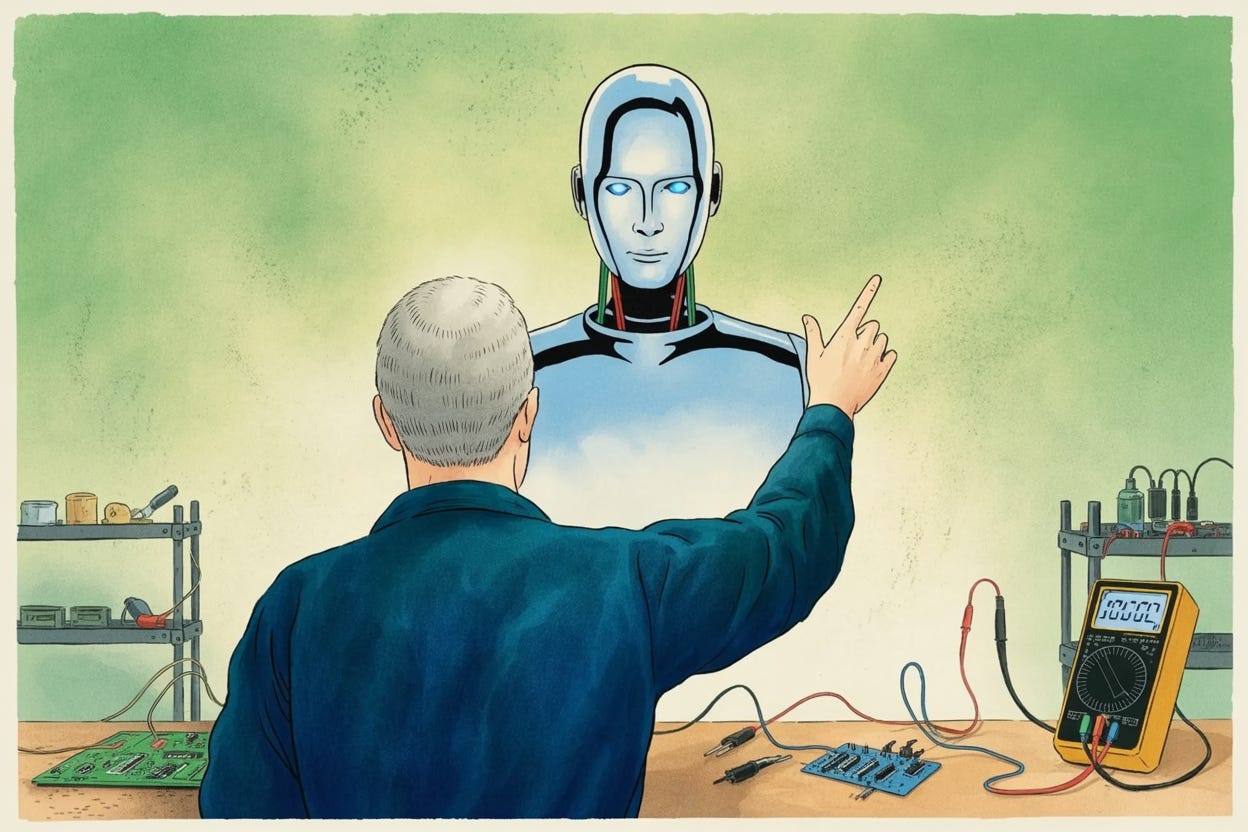
For centuries, the dream of the artificial servant has haunted the human imagination, tracing a jagged line from the clay feet of the Golem to the clockwork automata of the Victorian era, and finally to the silicon-veined constructs of the modern laboratory. We have always sought to breathe life into matter, to organize the chaos of the inanimate into a semblance of agency. Yet, as the gear-work gives way to neural networks and the brass casings morph into soft polymers, a paradox emerges. Designing a robot is not merely a feat of sophisticated mechanics or elegant code; it is an exercise in psychology, a navigation of the turbulent waters where human expectation meets the hard reality of the machine.
Before a single line of logic is executed, before a servo whirs, the human observer has already made a judgment.
When a robot steps into a human-populated environment, it triggers an ancient, almost biological calculus. The interaction is immediate. Before a single line of logic is executed, before a servo whirs, the human observer has already made a judgment. This is the friction of the interface. The study of Human-Robot Interaction (HRI) reveals that the most advanced algorithmic brain will falter if its chassis—its shell, its very presence—clashes with the intuitive physics of human sociality. If the signal is wrong, if the LED blinks with a cold, predatory rhythm, or the movement creates a dissonance in the air, the connection snaps. Trust, that most fragile of currencies, evaporates.
In the geometry of this interaction, scale is the first variable. It is a matter of displacement. Research suggests a rudimentary equation: massive forms cast shadows of intimidation, displacing too much space, suggesting a latent capacity for violence. Conversely, the diminutive invites a peculiar, biological warmth. We are hardwired to protect the small, to find the compact form “cute.” This is the gravitational pull of anthropomorphism—our innate tendency to project a soul onto the soulless, to see a face in the clouds or a personality in a collection of sensors. We judge the machine by the standards of our own biology. A robot that echoes human dimensions bridges the gap; it feels familiar, a known quantity in an unknown equation.
Yet, the mimetic impulse is fraught with peril. Designers tread a fine line between the familiar and the grotesque. The spectrum of morphology is vast. At one end stands the humanoid, a mirror made of metal, possessing a head, limbs, and the suggestion of a face. In arenas like the performing arts or the intimacy of stand-up comedy, this form is a shortcut to understanding; the audience recognizes the silhouette, and the neural pathways for empathy are lit.
These forms bypass the uncanny valley entirely. They do not fail to be human; they succeed at being something else.
But there is power in abstraction. The machine need not lie about what it is. Consider the enduring resonance of the abstract droid (the “R2-D2” archetype) or the tactile novelty of a device wrapped in soft cotton, or an inflatable vest that simulates the pressure of a hug. These forms bypass the uncanny valley entirely. They do not fail to be human; they succeed at being something else. They exploit the noise of novelty to create a new kind of signal, expanding the emotional palette from simple recognition to curiosity and tactile comfort.
The laboratory, however, is a sterile vacuum; the real world is a messy system of variables. The optimal design is never static; it is an emergent property of the user’s needs. Consider the chaotic environment of a pediatric physical therapy session. Here, the rigid humanoid might be an intruder. Instead, designers have found success in repurposing the mundane—a robotic vacuum platform, stripped of its domestic drudgery and outfitted with a carnival of lights, sounds, and a bubble-blowing module. It becomes a distinct entity, a playful provocateur designed to capture the wandering attention of a child. It is a machine dreaming in bubbles, and in doing so, it motivates movement where a sterile clinician might fail.
Shift the scene to the quiet corridors of a skilled-nursing facility, and the variables change again. Here, amidst the fading memories of the elderly, the demand is for the anchor of the familiar. The abstract becomes alienating; the humanoid becomes a comfort. Research indicates a clear preference for robots that convey empathy through recognizable cues—a face that can simulate attention, a posture that suggests listening. But this cannot be engineered from a distance. It requires a descent into the field. Researchers and product leaders must immerse themselves in the daily rhythms of these facilities, observing the subtle interplay of routine and emotion.
This is the long view of the machine age. It is not about the triumph of silicon over flesh, but the slow, iterative negotiation between the two. Whether for academic inquiry or commercial rollout, the success of the robot hinges on a design process that respects the delicate, often irrational nature of human perception. We are shaping the machine, and in the feedback loop of interaction, the machine, inevitably, shapes us. The robot is no longer just a tool; it is a question we ask of ourselves, reflected in glass and steel.