

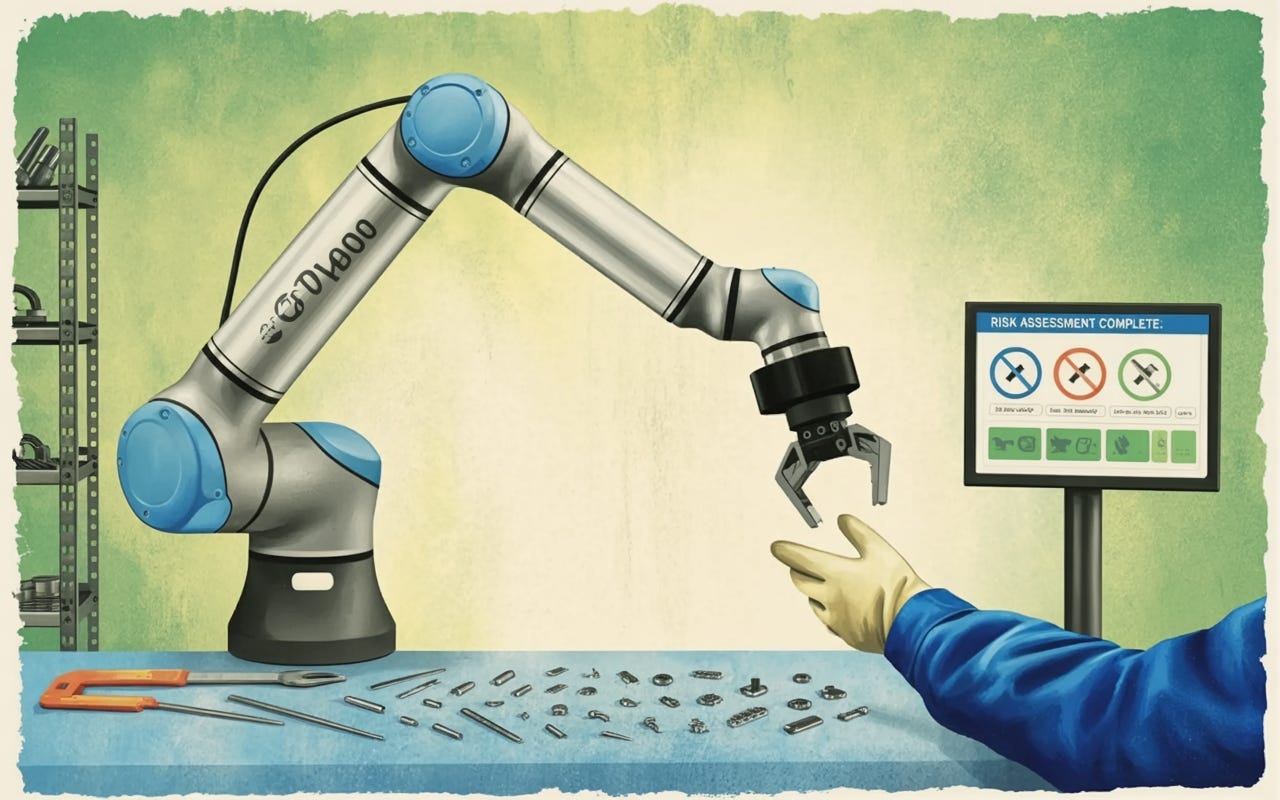
Robots are powerful machines—they move fast, they’re incredibly strong, and they don’t get tired or distracted. In a factory, a robot arm weighing hundreds of pounds can crush a hand in milliseconds. A moment’s inattention from a human worker, or a glitch in the system can mean serious injury or worse. This is why they are almost always locked behind safety cages.
But manufacturing is shifting away from robots operating in isolation to having them work alongside people. International safety standards now define how robots can collaborate safely with humans. When manufacturers follow these guidelines carefully, they can unlock workspaces where people and machines work together productively and safely.
The International Organization for Standardization established ISO 10218 and ISO/TS 15066 to define safe interaction parameters and specify collaborative operating modes. These modes are as follows:
Power and Force Limiting (PFL)
The most common and arguably the most inherently “collaborative” mode is Power and Force Limiting (PFL). In this mode, the physical design and the electronic control systems of the robot are engineered from the ground up to ensure that accidental contact with a human will not cause injury.
PFL relies heavily on extensive biomechanical research that established Pain Onset Levels—the specific thresholds of kinetic energy, force, and pressure the human body can withstand across various anatomical regions before experiencing pain. To stay well below these scientific limits, PFL cobots are typically constructed with rounded geometries, energy-absorbing materials, and highly sensitive force-torque sensors embedded directly into their joints.
If the robot’s sensors detect an abnormal spike in resistance, such as gently bumping into an operator’s arm, it instantly halts or reverses its trajectory. Because the robot itself is intrinsically safe, this mode is ideal for applications requiring continuous, close-proximity interaction. Common use cases include small parts assembly, precise quality inspection, or collaborative packaging, where the robot acts as a direct, physical assistant to the human worker.
Speed and Separation Monitoring (SSM)
When manufacturing processes require higher speeds or heavier payloads than PFL safely allows, Speed and Separation Monitoring (SSM) provides an elegant, dynamic solution. This mode shifts the safety focus from the robot’s physical contact limits to spatial awareness, relying on a sophisticated array of external sensors, such as safety laser scanners, light curtains, or advanced 3D vision systems, to map out safety zones around the robot.
The core of SSM is the continuous calculation of a “minimum protective distance.” This calculation processes real-time variables including the robot’s current speed, its payload inertia, the human operator’s approach speed, and the system’s total braking time. As a human enters the outer warning zone, the robot automatically decelerates. If the human breaches the critical protective separation distance, the robot comes to a complete, safe stop before contact can occur. Once the human leaves the area, the robot autonomously ramps back up to its operational speed. SSM empowers manufacturers to maximize cycle times when workers are absent while ensuring safety when human intervention is necessary.
Safety-Rated Monitored Stop (SRMS)
The Safety-Rated Monitored Stop (SRMS) mode bridges the gap between traditional industrial automation and modern collaborative requirements. In this setup, the robot operates much like a traditional industrial robot, utilizing maximum speeds and heavy payloads, as long as the shared collaborative workspace is empty.
However, when a human operator needs to enter that shared space (for example, to load raw materials, inspect a machined part, or clear a mechanical jam), the robot must come to a complete, verified halt. Unlike a traditional Emergency Stop (E-stop), which cuts drive power to the motors and requires a lengthy manual reboot and homing sequence, SRMS keeps the robot’s drive power engaged. The robot is actively “locked” in its current position by a safety-rated control system. Once the operator finishes their task and safely exits the workspace, the robot instantly resumes its operation from the exact millimeter it paused. This drastically reduces machine downtime while mitigating the risk of collision.
Hand Guiding
Finally, Hand Guiding transforms the robot from an autonomous machine into a highly sophisticated, power-assisted tool. In this operating mode, an operator physically grasps a specialized handle, joystick, or the robot’s end-effector to manually direct the robot arm through its environment.
The robot’s motors read the operator’s applied force and actively assist the movement, effectively negating the weight of the arm and any attached payload. Crucially, the robot only moves when the operator is actively engaging an enabling device (often a three-position “dead man’s switch”); if the operator lets go or squeezes in panic, the robot instantly stops.
This mode is heavily utilized for two purposes. First, as an intelligent lift assist, where the robot helps operators maneuver heavy or unwieldy objects, significantly reducing workplace ergonomic injuries. Second, it is used for “lead-through programming,” where operators teach the robot complex spatial paths, like a painting stroke or a welding trajectory, simply by physically showing it the motion. This democratizes automation, allowing skilled tradespeople to program robots without writing a single line of code.
New Innovations
Recently, a critical technological shift in safety architectures has emerged, with robot makers moving from the passive, force-limiting mechanisms of traditional collaborative arms to active “multimodal fusion” for cobot platforms. By integrating vision systems, tactile sensors, and predictive artificial intelligence, the next generation of robots is beginning to anticipate human movement rather than just reacting to physical contact. This transition is essential for deploying large-scale systems in high-stakes environments like aerospace maintenance and specialized laboratory automation, where traditional fenceless solutions have previously fallen short of rigorous operational requirements.
More Than Safety Checkboxes
Companies are following these safety standards to build robots that adapt to the task and the human rather than forcing humans to adapt to machines. By embracing standardized safety as a foundation rather than a constraint, manufacturers unlock the flexibility to scale agile production, extend the value experienced craftspeople, and attract younger talent to roles that augment rather than isolate them. The factories that thrive in the next decade will be those that view collaborative robotics not as a replacement technology, but an augmentation that preserves human expertise, judgment, and dignity while capturing the precision, speed, and tireless consistency that only machines can deliver.