

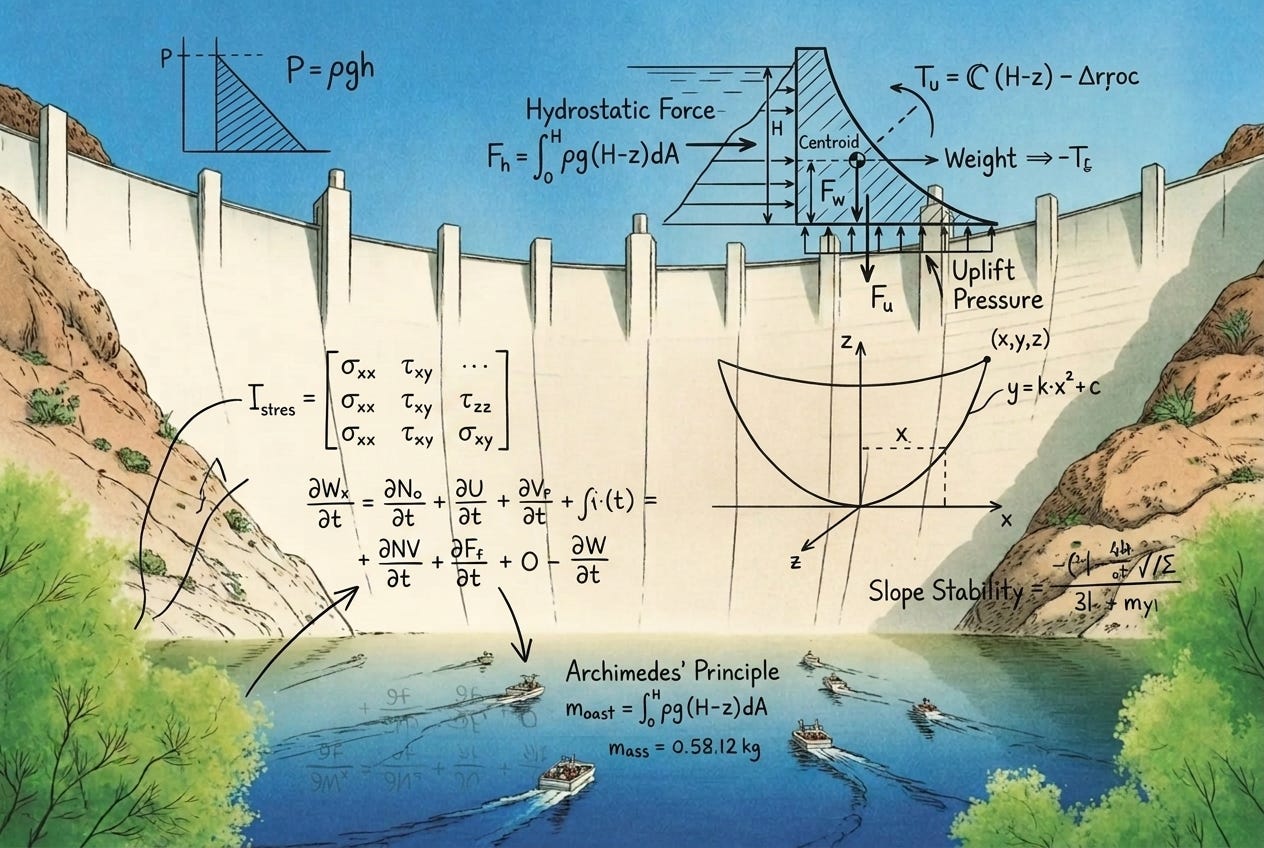
In the early 1930s, as hundreds of laborers gathered in the suffocating heat of Black Canyon on the Colorado River, the engineers building the Hoover Dam faced a terrifying mathematical reality. They were tasked with pouring more concrete than had ever been assembled in human history.
The conventional wisdom of construction at the time was simple. If you want to build a wall, you pour the concrete, you let it dry, and you move on. But the Bureau of Reclamation engineers sat down with their slide rules and realized something horrifying. If they poured the Hoover Dam in a single, massive block, the chemical reactions inside the curing concrete would generate so much trapped heat that the structure would take more than one hundred and twenty years to cool down. Long before that century was up, the dam would expand, crack, and violently fracture into pieces under its own thermal stress.
So, what did they do? They threw out the idea of the single, monumental pour. Instead, they built a complex, interlocking matrix of small, individual concrete columns, weaving hundreds of miles of steel piping through the blocks to constantly run refrigerated water through the structure. They turned a massive, stagnant event into a living, breathing, continuous process of thermal management. They didn’t just build a dam. They engineered a flow.
For the better part of the last century, modern business has ignored this lesson. We have remained obsessed with the giant pour.
The Tyranny of the Event
Walk into the marketing or product department of almost any major corporation and you will find an organization governed by a calendar of discrete events. There is the Winter Product Launch. There is the Q3 Marketing Campaign. There is the Big System Migration.
The conventional wisdom dictates that batching work into massive, episodic releases is the safest way to ensure quality, manage risk, and rally an organization around a unified goal. It feels orderly. It looks clean on a PowerPoint slide. It gives executives a clear milestone to celebrate.
But there is a problem with that theory. It turns out, that isn’t true at all.
In a world defined by hyper-velocity execution, the company that relies on episodic launches is operating at a catastrophic disadvantage. Why? Because a batch is, by definition, a period of waiting. When you batch your work, you are gathering your ideas, your insights, and your code, and you are holding them hostage until a arbitrary calendar date arrives. You are choosing to keep your value stagnant.
And in 2026, stagnation is lethal.
The Frictionless Stream
Consider what happens when the structural barriers to execution drop to zero. In an earlier era of business, batching made sense because the cost of distribution was high. If you were Microsoft in 1995, you had to stamp Windows 95 onto physical compact discs, pack them into cardboard boxes, and ship them on diesel trucks to thousands of retail stores. You couldn’t do that continuously. You had to do it in a massive, expensive batch.
Today, however, we live in an economy of continuous operation. When software testing is autonomous, when infrastructure scales instantly in the cloud, and when AI agents can write and deploy code in seconds, the structural cost of delivering value drops to zero. When that happens, the very concept of the product launch becomes an anachronism.
The most competitive businesses of this new era do not think in terms of versions or editions. They think in terms of streams. They understand that value is not a solid object to be delivered in a box; value is a liquid utility, like electricity or running water. You do not wait for Water Release 2.0 to come out of your kitchen tap. You turn the handle, and it is simply there, adapting instantly to your demand.
The Temporal Advantage
What does this look like in practice? Imagine two competing digital banking platforms in 2026.
The first platform operates with the idea of episodic product releases. They have a brilliant team of data scientists who notice a subtle shift in user behavior. Customers are suddenly anxious about a new micro-inflation trend. The team designs a beautiful, elegant feature to help users hedge against this risk. But because the company releases updates on a quarterly cycle, that feature sits in a queue. It waits for security audits. It waits for the marketing team to prep a press release. It waits for three months.
The second platform operates continuously. They don’t have a launch calendar. Instead, they utilize an evaluation-driven, continuous delivery loop. Their system detects the same customer anxiety on a Tuesday morning. By Tuesday afternoon, an AI agent has generated the feature, run it through thousands of automated security simulations, and streamed it directly to the users who need it most.
The second company didn’t just beat the first company to market. They inhabited an entirely different temporal reality. By the time the first company launches their feature in Q3, the second company has iterated on their feature ninety times based on real-world feedback. They have absorbed three months of customer data, intimacy, and loyalty that their competitor can never claw back.
Continuousness changes the fundamental relationship between a company and the market. It turns the market from a judge into a collaborator.
The Shift to Living Systems
This is the hidden psychological mechanism of the modern economy. We used to believe that competitiveness was a function of scale, or capital, or the sheer brilliance of a company’s initial strategy.
But it isn’t. Competitiveness is a function of velocity and feedback.
When you move to a model of continuous value delivery, you stop trying to predict the future. Predictability is an obsession of the defensive mind. Instead, you build an organization that is intensely, radically present. You stop building static monuments and start managing living systems.
The engineers at the Hoover Dam realized that the only way to survive the crushing pressure of their own creation was to keep the water flowing through the concrete, cooling the system in real time, hour by hour, block by block. They didn’t wait for the heat to destroy them. They designed a mechanism to carry it away continuously.
The lesson for the modern enterprise is identical. The businesses that will dominate the landscape of 2026 and beyond are not those with the biggest launches, the loudest announcements, or the most disruptive events. The future belongs to the quiet operators who understand that the ultimate competitive advantage is a stream of value that never stops moving.