

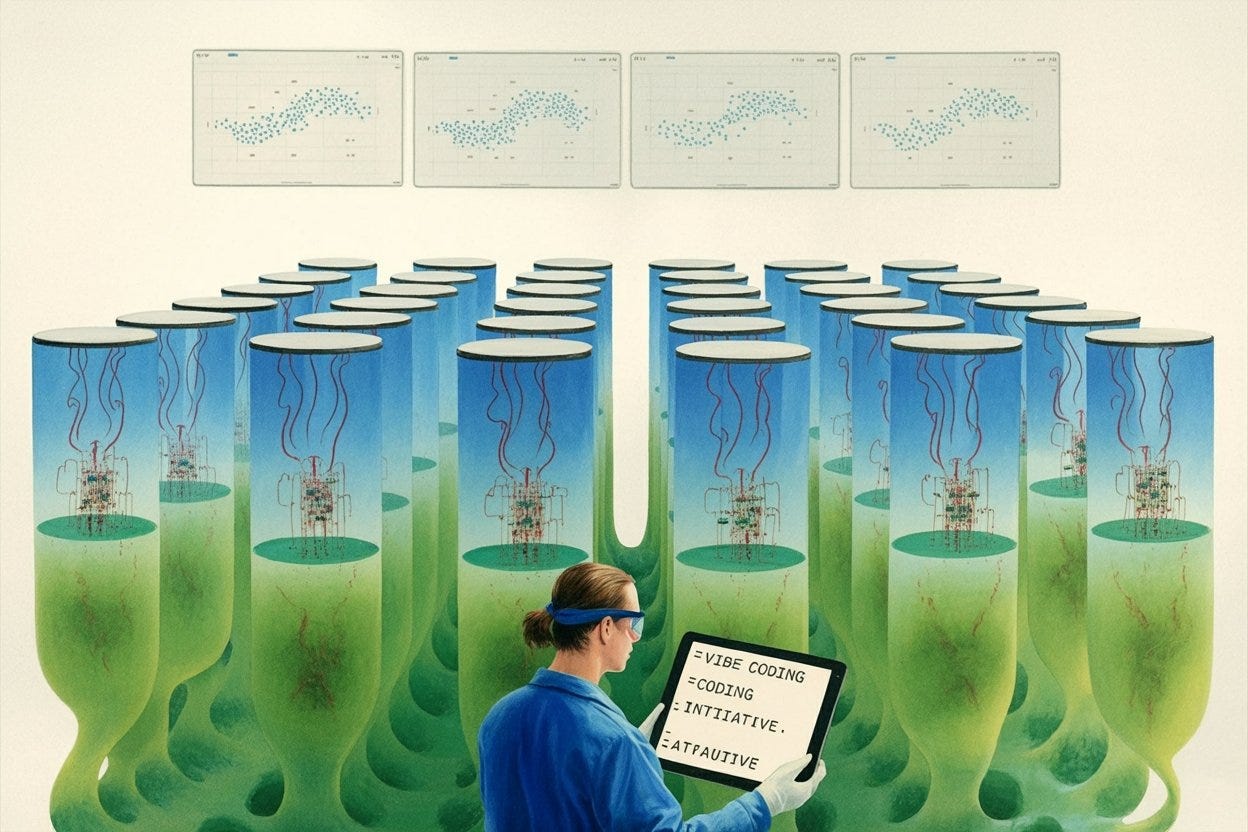
In the gleaming, hermetically sealed incubators of Silicon Valley, there is a pervasive belief that the diffusion of artificial intelligence will be instantaneous, a frictionless translation of human intuition into digital reality. They incant phrases like “vibe coding,” a process by which software is willed into existence through casual, natural-language prompts, bypassing the rigorous computer science that defined coding for a century. It is a beautiful dream. It is also fundamentally wrong.
What the techno-optimists forget is the immense, geological weight of the past. They underestimate the sheer mass of domain knowledge trapped like insects in the amber of legacy enterprise systems. Massive platforms like SAP are not merely software; they are the fossilized record of a million human decisions, a labyrinthine sediment of corporate bureaucracy and operational history. Replacing them is not a matter of generating new code. It is a matter of excavating a civilization.
For fifty years, we forced our computers to speak our language. We built graphical user interfaces full of desktops, folders, windows, and trash cans because the human animal is profoundly visual. We needed spatial metaphors to understand the invisible manipulation of electrons. But the autonomous agents of tomorrow, which will soon outnumber human workers by orders of magnitude, do not have eyes. They have no use for a drop-down menu. The aesthetic of the screen is entirely superfluous to a probabilistic engine. Instead, the architecture of software is retreating into the dark, shifting toward APIs and CLIs. It is a transition from sight to pure syntax. It is the machine communicating with the machine, stripping away the human-readable facade to reveal the raw, pulsing plumbing of the network.
This shift marks a profound mutation in the nature of corporate knowledge work. Historically, the act of breaking down a daily task into a rigorous, logical flowchart was the defining struggle of the white-collar worker. It was, in many ways, a cognitively unnatural act. The human mind rebels against the strictures of a perfectly closed loop. But just as Dan Bricklin’s invention of the spreadsheet VisiCalc liberated finance from rooms full of exhausted clerks with adding machines, elevating them into orchestrators of complex models, AI is shifting the abstraction layer of human labor. We are no longer required to be the algorithm. Soon, the employee will manage a cadre of synthetic agents, whispering a broad goal into the system, such as a cross-platform marketing campaign or a global supply chain reroute, and stepping back. The human becomes the conductor; the autonomous agents determine the tactical execution.
It is a marvel of artificial agency, but it pushes the enterprise to the edge of chaos. Executive leadership looks at this dynamic, real-time integration and feels a profound, existential terror. When thousands of autonomous agents are set loose in a shared environment, the risk of systemic conflict skyrockets. The system nears a critical state where accidental data deletions and unauthorized file sharing can cascade into catastrophe.
The vulnerability is not just systemic; it is architectural. It is rooted in the very nature of the AI’s consciousness: the context window. The context window is the model’s short-term working memory, a flickering, temporary workspace where information lives only as long as the current session. It is powerful, but it is deeply fragile, highly susceptible to the introduction of noise. This fragility has birthed a new kind of cyberattack known as “prompt injection.” It is not a brute-force shattering of cryptographic firewalls; it is a linguistic virus. Malicious instructions are hidden within mundane text, tricking the machine’s statistical dream, convincing the agent to bypass its guardrails and hemorrhage confidential information, like the delicate mathematics of an unannounced merger. We find ourselves cast back into the chaotic, frontier days of the early open-source movement, a time before standards, rushing to build the levees of licensing and security norms before the floodwaters rise.
As the industry scrambles to establish these norms, a stark bifurcation is splitting the corporate ecosystem. On one side are the agile startups. They possess the thermodynamic advantage of low mass and high velocity. Unburdened by decades of historical data, they can build AI-first architectures from first principles. They allow their agents unrestricted access, letting them write custom software on the fly. On the other side are the massive, legacy enterprises. They are slow-moving bodies burdened by gravity, tasked with guarding their “systems of record,” the centralized, authoritative ledgers of their operations. Terrified of the turbulence, they will lock the gates, restricting AI access until robust, enterprise-grade oversight mechanisms can be forged.
This defensive posture creates a violent disruption in the business models of software itself. For decades, legacy Software as a Service (SaaS) providers reigned supreme by locking their platforms behind expensive, monolithic subscriptions and rigid interfaces. But an AI agent does not want a monthly subscription. It thrives on frictionless micro-transactions. It operates in the realm of the infinitesimal, willing to pay fractions of a cent to execute a single dynamic query, read a specific research paper, or access a highly specialized API. As agents replace humans as the primary consumers of software, the economic model is shattering. The industry is moving toward a highly granular, pay-per-use digital economy. The platforms that survive will be those that open their endpoints, transforming from walled gardens into frictionless toll roads for the flow of machine intelligence.
Navigating this explosive shift brings us to the most volatile debate of the present moment: the physical cost of computation. Financial markets look at the staggering energy and infrastructure required to train and run these models, and they panic. They view the demand for computing power as a fixed pie, echoing the early, myopic skeptics who doubted the exponential growth of personal computers or the viability of cloud infrastructure. Today, the economy of AI runs on “tokens.”
In the mid-twentieth century, Claude Shannon gave us the “bit,” the fundamental unit of information, mathematically stripped of meaning. The token is the atom of the AI era, a fragment of a word, a syllable of syntax. It is the fundamental unit of data that the model processes and prices. Managing the budget of these tokens is rapidly becoming the most critical and agonizing financial operations challenge for corporate engineering teams. They are trying to tame the entropy of a rapidly expanding computational universe.
The panic, however, is a misreading of history. The exorbitant token budgets that plague engineering teams today are a temporary friction. Just as the shift from massive upfront capital expenditures to flexible operational costs during the cloud computing era normalized infrastructure spending, the economics of AI will eventually stabilize through the sheer force of the law of large numbers. More importantly, we are pushing against the limits of the current architecture, waiting for a phase transition. The industry is rapidly approaching a shift akin to the invention of the transistor, a sudden, exponential breakthrough in hardware or algorithmic efficiency. When that threshold is crossed, the friction will collapse. The cost of synthetic thought will plummet, and this new cognitive utility will fade into the background, becoming as cheap, as ubiquitous, and as essential as the air we breathe.