

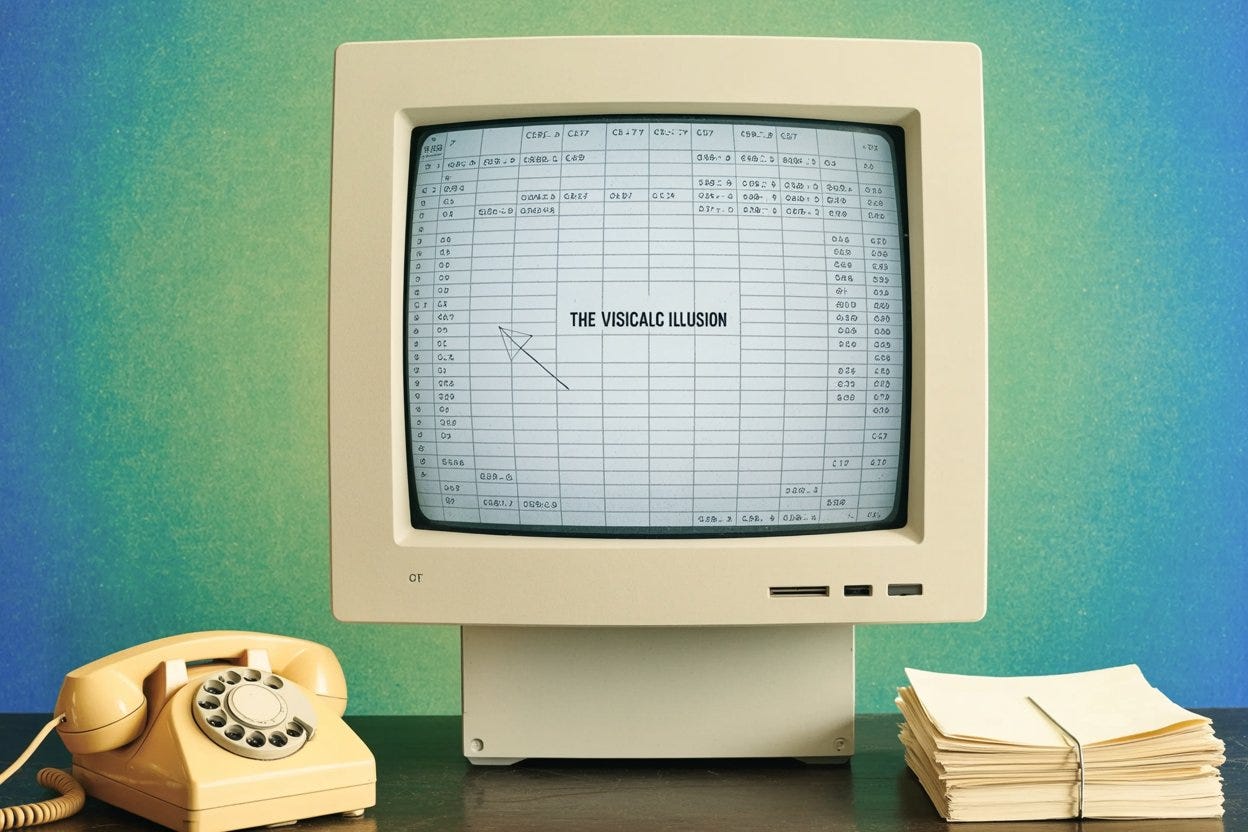
In the late autumn of 1979, a business student named Dan Bricklin watched his accounting professor erase a single number on a blackboard. The professor then had to recalculate every other number in the row by hand. It was tedious. It was frustrating. And it gave Bricklin an idea. He went home and wrote the code for VisiCalc, the world’s first electronic spreadsheet.
Imagine being an accountant in 1978. Your desk is covered in pale green ledger paper. Your right hand is permanently stained with graphite. To calculate a five-year financial forecast takes a week of mind-numbing arithmetic. Then VisiCalc arrives. Suddenly, that grueling week of work takes ten seconds.
Conventional wisdom tells us what should happen next. The accountant finishes his work by Tuesday morning. He packs up his briefcase. He goes golfing for the rest of the week. The machine has taken the burden, so the human gets to rest.
But there is a problem with that theory. It turns out, that isn’t true at all.
The Ideation Bottleneck
Accountants did not work less after 1979. They worked significantly more. Because once calculation became cheap and fast, clients stopped asking for one financial forecast. They asked for ten. They wanted best-case scenarios, worst-case scenarios, and everything in between. The bottleneck shifted. It was no longer about doing the math. It was about deciding which math to do.
Today, we are living through the exact same phenomenon, only on a much grander scale. We are in the era of generative artificial intelligence. The ability to generate functional code is now practically free. It is instantaneous. And just like the accountant in 1979, the modern software developer is facing a profound shift in expectations.
Verifying the safety of the end product and deciding what to build in the first place are now the primary domains where human cognition remains indispensable. Because generating code is incredibly cheap and fast, the bottleneck in product development has moved away from engineering. It has landed squarely on ideation and strategy.
The Paradox of Agentic Overload
A professional can now freely prototype three or four different versions of a feature in a single afternoon. They use AI as a high-speed brainstorming partner to clear out obvious ideas. They reach innovative conclusions faster than ever before.
Navigating this accelerated ideation and testing process requires an intense level of cognitive effort. The modern technological workplace paradox is that rather than working less, professionals actively utilizing AI are working harder. They are facing unprecedented mental exhaustion. The cognitive load of managing multiple autonomous agents running in parallel pushes human working memory to its absolute limits. Industry-wide burnout is no longer just a risk. It is a mathematical certainty if we do not change our approach.
The Conductor and the Orchestra
Yet, this era also heavily rewards extreme ambition. Consider the seasoned worker, the veteran often referred to as the “10x engineer.” For these individuals, agentic overload is completely flipped on its head. Their decades of architectural knowledge are massively amplified. They are suddenly tackling sprawling, complex projects they previously would have avoided. The AI does the heavy lifting. The engineer acts as the conductor of a very fast, very capable orchestra.
But how do we harness this newfound ambition without burning out?
The answer lies in adopting specific new workflows. Industry insiders call these Agentic Engineering Patterns. These patterns maintain order and quality amidst rapid development. They are the necessary guardrails for our working memory.
Think back to the accountant staring at a spreadsheet for the first time. The tool did not give him less work. It gave him more important work. The same is true for us today. The machine can write the code. The machine can test the feature. But only we can decide what is worth building in the first place. And if we can master these new patterns without letting the technology master us, the world we build will not just be faster. It will be fundamentally better.