

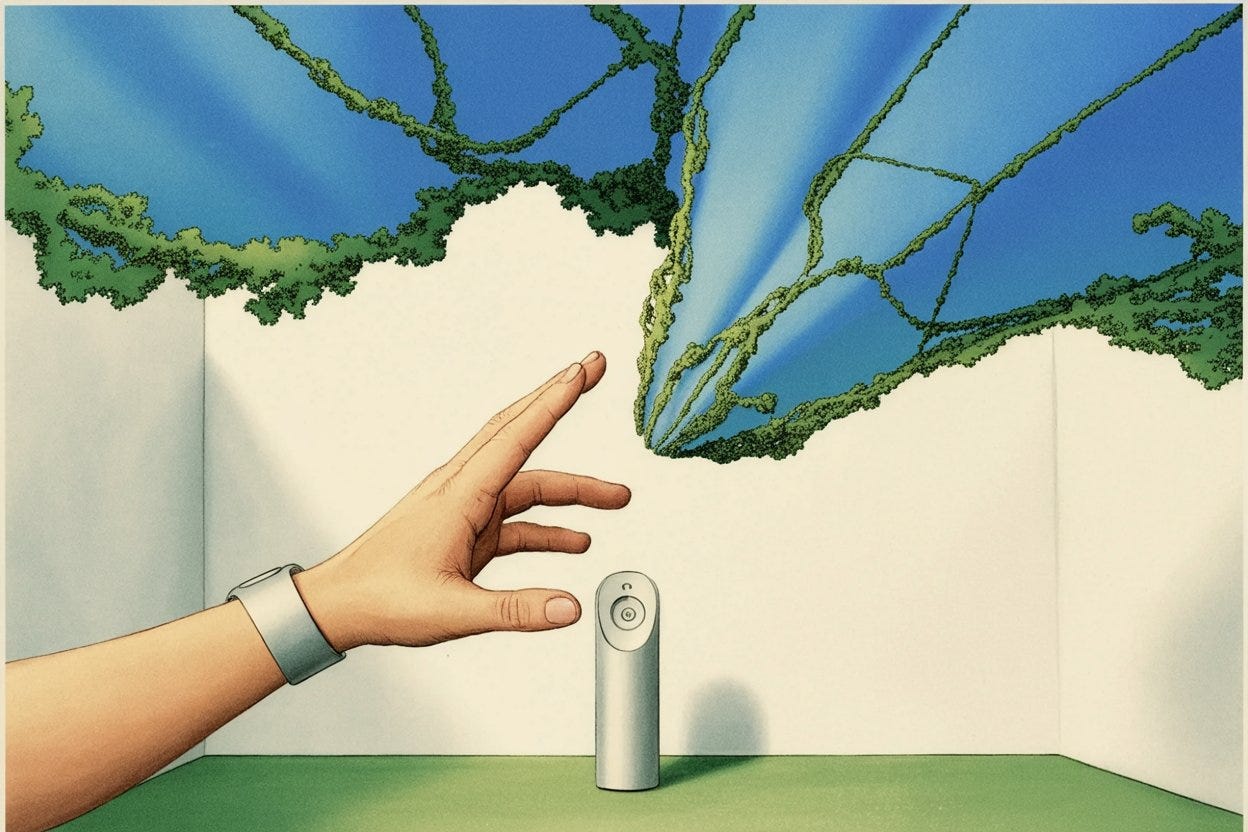
The Man With the Lever
It is 1945 in New York City. Imagine a man standing in the center of a crowded, mahogany-paneled elevator car. He wears a crisp uniform with polished brass buttons. His right hand rests on a heavy steel lever. This is the elevator operator. And he is constantly, obsessively looking. He watches the floors whiz by. As the car approaches the tenth floor, he pulls the lever back. He slows the descent. He peers through the grated door, carefully inching the car up and down until it aligns perfectly with the floor outside.
It requires intense visual focus. It requires skill. The passengers stand behind him, watching his every move, feeling safe because they can see a human actively controlling the machine.
For decades, the elevator industry believed that the key to a better elevator was a better operator. They designed clearer windows. They built more precise levers. They added more complex dials to the cabin.
But then, the engineers realized something profound. The solution to the elevator problem was not a better visual interface. The solution was removing the visual interface entirely. The solution was the automated push-button.
For the past twenty-five years, the entire enterprise software industry has operated exactly like a 1940s elevator company.
We Mistook the Dashboard for the Engine
Think about how we interact with Software as a Service today. We operate under a very specific, very logical assumption. We believe that to manage complex data, a human must act as the operator. We log in. We click. We scroll. We navigate sprawling dashboards filled with charts, graphs, and drop-down menus. We believe that visual navigation is the only way to achieve operational control. We think the software is the screen.
But there is a problem with that theory. It turns out that isn’t true at all.
For decades, we mistook the dashboard for the engine. We believed that the glowing glass on our desks was the software itself. We had built a vast, planetary nervous system of commerce and logic, but we insisted on interacting with it at the speed of human fingers moving across plastic keys. We demanded that the machine paint a picture for us before we would allow it to do its work.
The Tyranny of the Screen
In the parlance of systems architecture, the removal of this graphical bottleneck is called going “headless.” It sounds violent, a sudden decapitation of the digital body. In truth, it is a liberation of information from the tyranny of the screen. A headless architecture severs the presentation layer (the “head” that the human looks at) from the back-end logic, the churning, mathematical brain where the actual state of the universe is calculated and stored. It is a return to a more elemental form of computing. Long before we had browsers, Babbage’s analytical engines possessed no face, only the relentless grinding of gears; the ENIAC communicated through the brutal poetry of punch cards. The screen was always a concession to human frailty, a translation layer for a species that cannot read voltage.
The concept of headless software began as a pragmatic mutation in e-commerce, a trick to sell a product on a smartwatch, a mobile phone, or a refrigerator without having to rebuild the entire database. But ideas, once introduced into an ecosystem, tend to seek their maximum logical expansion. Headless architecture wanted to consume everything.
The Monolith Performs Its Own Demolition
In the spring of 2026, the quiet theoretical shift became a seismic physical reality. Salesforce, the colossal cathedral of the cloud era, the company that had spent twenty-five years teaching the corporate world to log into a browser, told the world to stop logging in. With their Headless 360 announcement, the monolith performed a public, architectural auto-da-fé. They stripped away the user interface to expose the raw, vibrating nervous system of their platform. Everything—every customer record, every workflow, every piece of business logic—was suddenly reduced to an API, a Model Context Protocol tool, a command-line pulse.
To understand this pivot is to understand the changing nature of the user. The architects in San Francisco did not dismantle their monolithic temple for our benefit. They did it because the primary consumer of software is no longer human.
The New User Does Not Click
The new users are probabilistic engines. They are AI agents, silicon minds like Claude and Codex operating entirely within the dark currents of the data stream. An AI agent does not need a beautifully rendered webpage. It does not click. It breathes raw telemetry.
When a human searches for a record, the process is agonizingly slow: a query is typed, the server fetches the data, the browser renders the CSS, the human reads, interprets, and finally acts. It is an ocean of friction. When an agentic system accesses the same data through a headless API, the transfer is nearly instantaneous in a frictionless exchange of pure state.
Salesforce recognized the inevitable slide of digital thermodynamics. When human bandwidth limits the transfer rate of an interconnected system, the system will eventually route around the human. By turning their entire platform into pure infrastructure, they acknowledged that the future of software is not a place you visit. It is an invisible utility, a subterranean river of logic tapped by synthetic agents working a hundred times faster than flesh and bone.
We are witnessing the ghost leaving the machine’s shell. The architecture of the future has no face, no buttons, and no glass. It is just the logic, spinning in the dark, speaking in a language only the machines can truly comprehend.
"We are witnessing the ghost leaving the machine’s shell. The architecture of the future has no face, no buttons, and no glass. It is just the logic, spinning in the dark, speaking in a language only the machines can truly comprehend." - that is some beautiful prose, Matt.